How to Stack Peltier Units for Optimal Cooling
TL;DR
To stack Peltier units effectively for optimal cooling, apply thermal grease between the units, ensure proper insulation, and manage the hot side's temperature efficiently. The setup's effectiveness relies on real-time adjustments and monitoring of power supplies, ambient conditions, and water temperatures to achieve desired low temperatures.
Transcript
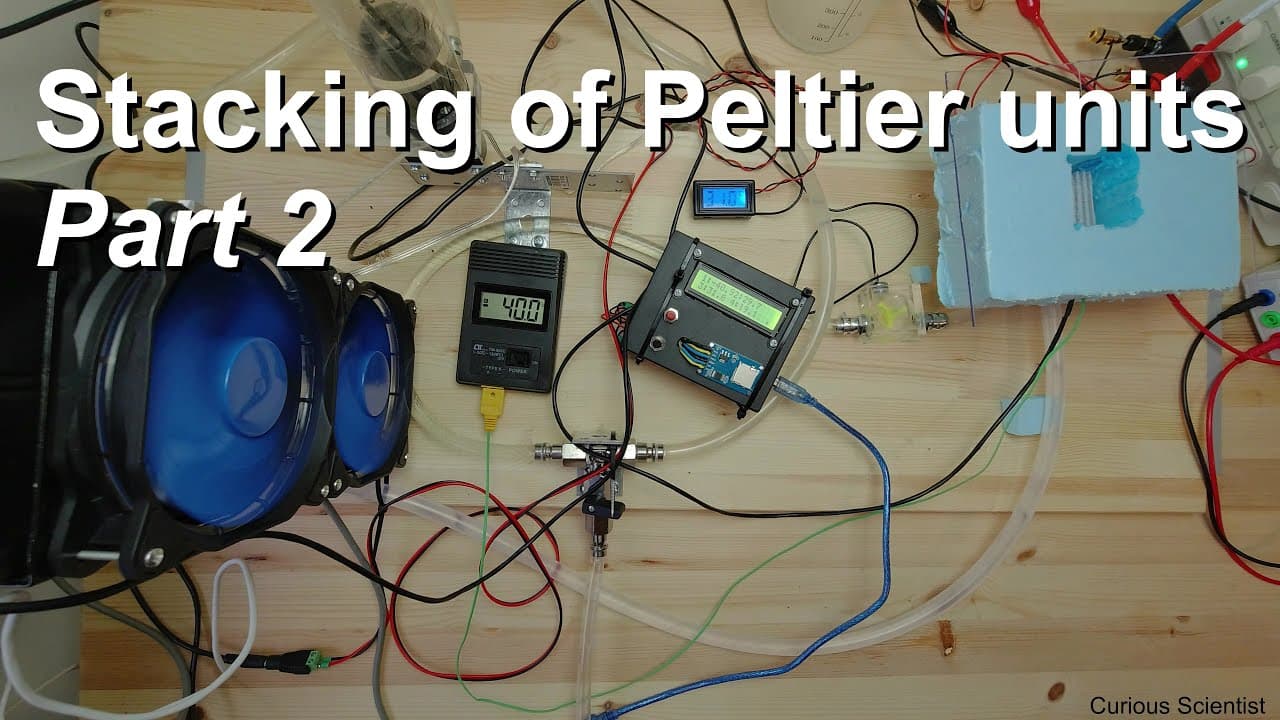
welcome everyone so this is the experimental part of the previous videos calculations where I showed you how to get to the best possible solution for stacking pathway units and in this part of the video I will do the experimental part so as you can see I have my let's call it test bench so hopefully you can see here is the water cooling radiator wi... Read More
Key Insights
- 🇦🇪 Stacking methods significantly impact the performance of Peltier units, necessitating a balance between unit size and heat distribution.
- 🥵 Efficient heat dissipation on the hot side is equally vital to achieving desired low-temperature outcomes in thermoelectric experiments.
- 😎 Utilizing proper insulative materials and techniques can greatly enhance the overall efficiency of cooling systems.
- 😎 Ambient conditions and water temperatures are critical variables that must be carefully managed to optimize cooling experiments.
- 🥵 Applying thermal grease effectively creates a better thermal interface and ensures efficient heat transfer between units.
- ⌛ Real-time observations and adjustments during experiments are essential for identifying and overcoming operational challenges.
- 😎 The type of power supply used can influence the voltage and current, directly affecting the performance of the cooling system.
Install to Summarize YouTube Videos and Get Transcripts
Explore YouTube Video Summarizer or Get YouTube Transcript Extractor
Questions & Answers
Q: What is the purpose of using Peltier units in this setup?
Peltier units, also known as thermoelectric coolers, are used in this setup to create a temperature difference for cooling applications. By utilizing the Seebeck effect, these units can effectively transfer heat from one side to another, allowing for controlled cooling and enabling experiments to achieve low temperatures.
Q: Why is thermal grease necessary in the stacking process?
Thermal grease serves as a crucial medium for enhancing thermal conductivity between the stacked Peltier units and heat sinks. It fills microscopic gaps at the interfaces, ensuring efficient heat transfer. Applying it evenly allows for better adhesion and reduces the chances of air pockets, thereby optimizing cooling performance.
Q: How does ambient temperature affect the experimental results?
Ambient temperature significantly impacts the performance of the cooling system. Increased ambient temperatures can limit the effectiveness of the cooling generated by the Peltier units, as the heat dissipation into the environment becomes less efficient, potentially leading to higher operating temperatures and reduced cooling capacity.
Q: What challenges did the experiment face regarding temperature control?
The experiment encountered challenges in maintaining low temperatures due to high ambient heat on the hot sides of the Peltier units. The inability to effectively cool these units resulted in a suboptimal temperature difference, leading to limited cooling capabilities and raising concerns about the potential for overheating or damage to the units.
Q: What role did the cooling water temperature play in the experiment?
The temperature of the cooling water was crucial as it directly influenced the cooling potential of the system. Lower cooling water temperatures improved the overall efficiency of the Peltier units, facilitating better heat exchange and allowing the system to achieve lower temperatures, ultimately enhancing cooling performance.
Q: What was concluded about the effectiveness of stacking Peltier units?
The experiment concluded that stacking Peltier units can be ineffective without proper heat management. Efficient cooling on the hot side is crucial for maximizing the cooling potential of the stacked units. Careful consideration of sizes and surface areas could improve performance by minimizing the heat load on the bottom units.
Summary & Key Takeaways
-
The video outlines a detailed experimental setup using Peltier units, water cooling radiators, and thermal grease to optimize cooling efficiency.
-
Key steps include stacking selected units, applying thermal grease, and ensuring proper insulation to maintain low temperatures during operations.
-
Through real-time measurements, the video highlights the challenges encountered in achieving desired temperature levels, emphasizing the importance of efficient heat transfer and insulation.
Read in Other Languages (beta)
Share This Summary 📚
Summarize YouTube Videos and Get Video Transcripts with 1-Click
Try YouTube Summary with ChatGPT & Claude or YouTube Transcript Generator
Explore More Summaries from Curious Scientist 📚




Summarize YouTube Videos and Get Video Transcripts with 1-Click
Try YouTube Summary with ChatGPT & Claude or YouTube Transcript Generator