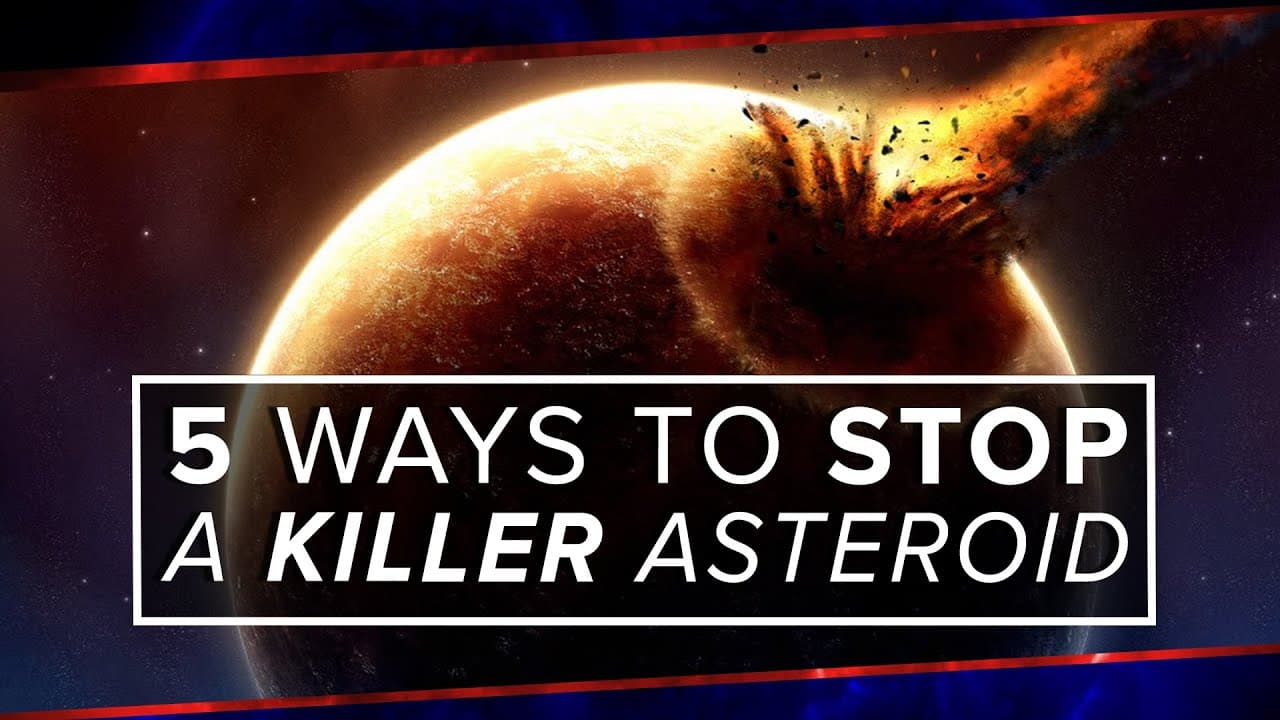
5 Ways to Stop a Killer Asteroid
TL;DR
Earth faces asteroid threats, but we have potential defensive options.
Transcript
It's a scientific fact that the planet Earth will be hit by cataclysmic asteroids in the future. Assuming we can see them coming, what can we do to stop them? [MUSIC PLAYING] Space is swarming with lots of really fast moving rocks, like the planet Earth, but also like that 19-meter-wide wide chunk, that blazed across the sky above the Russian town ... Read More
Key Insights
- Asteroids pose a significant threat to Earth, with potential impacts ranging from city-level to planet-wide devastation. The frequency and severity depend on the size of the asteroid.
- Smaller asteroids, less than 10 meters, typically vaporize in the atmosphere harmlessly. Larger ones, however, can cause significant damage, with city-killer asteroids expected every century.
- The Spaceguard Program has been successful in tracking large Near Earth Objects (NEOs), ensuring no immediate threat from them for centuries, but smaller, potentially dangerous asteroids remain mostly undetected.
- Several methods are proposed to deflect asteroids, including kinetic impactors, nuclear explosions near the surface, and even altering the asteroid's surface properties to change its trajectory.
- The gravitational tractor method involves using a spacecraft's gravity to slowly alter an asteroid's path over time, provided it is detected early enough.
- In urgent scenarios where deflection isn't possible, breaking up the asteroid with a nuclear device may be necessary to minimize impact damage.
- Funding and international cooperation are crucial for developing and implementing asteroid detection and deflection technologies effectively.
- Public engagement and awareness can drive political and financial support for asteroid defense initiatives, ensuring Earth is prepared for future threats.
Install to Summarize YouTube Videos and Get Transcripts
Explore YouTube Video Summarizer or Get YouTube Transcript Extractor
Questions & Answers
Q: What are the potential effects of an asteroid impact on Earth?
Asteroid impacts can range from harmless vaporization in the atmosphere to catastrophic damage. Smaller asteroids may cause city-level destruction, while larger ones can have global consequences, such as nuclear winter effects, ocean acidification, and mass extinction events, similar to the one that likely killed the dinosaurs.
Q: How effective are current asteroid tracking systems?
Current tracking systems, such as the Spaceguard Program, have successfully identified most large Near Earth Objects, ensuring no immediate threats for centuries. However, smaller asteroids, which can still cause significant damage, remain largely undetected due to their faintness and the limitations of current monitoring technologies.
Q: What are some proposed methods to deflect asteroids?
Proposed methods to deflect asteroids include kinetic impactors, which involve slamming a spacecraft into the asteroid to alter its course, and nuclear explosions near the surface to create pressure and change its trajectory. Other methods include altering the asteroid's surface reflectivity or using a gravitational tractor to gradually pull it off course.
Q: Why is early detection crucial for asteroid deflection?
Early detection is crucial because it allows more time to implement deflection strategies effectively. The further out an asteroid is detected, the smaller the required change in its trajectory to avoid impact. Early detection increases the chances of success and provides more options for intervention.
Q: What challenges exist in funding asteroid defense initiatives?
Funding asteroid defense initiatives faces challenges such as political hesitation due to scientific uncertainty and the long-term nature of the threat. Securing financial support requires public awareness and advocacy to prioritize these initiatives, as well as international collaboration to share resources and expertise.
Q: How can public engagement aid in asteroid defense efforts?
Public engagement can drive political and financial support for asteroid defense by raising awareness of the threat and the importance of preparedness. Educating the public about potential risks and the science behind defense strategies can lead to increased advocacy and funding for research and implementation.
Q: What role does international cooperation play in asteroid defense?
International cooperation is vital for pooling resources, expertise, and data to enhance asteroid detection and deflection capabilities. Collaborative efforts can lead to the development of more effective technologies and ensure global preparedness, as asteroid impacts are a threat to all nations, regardless of borders.
Q: What is the significance of the B612 Sentinel mission?
The B612 Sentinel mission aims to launch an infrared telescope to orbit the sun, improving the detection of smaller asteroids that pose a threat to Earth. By tracking hundreds of thousands of Near Earth Objects, the mission seeks to fill gaps in current monitoring systems and enhance global preparedness for potential asteroid impacts.
Summary & Key Takeaways
-
Asteroids pose a significant threat to Earth, with varying levels of potential damage depending on their size. While large asteroids have been tracked, smaller ones remain undetected, posing a risk to urban areas.
-
Various methods to deflect or destroy incoming asteroids have been proposed, including kinetic impactors, nuclear explosions, and gravitational tractors. Each method's effectiveness depends on the time available before impact.
-
International cooperation and funding are essential for developing asteroid defense systems. Public awareness and support can help drive political action to ensure Earth is prepared for potential asteroid impacts.
Read in Other Languages (beta)
Share This Summary 📚
Summarize YouTube Videos and Get Video Transcripts with 1-Click
Try YouTube Summary with ChatGPT & Claude or YouTube Transcript Generator
Explore More Summaries from PBS Space Time 📚



Summarize YouTube Videos and Get Video Transcripts with 1-Click
Try YouTube Summary with ChatGPT & Claude or YouTube Transcript Generator