How Did Capitalism Transform Modern Warfare?
TL;DR
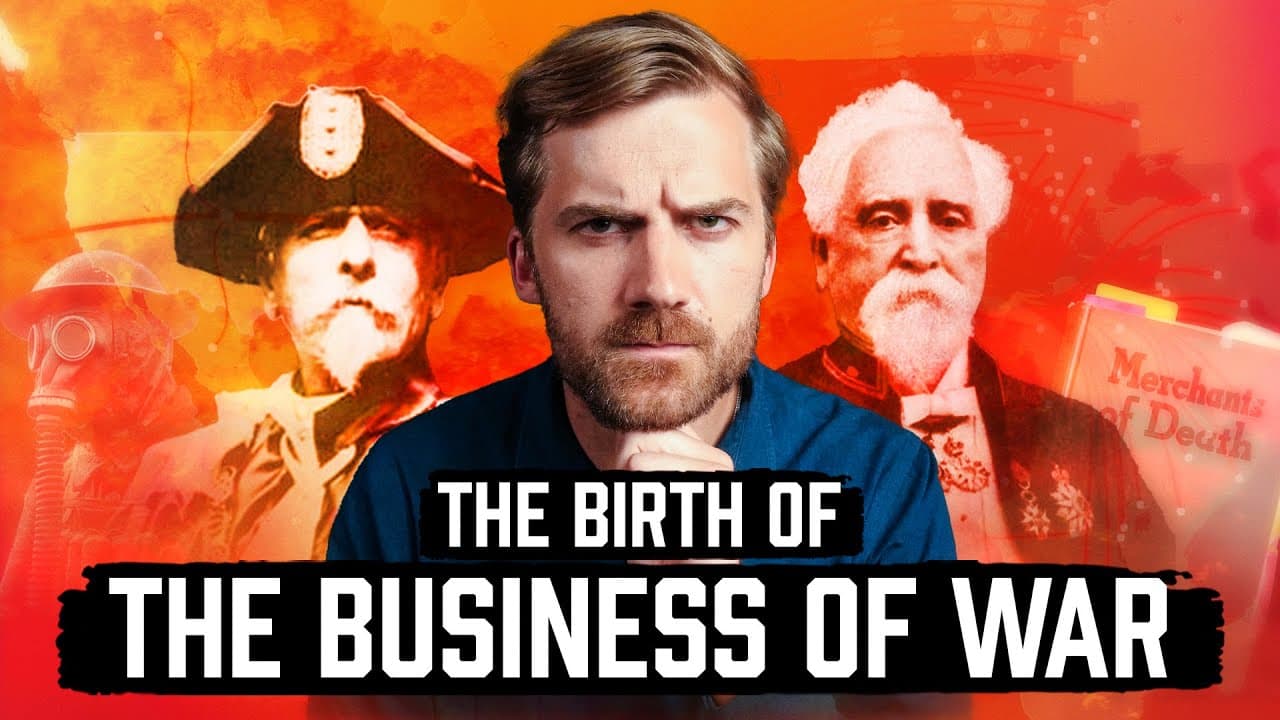
Industrialization transformed warfare by combining coal, oil, mass production, and private enterprise to create increasingly powerful weapons that corporations sold internationally. Manufacturers such as Hiram Maxim and salesmen such as Basil Zaharoff profited from global demand, while competitive purchasing helped expand arsenals and military budgets before World War I demonstrated the devastating consequences.
Transcript
(slow, calm music) - War used to be simpler, violent, yes, always violent, but more straightforward. It used to be about large groups of men fighting with their muscles, their spears, and eventually their swords and their crossbows, and then their guns and their cannons. (cannon fires) But then we hit a point where it just started to change so quic... Read More
Key Insights
- Industrialization changed warfare by replacing many human and animal-powered systems with machines fueled by coal and oil. Steam moved warships, iron replaced wooden protection, trains transported armies and supplies, and trucks began replacing horses as industrial production delivered increasingly sophisticated weapons in abundance.
- Private corporations controlled much of the international weapons market in the late 1800s and early 1900s. The Prince of Wales told the Shah of Persia that he could not give him Maxim guns because those weapons belonged to Hiram Maxim's corporation, illustrating corporate authority over sales.
- The arms merchant is portrayed in "Merchants of Death" as a businessman following prevailing commercial practices. From that perspective, responsibility for how weapons are used is separated from the act of selling them, much as an automobile salesman might disregard the eventual use of a vehicle.
- Hiram Maxim's machine gun could fire 666 rounds per minute and avoided the frequent jamming associated with other machine guns. Maxim personally promoted it across several countries, including France, Switzerland, Italy, Germany, Russia, and South Africa, turning technological superiority into international commercial demand.
- The Maxim gun gave industrialized forces a severe advantage over opponents equipped with older weapons. British forces used it during operations in modern-day Sudan against local fighters carrying swords, and a British newspaper described a visible wave of death passing over the advancing forces.
- Basil Zaharoff increased weapons sales by exploiting fear among rival governments. After selling outdated submarines to Greece, he cited that purchase to sell submarines to Turkey, then approached Russia with the argument that Greek and Turkish submarines in the Black Sea created another military need.
- Industrial weapons created a commercial cycle in which manufacturers became richer as weapons became more capable. The video identifies the Krupp family with steel, the DuPont family with gunpowder, Remington with guns, and Alfred Nobel with dynamite as participants in this expanding industrial system.
- World War I deployed and further developed weapons created during the preceding half century. Machine guns improved, artillery became motorized and more accurate, tanks entered combat, and hand grenades and rifle grenades reached the trenches, contributing to tens of millions of people being killed or wounded.
Install to Summarize YouTube Videos and Get Transcripts
Explore YouTube Video Summarizer or Get YouTube Transcript Extractor
Questions & Answers
Q: How did the Industrial Revolution change warfare?
The Industrial Revolution shifted warfare away from combat dominated by handheld tools and toward conflict conducted with large machines. Energy stored in coal and oil powered steamships, while iron replaced wood as naval protection. Trains carried armies and supplies, trucks began replacing horses, and hotter industrial processes produced advanced cannons, guns, ships, and other weapons in unprecedented abundance.
Q: Why did private corporations become important to the arms trade?
Private corporations became important because businessmen, rather than governments alone, controlled the production and sale of many industrial weapons in the late 1800s and early 1900s. When the Shah of Persia sought Maxim guns, the Prince of Wales said he could not provide them because they belonged to Hiram Maxim's corporation. Weapons consequently flowed through an international commercial market.
Q: What made Hiram Maxim's machine gun significant?
Hiram Maxim's machine gun could fire 666 rounds per minute and did not suffer from the frequent jamming associated with many other machine guns. Maxim traveled internationally to demonstrate and market the weapon to governments. Russian observers were initially skeptical, but a successful demonstration impressed them, and Maxim eventually met the Czar and received Russian honors.
Q: How was the Maxim gun used in modern-day Sudan?
British forces used the Maxim gun during their military operations in modern-day Sudan against local fighters armed with swords. Its rapid industrial firepower created an enormous imbalance on the battlefield. A British newspaper celebrated the result by describing a visible wave of death and credited victory to the scientific inventor behind the weapon rather than only to soldiers' bravery or skill.
Q: How did Basil Zaharoff sell weapons to rival countries?
Basil Zaharoff used each sale to create pressure for another. He first sold outdated submarines to Greece after greater powers declined to buy them. He then told Turkey, Greece's rival, that Greece had acquired submarines and therefore Turkey needed them too. Finally, he approached Russia by pointing to the Greek and Turkish submarines in the Black Sea, prompting another purchase.
Q: Did arms manufacturers start World War I?
The transcript mentions a claim that arms sellers started World War I, but the narrator explicitly says he is skeptical of it. The supported conclusion is narrower: private manufacturers supplied increasingly powerful weapons internationally, benefited from rivalry and fear, and helped create vast arsenals. World War I then used and further developed the many weapons perfected during the previous half century.
Q: What weapons were developed or improved during World War I?
World War I used industrial weapons developed during the preceding half century and stimulated further changes. Machine guns were improved, artillery was motorized, and artillery range increased. Sights and fire-control equipment became more scientific and accurate. Tanks entered combat, while hand grenades were supplied in trenches and rifle grenades extended the range of those explosive weapons.
Q: Why did critics call the arms industry a menace to peace?
Critics argued that arms makers could encourage fear between neighboring or rival countries so they could sell more weapons. Scientific death machines were also far more expensive than earlier weapons, and their purchase and maintenance contributed to rapidly increasing national war budgets. "Merchants of Death," published in 1934, presented the industry as a danger that civilization nevertheless continued to support.
Summary & Key Takeaways
-
The Industrial Revolution changed warfare from combat centered on handheld weapons into conflict powered by machines. Coal, oil, steamships, iron hulls, trains, trucks, improved guns, and industrial production expanded military capabilities. Private businessmen oversaw much of the new weapons trade, treating armaments as ordinary commercial products sold to interested governments worldwide.
-
Hiram Maxim demonstrated how invention and salesmanship became linked in the arms business. His machine gun could fire 666 rounds per minute without the frequent jamming associated with other machine guns. He promoted it internationally, impressed Russian leaders, and supplied technology that British forces later used with devastating effect in modern-day Sudan.
-
Basil Zaharoff demonstrated how arms sellers could exploit rivalry to generate successive purchases. He sold submarines to Greece, used that transaction to persuade Turkey to buy submarines, and then invoked both countries when approaching Russia. World War I subsequently concentrated decades of weapons development into an unprecedented conflict involving improved artillery, machine guns, tanks, and grenades.
Read in Other Languages (beta)
Share This Summary 📚
Summarize YouTube Videos and Get Video Transcripts with 1-Click
Try YouTube Summary with ChatGPT & Claude or YouTube Transcript Generator
Explore More Summaries from Johnny Harris 📚





Summarize YouTube Videos and Get Video Transcripts with 1-Click
Try YouTube Summary with ChatGPT & Claude or YouTube Transcript Generator