How to Introduce Yourself in English: Phrases and Example
TL;DR
A self introduction in English follows a fixed order: name, where you come from, where you live, age, family, study or work, hobbies, likes and dislikes, favorite food, films, music, and why you study English. Each slot has a set phrase, such as "my name is," "I come from," "my hobbies are," and "I work as an," that you complete with your own details.
Transcript
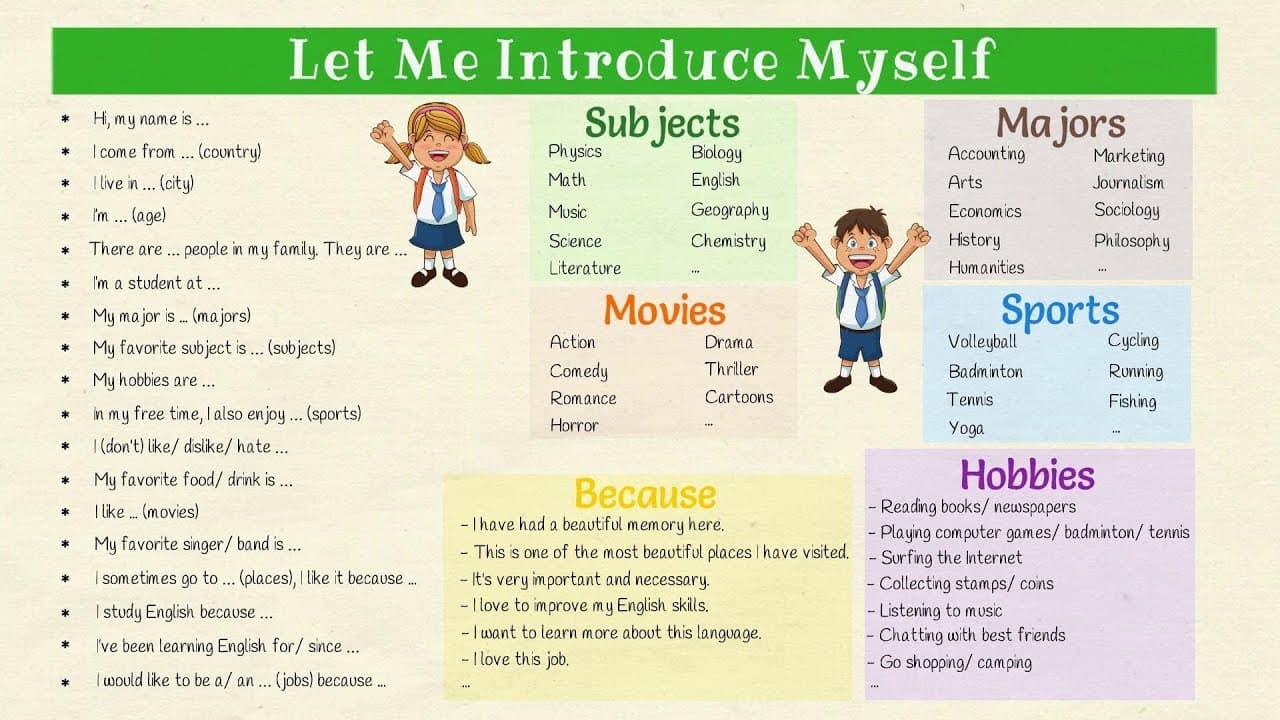
let me introduce myself hi my name is I come from I live in I'm 42 there are four people in my family they are my mother my brother my father and me I'm a student at my major is majors accounting marketing arts journalism economics sociology history philosophy humanities my favorite subject is subjects physics biology math English music geography s... Read More
Key Insights
- A basic English self introduction opens with the phrase "let me introduce myself," then "hi my name is," followed by "I come from" for your country and "I live in" for your current city, so origin and residence are stated as two separate facts.
- Family is described with the pattern "there are four people in my family," then listed by relationship, as in "they are my mother my brother my father and me." The alternative phrasing shown in the model introduction is "there are four of us in my family."
- Study is introduced with "I'm a student at" plus the school name and "my major is" plus the field. The lesson offers accounting, marketing, arts, journalism, economics, sociology, history, philosophy, and humanities as major options to choose from.
- Favorite subject uses "my favorite subject is" with options including physics, biology, math, English, music, geography, science, chemistry, and literature, which lets a learner swap one word and keep the same sentence frame for any school subject.
- Hobbies are introduced with "my hobbies are" and can include reading books and newspapers, playing computer games, badminton or tennis, surfing the internet, collecting stamps and coins, listening to music, chatting with best friends, and going shopping or camping.
- Free time activities use "in my free time I also enjoy" plus sports such as volleyball, cycling, badminton, running, tennis, fishing, and yoga. Dislikes are stated with three levels of strength: "I don't like," "I dislike," or "I hate."
- Preferences are covered with "my favorite food or drink is," "I like movies" with genres such as action, drama, comedy, thriller, romance, cartoons, and horror, and "my favorite singer or band is." Places use "I sometimes go to" plus "I like it because."
- The reason for studying English is stated as "I study English because it's very important and necessary," with duration given by "I've been learning English for" or "since." Career goals use "I would like to be a because I love this job."
Install to Summarize YouTube Videos and Get Transcripts
Explore YouTube Video Summarizer or Get YouTube Transcript Extractor
Questions & Answers
Q: How do you introduce yourself in English step by step?
Start with "let me introduce myself" and "hi my name is," then say where you come from and where you live, your age, and how many people are in your family with their relationships. Next state whether you study or work, giving your school and major or your job. Then list your hobbies, free time activities and sports, your dislikes, your favorite food or drink, movie genres, and favorite singer or band. Finish with places you visit, why you study English, how long you have been learning it, and what you would like to be.
Q: What phrases do you use to talk about your family in an English introduction?
The lesson gives the frame "there are four people in my family" followed by "they are my mother my brother my father and me," so you state the number first and then name each person by relationship. The model introduction shows a second version, "there are four of us in my family," combined with "I live with my wife and children." You can also add marital and household details separately, as Nicolas does with "I'm married," "I have two children," and "I've got a puppy."
Q: What can you say about your studies and major when introducing yourself?
Use "I'm a student at" plus your school and "my major is" plus your field. The lesson lists accounting, marketing, arts, journalism, economics, sociology, history, philosophy, and humanities as majors you can plug into that sentence. For your favorite subject, use "my favorite subject is" with options such as physics, biology, math, English, music, geography, science, chemistry, and literature. Because the sentence frame stays the same, you only change the final word to fit your own studies.
Q: How do you describe your hobbies when introducing yourself in English?
Begin with "my hobbies are" and then list activities. The lesson offers reading books and newspapers, playing computer games, playing badminton or tennis, surfing the internet, collecting stamps and coins, listening to music, chatting with best friends, and going shopping or camping. For sports and free time you can add "in my free time I also enjoy" with volleyball, cycling, badminton, running, tennis, fishing, or yoga. Nicolas combines several: reading books, playing badminton, listening to music, walking, and an interest in football.
Q: What is a good example of a complete self introduction in English?
The lesson's model is Nicolas: "hello I'm Nicolas I'm from Spain I'm 30 years old. There are four of us in my family. I live with my wife and children. My birthday is on January 1st. I work as an accountant. My hobbies are reading books playing badminton and listening to music. I also like walking. When I'm free I am interested in football. I don't like traveling. My favorite drink is coffee. I like watching documentary films. My favorite band is Backstreet Boys. I sometimes go to Malaga. I like it because this is a beautiful place."
Q: How do you say what you dislike in an English introduction?
The lesson gives three phrases in increasing strength: "I don't like," "I dislike," and "I hate," each followed by the thing you want to reject. This lets you choose how strong you sound while keeping the same sentence structure. In the model introduction, Nicolas uses the mildest option with "I don't like traveling." Stating a dislike is presented as a normal part of a full introduction, sitting between your free time interests and your favorite food or drink.
Q: Why should you mention why you study English when introducing yourself?
The lesson treats it as a standard closing part of the introduction and supplies the reason directly: "I study English because it's very important and necessary." You can extend it with "I love to improve my English skills" and "I want to learn more about this language." Duration is added using "I've been learning English for" or "since," as Nicolas does with "I've been learning English since I was 7," followed by an outcome statement such as "I can express myself and communicate in English."
Q: How do you talk about a place you like in an English self introduction?
Use "I sometimes go to" plus the place name, then give a reason with "I like it because." The lesson suggests two ready reasons: "I have had a beautiful memory here" and "this is one of the most beautiful places I have visited." Nicolas applies the pattern with "I sometimes go to Malaga. I like it because this is a beautiful place." The structure keeps the answer to two short sentences, one naming the place and one justifying the choice.
Summary & Key Takeaways
-
Introducing yourself in English means more than saying your name. The lesson opens with "let me introduce myself" and then walks through the basic slots learners are expected to fill: "hi my name is," "I come from," "I live in," age, and family size, using the example "there are four people in my family: my mother, my brother, my father and me."
-
The lesson then covers study and interests. Learners say "I'm a student at" and name a major from options such as accounting, marketing, arts, journalism, economics, sociology, history, philosophy, and humanities, then a favorite subject from physics, biology, math, English, music, geography, science, chemistry, and literature, followed by hobbies and free time sports.
-
A full model introduction closes the lesson. Nicolas says he is 30, from Spain, one of four in his family, living with his wife and children, born on January 1st, working as an accountant, enjoying reading, badminton, music, walking, and football, drinking coffee, liking documentaries and the Backstreet Boys, married with two children and a puppy, and learning English since he was 7.
Read in Other Languages (beta)
Share This Summary 📚
Summarize YouTube Videos and Get Video Transcripts with 1-Click
Try YouTube Summary with ChatGPT & Claude or YouTube Transcript Generator
Explore More Summaries from 7ESL Learning English 📚
Summarize YouTube Videos and Get Video Transcripts with 1-Click
Try YouTube Summary with ChatGPT & Claude or YouTube Transcript Generator