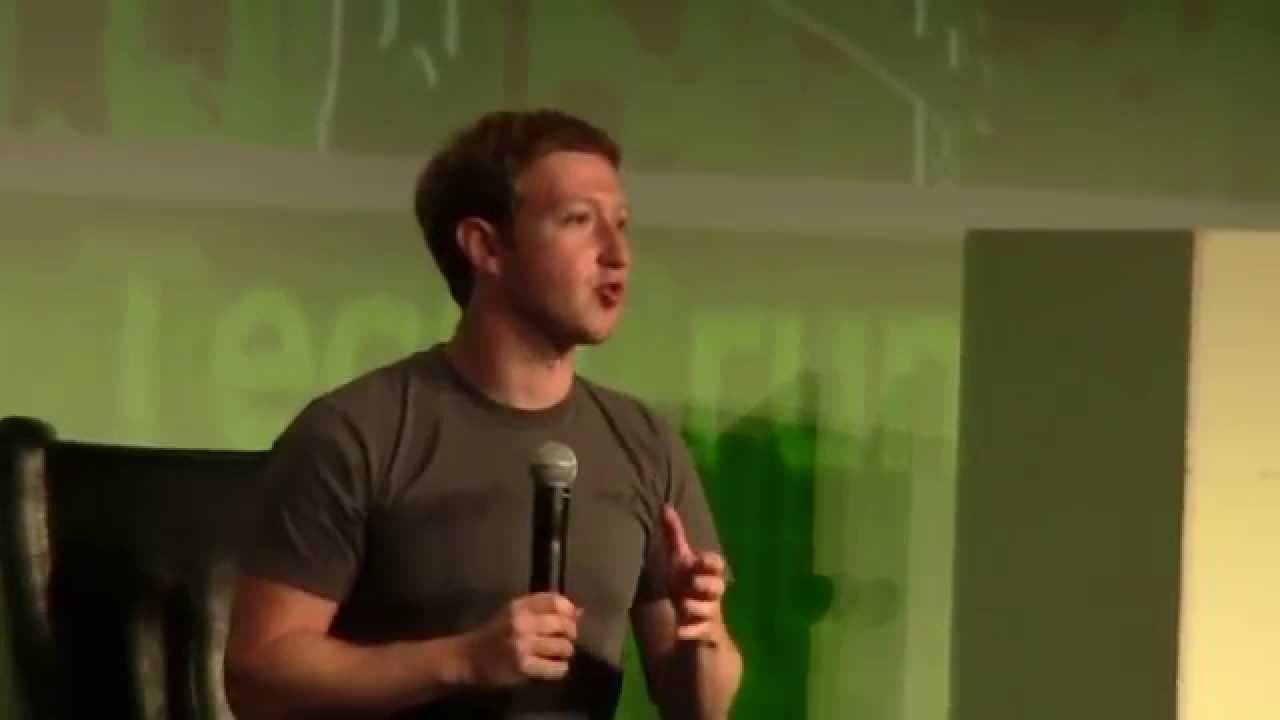
Mark Zuckerberg Interviewed by Michael Arrington - #TCDisrupt TechCrunch Disrupt 2012 Full Video
TL;DR
Facebook viewed mobile as its central long-term opportunity after its disappointing public-market debut. Mark Zuckerberg argued that phones could expand the user base, increase engagement, and eventually generate more revenue per unit of time than desktop use, while emphasizing that sustainable business performance, employee motivation, developer incentives, and advertiser returns were necessary to support the company’s mission.
Transcript
it's kazin's special coverage of tech crunch disrupt 2012 please join me in welcoming to the stage Facebook founder and CEO Mark Zuckerberg and Tech crunch founder crunch fund founder Michael Arington did I mess up already are you allow Standing Room you do this well yeah it's been like this uh hasn't really been more de here uh I think you want to... Read More
Key Insights
- Facebook’s stock performance after its public offering was disappointing, according to Zuckerberg, but the company’s stated response was to keep executing its mission and build value over the long term rather than redirect its strategy around short-term market reactions.
- Mobile was Facebook’s biggest strategic question for the next 3–5 years because Zuckerberg expected it to determine much of the company’s performance. He believed observers underestimated its potential while Facebook remained relatively quiet during the period surrounding the public offering.
- Facebook’s mobile opportunity rested on three expectations: more people would access the service, mobile users would spend more time and engage more frequently, and the company could eventually earn more revenue per unit of mobile time than from desktop use.
- Mobile users were more likely to use Facebook daily than desktop users, and they were more than twice as likely to use it six out of seven days. Zuckerberg presented this behavior as evidence that phones could deepen engagement rather than merely shift existing desktop activity.
- Facebook’s revised iOS application produced a major engagement improvement, according to Zuckerberg. After its release, the number of feed stories consumed per user each day doubled, supporting his claim that faster and more capable mobile products could materially change usage.
- Facebook’s mission and business model were mutually dependent in Zuckerberg’s account. Revenue enabled the company to recruit a strong team, maintain a platform, give developers financial incentives, and provide advertisers with returns that encouraged them to contribute content through pages.
- Employee motivation at Facebook came largely from building products people were proud to show friends and family. Zuckerberg said releases such as Messenger, the iOS application, iOS integration, and the camera application improved morale and attracted people interested in the company’s product work.
- Stock-price declines did not lead Facebook to create special equity incentives for employees. Zuckerberg said compensation translated a cash amount into shares, meaning a lower share valuation could provide employees with more shares if they believed the company would become more valuable later.
Install to Summarize YouTube Videos and Get Transcripts
Explore YouTube Video Summarizer or Get YouTube Transcript Extractor
Questions & Answers
Q: Why did Facebook consider mobile its biggest strategic opportunity?
Facebook considered mobile its biggest strategic opportunity because Zuckerberg expected phones to produce more users, greater engagement per person, and more revenue per unit of time than desktop use. He noted that many more people had phones than computers, smartphone adoption was growing quickly, and Facebook’s mobile-user population was also expanding. Mobile users were already showing stronger daily usage patterns than desktop users.
Q: How did Facebook plan to recover from its disappointing stock performance?
Facebook planned to respond by continuing to execute its mission of making the world more open and connected while building long-term value. Zuckerberg acknowledged that the stock’s performance was disappointing and said the company cared about shareholders. However, he framed success over the next 3–5 years primarily around execution, especially Facebook’s ability to improve its mobile products, engagement, and monetization.
Q: What evidence showed that Facebook users were more engaged on mobile?
Zuckerberg said mobile users were more likely to be daily active users than desktop users and were more than twice as likely to use Facebook six out of seven days each week. He also reported that, after Facebook released its improved iOS application, the number of feed stories consumed per user each day doubled. These observations supported his argument that mobile use could deepen engagement.
Q: How did Facebook’s iOS application affect user activity?
Facebook’s revised iOS application substantially increased content consumption, according to Zuckerberg. He said the number of feed stories consumed per user on a daily basis doubled after the application launched. He characterized the release as a massive improvement over the earlier mobile experience and used its results to argue that product changes could move engagement significantly beyond Facebook’s already strong mobile usage levels.
Q: Why did Zuckerberg say Facebook needed both a mission and a business?
Zuckerberg said Facebook needed a strong business to sustain its mission. Talented employees wanted meaningful work but also financial rewards, developers needed tools and a business model that let them earn money, and advertisers needed a good return from using Facebook. Those incentives supported the team, platform, and page content required to pursue the broader goal of making the world more open and connected.
Q: How did Facebook maintain employee morale after the stock decline?
Facebook relied primarily on product-building rather than special financial measures to maintain morale. Zuckerberg said employees were motivated by creating work they could proudly show friends and family. Releases such as Messenger, the improved iOS application, iOS integration, and the camera application energized employees and supported recruiting. He also reminded staff that the company was neither as good nor as bad as outside coverage suggested.
Q: Did Facebook change employee equity compensation after going public?
Facebook had not introduced special equity measures in response to the stock situation, according to Zuckerberg. The company continued translating a target cash compensation amount into shares. Under that approach, a lower share valuation meant employees received more shares for the same compensation amount. Zuckerberg described the period as a potentially attractive time to join, remain with the company, and increase commitment if employees expected future value growth.
Q: What had changed in Facebook’s mobile business before the interview?
Several important elements had changed during the six months before the interview. Facebook launched a new set of applications, Apple announced iOS integration, and Facebook began running mobile advertisements after previously running none. Zuckerberg also cited the improved iOS application and rising mobile engagement as evidence that the company’s position had advanced while it was relatively quiet publicly around the time of its public offering.
Summary
In this interview, Mark Zuckerberg, the CEO of Facebook, discusses a range of topics including the company's IPO, mobile strategy, product development, and future plans. He addresses the disappointing performance of Facebook's stock since going public and emphasizes the importance of mobile for the company's future success. Zuckerberg admits that one of the biggest mistakes they made was betting too much on HTML5 for mobile development instead of native apps. He also talks about the acquisition of Instagram and their plans for the platform. Throughout the interview, Zuckerberg reiterates his focus on the mission of connecting the world and building great products.
Questions & Answers
Q: If you could have done anything differently with hindsight, what would it be?
The performance of the stock has been disappointing, and while we care about our shareholders, our focus is on executing our mission of making the world more open and connected. The biggest question is how well we do with mobile, and to underestimate how good mobile is for us is a misunderstanding. We've made some missteps in the past, such as betting too much on HTML5 for mobile development, which was a strategic mistake. We had to start over and rewrite everything to be native. But now, with the new version of the iOS app and upcoming improvements for Android, we are in a better place and confident in our mobile strategy.
Q: In the IPO, you said that you don't build services to make money; you make money to build great services. Can you talk about that philosophy?
This philosophy goes to the heart of how we run the company. While we are a mission-driven company, we also understand the need to build a great team and a great business to attract the best talent and provide value to our developers and advertisers. Building a mission and building a business go hand in hand. We want to build a platform that allows developers to build and make money, and in return, they produce a lot of the content on Facebook. The primary thing that excites us is the mission, but we also recognize the importance of monetization to sustain our mission and growth.
Q: With the fluctuation in stock price, how are you dealing with employee morale and incentivizing employees to stay?
The stock performance doesn't help, but Facebook has experienced ups and downs before, so people are used to it. We have a good compass and understanding of what we need to do. Building great products that people are proud of is what motivates our employees. We've seen that when we release new apps and features, it drives morale and attracts new talent. In terms of incentivizing employees, we haven't done anything specifically, but we translate the amount of cash we want to give into shares, which means if the shares are undervalued, employees will receive more shares. Despite the challenges, it's a great time for people to join and stay at Facebook.
Q: You mentioned that mobile was a weakness for Facebook in the past. Is mobile now a strength and an opportunity for the company?
Mobile is not only a strength but also a huge opportunity for us. There are more users on mobile, and they are more engaged and spend more time on the platform. We believe we can make more money on mobile than on desktop. The number of smartphone users and engagement on mobile is growing rapidly. We've already seen improvements in engagement with the new version of the iOS app, and we're confident in our ability to monetize mobile. In the past, we made a strategic mistake by focusing too much on HTML5 for mobile development, but now we are investing in native apps and seeing positive results.
Q: Were there moments during the development of the mobile apps where you realized they weren't as good as they could be?
Yes, there were moments where we realized the apps weren't as good as we wanted them to be. We've been self-critical and acknowledge that there's room for improvement even with the current versions of the apps. We made the decision to prioritize speed and simplicity in the first release, but we have many exciting features and improvements in the pipeline. The iOS app is in good shape, and we're working on enhancing the Android app as well.
Q: Are you planning to release a Facebook phone?
No, building a Facebook phone is the wrong strategy for us. We want to integrate Facebook deeply into every major device and platform. Building our own hardware and operating system is not aligned with our vision. We prioritize integration and collaboration with other platforms rather than competing directly with them. Our goal is to be a mobile company and provide value across different platforms.
Q: Do you have any plans for search capabilities on Facebook?
Search is interesting, and we already receive a billion queries a day on our platform. While search on Facebook is currently focused on finding people, there is a meaningful portion of queries related to finding pages, brands, and apps. We believe there is a big opportunity for us to provide search capabilities that are unique to Facebook. We are exploring this area and have a team working on it, but I don't have any specific details to announce at this time.
Q: What other areas are you excited about in terms of future development?
One area I'm personally excited about is the Open Graph. We see a lot of potential in allowing people to bring their information and friends to apps and bring context from those apps back to Facebook. We're already seeing interesting developments in areas like music (Spotify) and accommodation (Airbnb). We want to give developers more distribution and help them leverage social context in their apps. We're also working on new tools like the mobile app install product, which provides a great opportunity for mobile developers.
Q: Are people underestimating Facebook's potential?
Some people may be underestimating us, and I think that's a good thing. We'd rather be underestimated because it gives us the freedom to take big bets and amaze people. We have a lot of interesting long-term projects in the works that will contribute to our mission of connecting the world. Despite the challenges, I find motivation in the opportunity to build something incredible.
Q: Are you still having fun?
For me, it's not just about fun but about the mission. We want to connect everyone in the world and enable them to share everything. Building good products and executing our mission is what keeps me going, even on challenging days. I'm focused on the long-term impact we can make rather than immediate gratification.
Summary & Key Takeaways
-
Mark Zuckerberg acknowledged that Facebook’s stock performance after going public had been disappointing. He said the company remained committed to making the world more open and connected while building long-term value. He identified Facebook’s performance on mobile during the following 3–5 years as the most important question facing the business.
-
Zuckerberg presented mobile as an opportunity built on three expectations: more users, greater engagement per user, and stronger monetization per unit of time. He said Facebook had launched improved applications, gained iOS integration, and begun running mobile advertising after previously running no mobile ads six months before the interview.
-
Facebook’s operating philosophy connected mission and business rather than treating them as competing priorities. Zuckerberg said strong economics helped recruit talented employees, support platform developers, and deliver returns to advertisers. He also argued that employees were motivated by creating products they could proudly show friends and family, despite criticism and stock-price volatility.
Read in Other Languages (beta)
Share This Summary 📚
Summarize YouTube Videos and Get Video Transcripts with 1-Click
Try YouTube Summary with ChatGPT & Claude or YouTube Transcript Generator