Elon Musk Talks About Colonizing the Galaxy
TL;DR
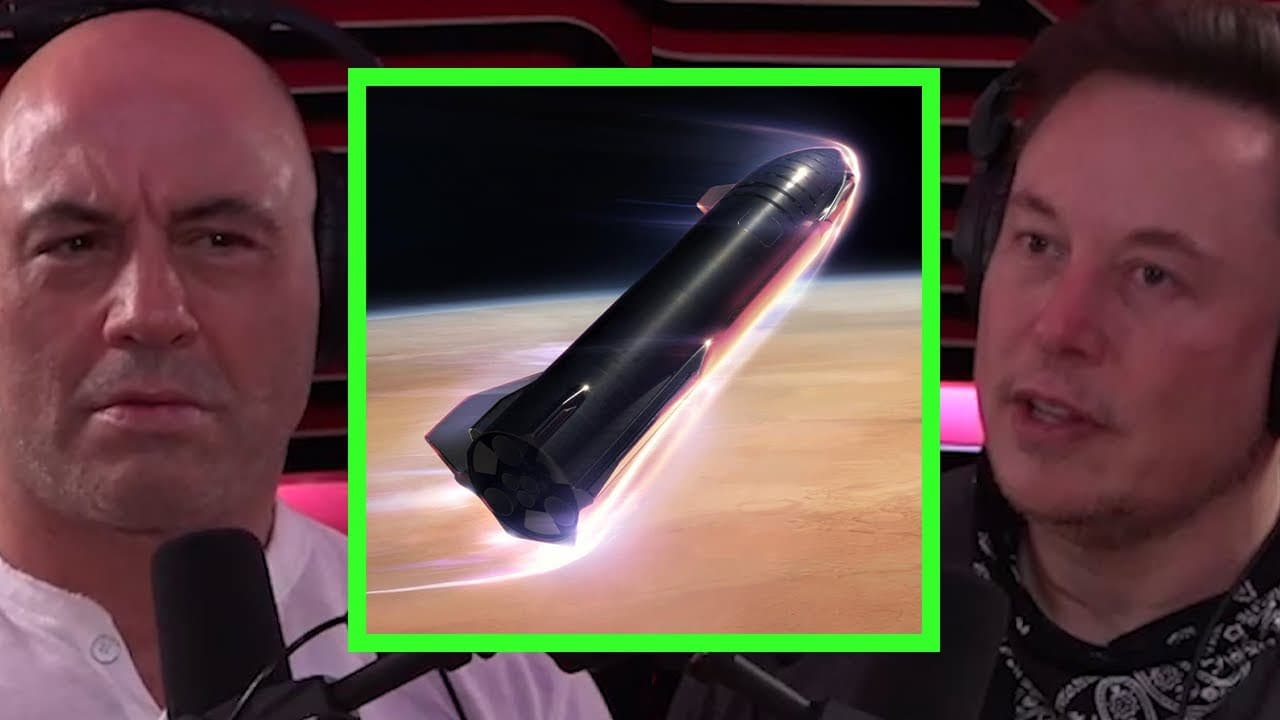
Elon Musk argues that Mars must have every resource needed to sustain civilization without shipments from Earth. He says those shipments could stop because of World War III, natural disasters, or a slow civilizational decline, while the absence of direct evidence for alien life raises the possibility that civilizations fail before becoming interstellar. Read on for his survival threshold, “great filter” argument, and response to UFO claims.
Transcript
the jurogan experience how much time before there's regular travel back and forth to mars roughly like a real civilization on mars well i think it's going to take a while to build a real civilization the i the the real the threshold that really matters is for getting past the great filter uh is do we have enough resources on mars such that if the u... Read More
Key Insights
- 👻 Building a self-sustaining civilization on Mars requires sufficient resources to allow survival independently of Earth.
- 🫱 Potential threats like world war III, natural disasters, or extinction events on Earth emphasize the urgency of interplanetary colonization.
- 👽 Elon Musk hints at the existence of aliens but emphasizes the lack of concrete evidence, focusing on the imperative of expanding human civilization to other planets.
- ❓ Interstellar colonization could enable the human species to survive and thrive beyond Earth's constraints.
- 🤨 The Fermi paradox raises questions about the lack of tangible evidence for alien civilizations' existence.
- 👾 Earth's geological history, marked by extinction events and natural disasters, underlines the vulnerability of the planet and the need for space colonization.
- 😀 Elon Musk advocates for resilience in the face of potential catastrophic events, highlighting the importance of securing human civilization's future through space exploration.
Install to Summarize YouTube Videos and Get Transcripts
Explore YouTube Video Summarizer or Get YouTube Transcript Extractor
Questions & Answers
Q: What would make a civilization on Mars truly self-sustaining according to Elon Musk?
Mars would need enough resources for its inhabitants to survive if spaceships from Earth stopped arriving. Musk says the settlement must possess all the things necessary to sustain civilization independently.
Q: Why does Elon Musk think shipments from Earth to Mars might stop?
He identifies World War III, a slow decline of civilization, natural disasters, and asteroid impacts as possible causes. In his words, civilization on Earth could end with either a bang or a whimper.
Q: What does Elon Musk mean by the “great filter”?
He connects the great filter to the possibility that civilizations are destroyed before becoming interstellar. Establishing a self-sustaining civilization on Mars would help humanity move past that danger.
Q: How does the Fermi paradox relate to Musk’s argument about space colonization?
The Fermi paradox asks where the aliens are. Musk considers whether the absence of visible alien civilizations could mean that civilizations tend to disappear before they become interstellar.
Q: Does Elon Musk say there is evidence of alien life on Earth?
No. He states that, to the best of his knowledge, there is no direct evidence for alien life on Earth or elsewhere.
Q: What standard does Musk suggest for credible alien-sighting evidence?
He says the evidence should be at least as good as footage from a 7-Eleven or ATM camera. He also notes that images are easy to fake today.
Q: What Tic Tac UFO account is described in the conversation?
Joe Rogan describes naval fighter pilot David Fravor’s account of an object tracked from more than 60,000 feet above sea level to one foot in less than a second. Rogan says it had no visible propulsion, jammed tracking systems, and traveled to a point 30 miles away within a couple of seconds.
Q: How does Musk respond to the idea that alien civilizations may be quietly observing humanity?
He jokes that if alien civilizations are real, they are very subtle. He adds that if they wanted humanity to know they existed, they could make themselves obvious.
Summary
In this video, Joe Rogan and his guest discuss the possibility of regular travel to Mars and the concept of building a civilization on the planet. They touch on the idea of the "great filter," which refers to the threshold of having enough resources on Mars to sustain life in the event that spaceships from Earth stop coming. They also talk about the different scenarios that could lead to the cessation of travel from Earth to Mars, such as world war, decline of civilization, or natural disasters. Additionally, they delve into the topic of alien life and the Fermi paradox, questioning why we haven't encountered any extraterrestrial civilizations. The discussion concludes with the importance of interplanetary travel for the survival of the human species due to the various threats Earth faces.
Questions & Answers
Q: How much time until there's regular travel back and forth to Mars like a real civilization?
Building a real civilization on Mars will take a while. The crucial factor in establishing such a civilization is having enough resources on Mars to ensure survival even if spaceships from Earth no longer arrive. It's important to have everything necessary for sustaining a civilization, considering the possibility of Earth experiencing world war, decline of civilization, or natural disasters.
Q: What could lead to the spaceships from Earth to Mars stopping?
The reasons for the spaceships from Earth stopping could vary. It could be due to a sudden event like world war or a gradual decline of civilization. Natural disasters, such as asteroid impacts, are also a possibility. Similar to the extinction of dinosaurs, it might not be a single event but a series of occurrences that disrupt the flow of spaceships from Earth to Mars.
Q: Why are crocodiles still here despite catastrophic events?
Crocodiles have managed to survive because they are resilient creatures. They can sustain themselves on decayed meat, thriving in disastrous situations where there are plentiful dead creatures. Alongside crocodiles, bugs, mushrooms, and shrews have also shown great adaptability. These creatures are the descendants of our ancient ancestors, and their ability to survive offers hope for other species, including humans, in challenging circumstances.
Q: What is the "great filter" that is mentioned?
The "great filter" refers to the concept of the Fermi paradox, which raises the question of why we haven't encountered any extraterrestrial civilizations despite the vastness of the universe. It suggests that there may be a threshold that civilizations must overcome to become interstellar. It poses two possibilities: either there are many alien civilizations or none at all. In either case, it is equally unsettling, as if there are numerous alien civilizations, the invasion or eradication of humanity becomes a concern, while the absence of civilizations raises questions about why they are constantly destroyed before reaching interstellar capabilities.
Q: Is there any evidence of alien life on Earth?
To the best of our knowledge, there is no direct evidence of alien life on Earth. Claims of alien sightings or encounters require substantial evidence, at least on par with the quality of a 711 or ATM surveillance camera. However, due to the advancements in technology, it has become easy to manipulate and fake evidence, making it difficult to discern genuine encounters from hoaxes. Until there is convincing evidence, there is little reason to invest significant time and resources in the search for aliens.
Q: Could aliens be observing us without revealing themselves?
If alien civilizations exist, they might choose to be subtle in their interactions with us. They may observe us without direct contact, potentially out of concern for our destructive nature or to prevent interference with our civilization. If they wanted us to know of their presence, they could easily reveal themselves in a more overt manner, such as landing in the middle of a populated area or hovering over major cities. Therefore, the lack of such apparent encounters suggests that either they don't exist or they prefer to remain hidden.
Q: Does the possibility of aliens occupy your thoughts often?
Personally, I don't think about aliens too much. It's not a subject that forefronts my mind, even though I am interested in interplanetary travel. The absence of any evidence or encounters makes it seem like a waste of time to dwell on the topic. However, if substantial evidence emerges, I would enthusiastically engage with the subject and thoroughly investigate its implications.
Q: What about the people dedicating their lives to researching aliens?
While some researchers have spent their entire lives studying the possibility of alien life, their findings have been limited. Apart from interesting stories, they have not discovered any concrete evidence that fundamentally alters our understanding of history or technology. Archaeologists keep unearthing artifacts consistent with the technology of past eras. If an archaeological finding deviated significantly from what we thought was possible during a particular time period, it might provide more compelling evidence for extraterrestrial influence.
Q: Could humanity colonize the entire galaxy in a million years?
Given a long enough timescale, even without new physics, it would be possible to colonize the entire galaxy using sub-light travel. The process would involve starting with Mars, building bases, and gradually expanding to other planets and solar systems over thousands of years. This kind of interstellar colonization becomes imperative for the survival of our species, considering the risks Earth faces, such as natural disasters and our own follies throughout history.
Q: What are some examples of major extinction events?
Earth has experienced numerous major extinction events throughout its geological history. The Permian extinction event is particularly notable, where over 90 percent of all species perished. Even among the survivors, a significant portion consisted of fungi, sponges, and other resilient organisms. These extinctions have been caused by factors like massive meteors, super volcanoes, continental drift, ice ages, and extreme climate changes. The unpredictability and frequency of such events emphasize the need for multi-planetary colonization to ensure the long-term survival of our species.
Takeaways
Regular travel and the establishment of a civilization on Mars will require significant time and resources. The great filter concept presents the challenge of having enough resources on Mars to sustain life independent of Earth. The absence of concrete evidence for alien life calls into question their existence and intentions. Regardless, interplanetary colonization is vital for humanity's survival due to Earth's susceptibility to natural disasters and the cyclical nature of extinction events.
Summary & Key Takeaways
-
Elon Musk discusses the need for Mars to sustain life independently from Earth to ensure civilization survival.
-
The potential threats to humanity, including world war III, natural disasters, and events like the Permian extinction, highlight the necessity of interplanetary colonization.
-
Musk hints at the existence of aliens but emphasizes the lack of concrete evidence, focusing on the imperative of expanding human civilization to other planets.
Read in Other Languages (beta)
Share This Summary 📚
Summarize YouTube Videos and Get Video Transcripts with 1-Click
Try YouTube Summary with ChatGPT & Claude or YouTube Transcript Generator
Explore More Summaries from PowerfulJRE 📚





Summarize YouTube Videos and Get Video Transcripts with 1-Click
Try YouTube Summary with ChatGPT & Claude or YouTube Transcript Generator