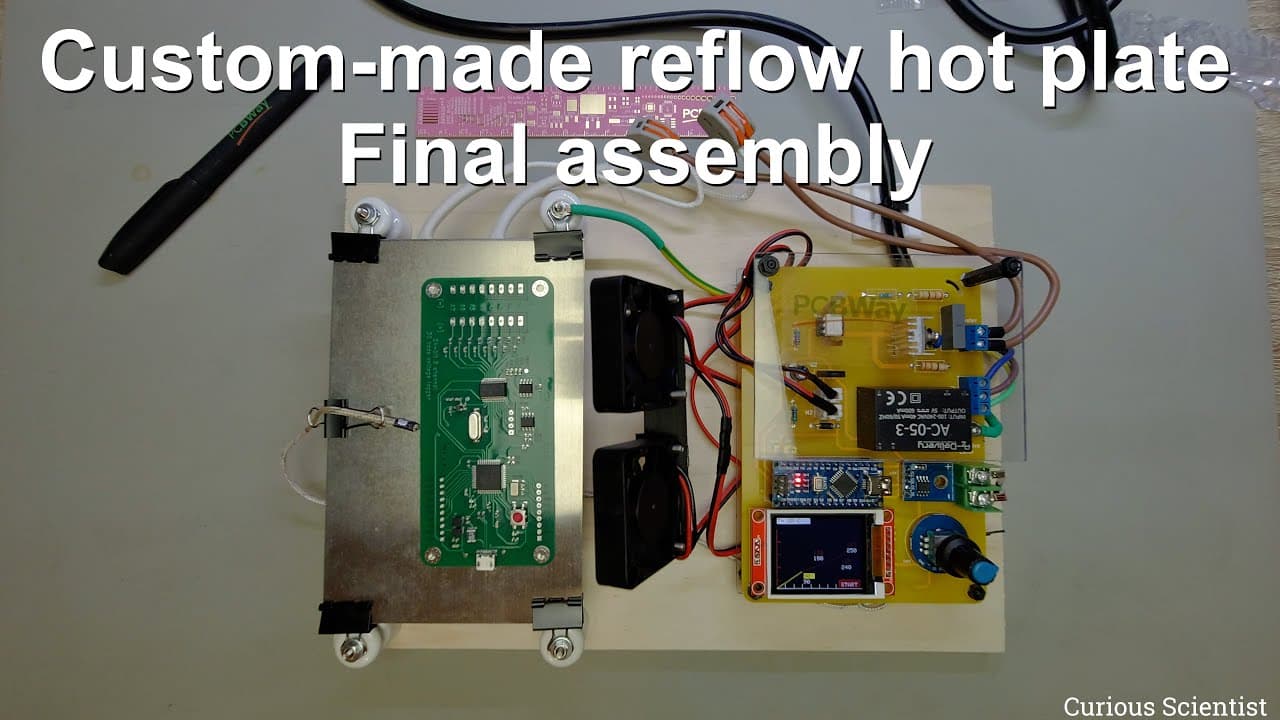
Custom-made reflow hot plate - Final assembly
TL;DR
A detailed overview of a DIY reflow hot plate soldering station.
Transcript
this video is sponsored by pcbway welcome everyone in this video i'm going to show you the final version of my reflow hot plate device or soldering station so you could see this device in some of my videos either in some dedicated video for this specific construction or in some other videos where i used this as as a dedicated tool but this has neve... Read More
Key Insights
- 😅 The reflow hot plate soldering station integrates various components into a cohesive DIY project, enhancing the user's soldering capabilities.
- 👻 The Arduino Nano serves as a powerful controller, allowing for programmable flexibility in managing soldering processes through tailored reflow curves.
- ⚡ Ensuring proper grounding and safety measures is essential when dealing with high voltages, providing protection against potential electrical hazards.
- ⌛ The thermocouple functionality is critical, supplying real-time temperature feedback to adjust heating elements appropriately during the soldering phase.
- 👤 The final assembly showcases thoughtful organization and design, improving user experience and device reliability.
- ❓ An engaging testing phase illustrated the importance of precise calibration of temperature settings for effective solder paste usage.
- 📽️ Visitors interested in electronics can find valuable resources and components for creating personalized projects through PCBWay.
Install to Summarize YouTube Videos and Get Transcripts
Explore YouTube Video Summarizer or Get YouTube Transcript Extractor
Questions & Answers
Q: What are the key components involved in the reflow hot plate device?
The reflow hot plate device comprises a PCB based on an Arduino Nano, a heating element, a thermocouple for temperature readings, and fans for cooling. The Arduino Nano controls the operation, customizing reflow curves, while the thermocouple provides real-time feedback on the surface temperature to ensure proper soldering.
Q: How does the Arduino Nano control the soldering process?
The Arduino Nano controls the soldering process by programming the reflow heating curve which specifies how temperature changes over time. It monitors the temperature via a thermocouple and adjusts the firing of a triac to switch the heater on and off, maintaining the desired temperature profile critical for effective soldering.
Q: How does the safety mechanism work in the device?
The safety mechanism includes a grounded cable connected to the frame of the device. This grounding protects users in case of electrical faults. If a fault occurs that energizes the metal surface, the grounding will divert the current safely, ideally triggering the circuit breaker, preventing electric shock hazards.
Q: What challenges did the creator face during testing?
During testing, the creator encountered an issue where the reflow curve was set incorrectly for the solder paste being used, necessitating reprogramming. This highlights the importance of precise matching of the heating profile to the solder paste specifications to achieve optimal soldering results without requiring additional heat corrective actions.
Q: Can viewers purchase the PCB and components to build their device?
Yes, viewers can purchase the PCB and components necessary to build their own reflow soldering station from the sponsor, PCBWay. Detailed documentation of the project is available, along with sources for required parts, allowing for an accessible DIY experience.
Q: What steps are involved in programming the reflow curve?
Programming the reflow curve involves accessing the Arduino Nano interface, selecting the parameters corresponding to the melting point of the solder paste being utilized, and modifying the values for each temperature phase. This allows the user to customize the heating process to suit specific soldering needs effectively.
Q: What was the result of the final soldering process?
The final soldering process yielded positive results, with the creator observing no short circuits and a neat solder appearance. While some solder joints could be improved with additional manual soldering, the majority of the circuit's functionality was confirmed operational and within expected voltage parameters.
Summary & Key Takeaways
-
The video presents a fully assembled DIY reflow hot plate soldering station, previously showcased in parts, now consolidated into a cohesive unit with improved organization and functionality.
-
Its core function is controlled by an Arduino Nano-based PCB, which manages the heating process through customizable reflow curves, temperature feedback from a thermocouple, and fan cooling mechanisms.
-
Viewers are encouraged to purchase the necessary PCBs and components from the sponsor, PCBWay, to build their own version of the station, with clear instructions and support provided.
Read in Other Languages (beta)
Share This Summary 📚
Summarize YouTube Videos and Get Video Transcripts with 1-Click
Try YouTube Summary with ChatGPT & Claude or YouTube Transcript Generator
Explore More Summaries from Curious Scientist 📚
Summarize YouTube Videos and Get Video Transcripts with 1-Click
Try YouTube Summary with ChatGPT & Claude or YouTube Transcript Generator