How to Start Cold Email Marketing Successfully
TL;DR
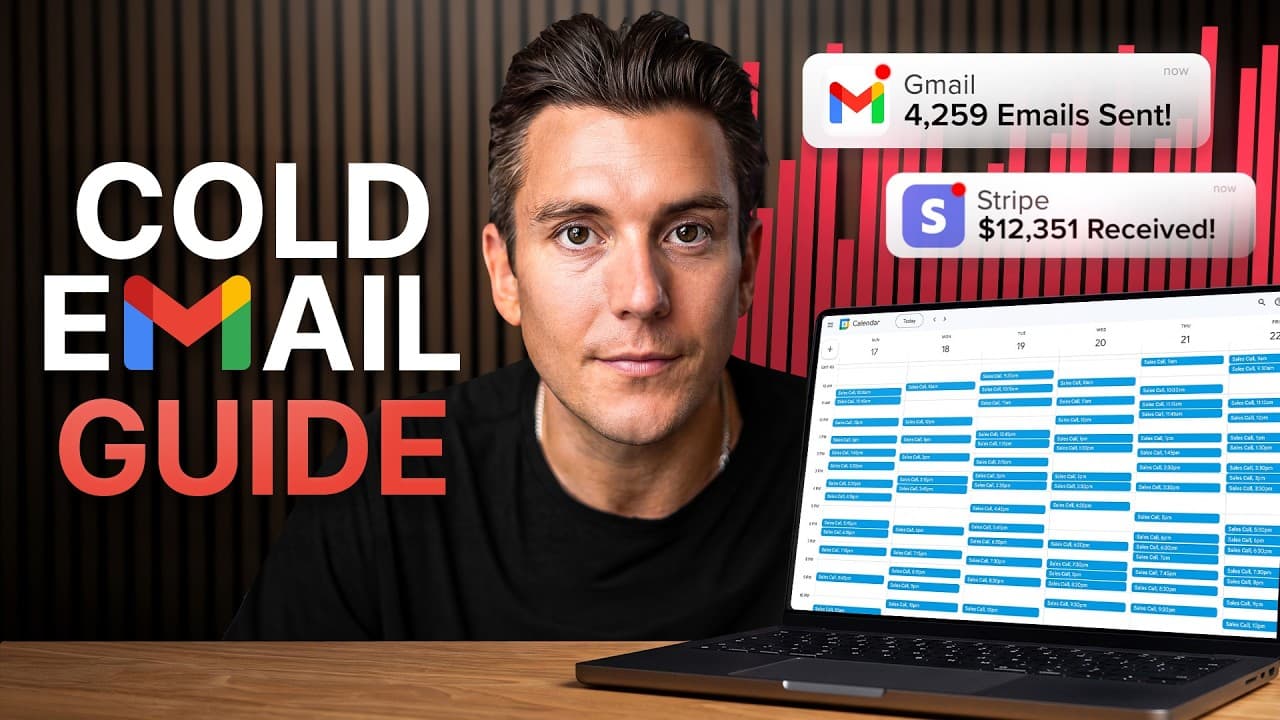
Build cold email campaigns in the right order: protect deliverability, identify relevant prospects, write honest messages, and follow up. A polished email cannot compensate for a damaged sending domain or a poorly targeted list, so beginners should treat their first campaign as a diagnostic test and measure delivery, replies, positive responses, and booked calls in sequence.
Transcript
Your first cold email is probably going to get zero replies. And honestly, the email itself is usually the last reason why. There are four things that have to work in order and the email is number three. And here's what you're up against. The average cold email gets a 3% reply rate. That's from our own benchmark report this year. So that's not me g... Read More
Key Insights
- Cold email is a business message sent to someone who has not requested contact, with the specific purpose of beginning a conversation. It is distinct from warm outreach, newsletters, and opt-in campaigns because the recipient has not previously engaged or joined a list.
- The difference between legitimate cold email and spam is relevance and honesty, not simply volume. Even one irrelevant or deceptive message can qualify as spam, while a large campaign can remain legitimate when every recipient has a relevant reason to receive it.
- Cold email performance depends on four ordered conditions: the message must arrive, reach the right person, earn a response, and receive adequate follow-up. Copy is only one part of the system, so rewriting an email cannot solve infrastructure or targeting failures.
- Deliverability is whether an email reaches the inbox before a recipient has any opportunity to respond. Providers such as Gmail and Outlook evaluate the sending domain, making domain reputation a foundational concern rather than an issue that can be corrected through better copy.
- A separate sending domain protects broader email activity from the consequences of a poor campaign. A damaged domain can impair sending for weeks, and recovery may be difficult enough that purchasing a new domain and rebuilding its reputation becomes the practical response.
- The first campaign is a diagnostic exercise that reveals whether outreach failed at delivery, targeting, messaging, or follow-up. Beginners should expect imperfect early results and use the resulting evidence to identify the broken stage instead of treating silence as proof that cold email never works.
- Cold email metrics should be evaluated in sequence: bounce rate, any reply, positive reply, and booked calls. Each stage confirms that part of the system is functioning, while a sudden drop between stages helps locate the campaign problem that needs attention.
- Cold email infrastructure requires time because domains and inboxes need warm-up before a real campaign begins. The process runs on a clock and cannot simply be rushed, so beginners should expect setup to take about two weeks before launching their first full campaign.
- More videos from this channel:
- More from this channel: Instantly
Install to Summarize YouTube Videos and Get Transcripts
Explore YouTube Video Summarizer or Get YouTube Transcript Extractor
Questions & Answers
Q: What is cold email marketing?
Cold email marketing is the practice of sending a business email to someone who has not asked to hear from the sender, with the goal of starting a conversation. It differs from warm email, where the recipient already knows or has engaged with the sender, and from newsletters or nurture campaigns, where recipients have chosen to join a list.
Q: What separates cold email from spam?
Relevance and honesty separate legitimate cold email from spam. The sender should have a credible business reason for contacting each recipient and should be straightforward about identity and intent. Misleading subject lines, fake reply markers, impersonation, and irrelevant mass messages violate those principles and can also damage the sending reputation needed for future outreach.
Q: Why should deliverability come before writing cold email copy?
Deliverability determines whether a message reaches an inbox before the recipient can read or answer it. Email providers evaluate signals connected to the sending domain, so excellent copy has no value when the infrastructure prevents delivery. A poor campaign can damage the domain for weeks, making deliverability the first part of the system to establish.
Q: How should a beginner set up cold email infrastructure?
A beginner should first determine the desired daily sending volume, then calculate the required sending domains and inboxes. The setup should use a separate sending domain, establish the authentication records that prove the sender's identity, and warm the infrastructure before launching a real campaign. This foundation helps messages reach inboxes without exposing the primary domain to unnecessary risk.
Q: How long should cold email setup take before launching?
The transcript advises allowing about two weeks before the first real campaign goes out. Part of the infrastructure and warm-up process operates on a timeline that cannot be rushed. Beginners should not interpret this waiting period as a technical failure. It is an expected part of preparing domains and inboxes for responsible outreach.
Q: How can you diagnose a cold email campaign with no replies?
A quiet campaign should be examined as a sequence of possible failures. The email may never have arrived, it may have reached the wrong person, it may have been ignored because the message was ineffective, or it may have received only one attempt instead of continued follow-up. Checking each stage in order identifies where improvement is needed.
Q: Which cold email metrics should beginners track?
Beginners should track bounce rate first, followed by any replies, positive replies, and booked calls. The transcript recommends keeping bounce rate under 2%. These metrics should be assessed in that order because each one provides evidence that a different stage works, from technical delivery through interest and eventual conversion into a business conversation.
Q: What results should a beginner expect from cold email?
The benchmark presented in the transcript gives an average reply rate of 3.43%, while stronger campaigns reach 10.7% or higher. Roughly half of replies may be positive when the process is followed, and some positive replies may become booked calls. These figures are expectations for diagnosing performance, not guarantees, because individual results can vary.
Summary & Key Takeaways
-
Cold email is a business message sent to someone who has not asked to hear from you, with the goal of starting a conversation. It differs from warm email and opt-in marketing because no prior engagement exists. Relevance and honesty separate legitimate outreach from spam, regardless of how many messages are sent.
-
Successful outreach depends on several stages working in order. The message must reach the inbox, go to a person who could reasonably accept the offer, earn attention, and receive follow-up opportunities. Beginners should use an initial campaign to determine which stage is failing instead of expecting polished results immediately.
-
Deliverability should be established before prospecting or copywriting because providers judge incoming messages partly through the sending domain. The recommended setup includes separate sending domains, inboxes, authentication records, and warm-up. Since domain damage can affect later campaigns and require weeks to repair, infrastructure deserves early attention.
Read in Other Languages (beta)
Share This Summary 📚
Summarize YouTube Videos and Get Video Transcripts with 1-Click
Try YouTube Summary with ChatGPT & Claude or YouTube Transcript Generator
Explore More Summaries from Instantly 📚

Summarize YouTube Videos and Get Video Transcripts with 1-Click
Try YouTube Summary with ChatGPT & Claude or YouTube Transcript Generator