How Were Easter Island's Moai Built and Moved?
TL;DR
Rapa Nui islanders carved the moai from local volcanic material and could transport them upright by rocking them with ropes in a walking motion. The island once supported a much larger population through farming and seafood, while its later decline is attributed not simply to environmental destruction, but largely to slave raids, introduced diseases, and forced migration after European contact.
Transcript
My song For many decades people's minds have been occupied with the mystery of Easter Island a remote piece of volcanic soil far away in the Pacific Ocean but our planet hosts thousands of such Lonely Island's What is so particular about this one the mystery is concealed not on the island itself? But the giant stone statues covering it who created ... Read More
Key Insights
- Rapa Nui is an exceptionally remote Chilean territory in the southern Pacific Ocean, with air travel from Santiago described as the only way to reach it. Its isolation helped create enduring questions about how its inhabitants developed, sustained, and transformed a monument-building society.
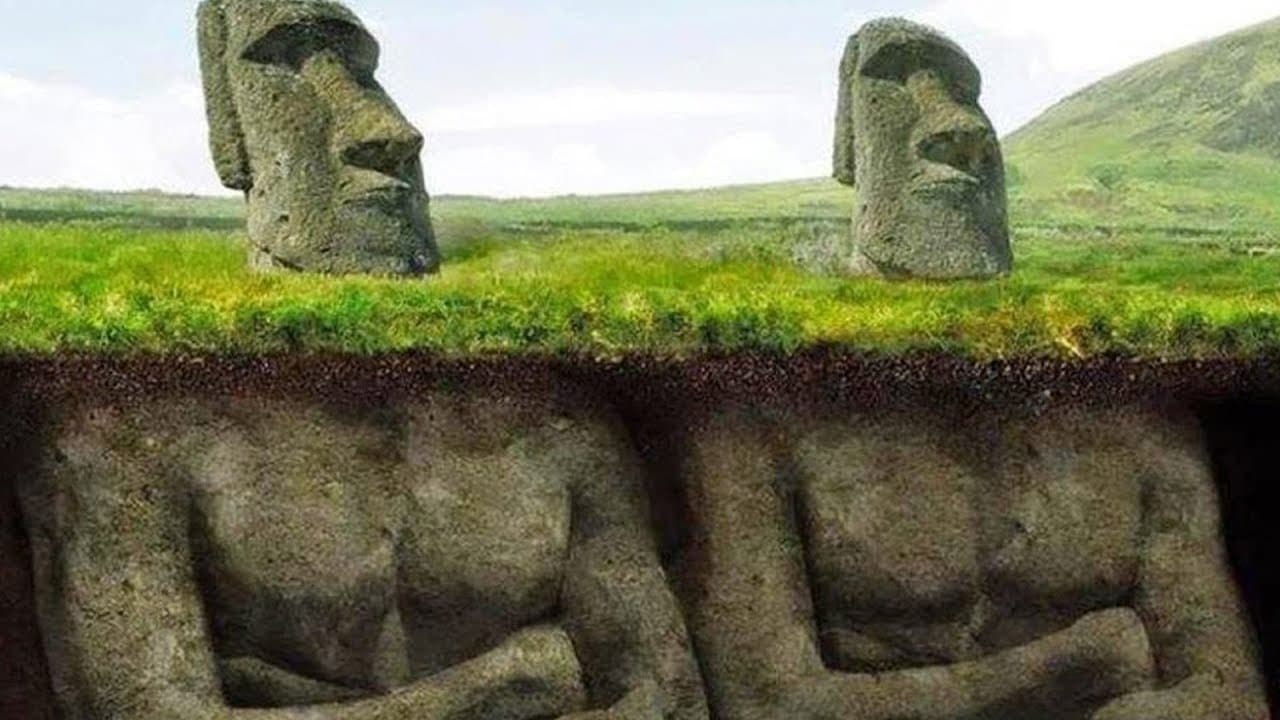
- The moai are complete humanlike figures, not detached stone heads. Excavations revealed bodies extending beneath the ground, while the visible heads account for only part of each statue. Their characteristic features include long noses, broad chins, rectangular ears, heavy brows, and deeply set eyes.
- Most moai were carved from tuff, described as compressed volcanic ash originating on the island. The principal source was an extinct volcano in northeastern Rapa Nui, which directly contradicts the idea that extraterrestrial visitors supplied the statues or their construction material.
- Most moai face inland rather than toward the ocean. The account suggests that this orientation may reflect their role as protectors watching over settlements, while a separate sacred group follows a different pattern and therefore does not fit the dominant inland-facing arrangement.
- Tukuturi is presented as a unique kneeling statue with a raised head, a beard, a smaller and more humanlike form, and red Puna Pau stone. Researchers cited in the account believe its posture may depict an ancient singer participating in the festival of rui.
- The moai could be moved upright by attaching ropes and rocking them from side to side in a controlled walking motion. Researchers demonstrated the method with replicas, providing a practical interpretation of local traditions claiming that the statues walked through magical assistance.
- Rapa Nui could support a substantially larger population than early European visitors encountered. Productive sweet-potato fields, seafood, fish, and deliberate fertilization with volcanic rock provided enough food to sustain the workforce required to carve and distribute numerous monumental statues.
- The population decline is linked to outside contact rather than only to ecological self-destruction. The account says people continued living on the island for centuries, while slave raids, imported diseases, and forced migration caused a devastating reduction after Europeans began arriving.
Install to Summarize YouTube Videos and Get Transcripts
Explore YouTube Video Summarizer or Get YouTube Transcript Extractor
Questions & Answers
Q: How were the Easter Island moai moved?
The moai could be transported upright using ropes attached around the statues. Teams pulled from alternating sides, rocking each figure and gradually advancing it with a controlled walking motion. Researchers tested this approach by moving replicas, including a full-sized example. The successful demonstrations also provide a practical explanation for Rapa Nui folklore saying that the statues walked with the help of magic.
Q: Who created the statues on Easter Island?
The statues were created by the Indigenous inhabitants of Rapa Nui. The account argues that the island once supported a much larger society than the small population encountered by early European visitors. Agriculture, fish, and seafood could sustain enough workers to carve and transport the monuments. The statues' local volcanic material also supports human construction on the island rather than theories involving extraterrestrial creators.
Q: Are the Easter Island statues only heads?
The Easter Island statues are complete figures with bodies attached beneath their prominent heads. Soil accumulated around many statues and concealed their lower sections, which created the common impression that they were only heads. Excavations exposed torsos and arms carved against the bodies in different positions. The unusually large heads remain visually dominant, but they represent only part of each full monument.
Q: What were the Easter Island statues made from?
Most of the statues were carved from tuff, which the transcript describes as compressed volcanic ash. Much of this material came from an extinct volcano in the northeastern part of the island. One unusual kneeling statue, Tukuturi, differs from the others because it was made from red Puna Pau stone. The local origin of these materials undermines claims that the monuments came from another planet.
Q: Why do most Easter Island statues face inland?
Most moai face inland with their backs turned toward the ocean. The suggested explanation is that the statues served as protectors of the villagers and were positioned to overlook their settlements. A group located at a sacred Rapa Nui site does not follow this pattern. The transcript presents the protective interpretation as a possibility rather than a definitively established purpose for every statue.
Q: How did Rapa Nui support a large population?
Rapa Nui supported its inhabitants through agriculture and marine food sources. Sweet potatoes were described as the main crop, while fish and other seafood supplemented the diet. The islanders also deliberately added volcanic rock to their fields as fertilizer, demonstrating skilled agricultural engineering. These resources could sustain a population large enough to organize the carving, movement, and placement of the island's many stone monuments.
Q: Why did the population of Easter Island decline?
The account attributes the severe population decline largely to events following European contact. South American slave raids removed many Indigenous inhabitants, while European traders introduced diseases against which local people had little protection. Forced migration caused additional harm. This explanation challenges the older claim that deforestation alone produced famine, warfare, cannibalism, and the collapse of Rapa Nui society.
Q: Did deforestation destroy Easter Island society?
The older ecocide theory claimed that islanders cleared forests for agriculture and statue transportation, mistakenly expected the trees to return quickly, and then suffered hunger, conflict, and cannibalism. The account says later research challenged that explanation. Evidence of deliberate volcanic-rock fertilization and continued settlement for centuries suggests adaptability, while population decline became pronounced after slave raids, disease, and forced migration followed European contact.
Summary & Key Takeaways
-
Rapa Nui is a remote Chilean island in the southern Pacific Ocean, known for giant stone statues called moai. The monuments have distinctive faces and complete bodies, although soil concealed much of many statues. Most were carved from compressed volcanic ash, and nearly all were positioned to face inland toward island settlements.
-
Researchers tested whether islanders could transport the heavy statues using tools and materials available to the original inhabitants. Experiments showed that ropes could rock an upright replica from side to side, producing a walking motion. This method offers a practical explanation for Rapa Nui traditions describing the statues as walking to their destinations.
-
The island could once support far more inhabitants than Europeans encountered during their early visits. Farming, deliberate volcanic-rock fertilization, sweet potatoes, fish, and seafood sustained the society. The later population collapse is linked primarily to slave raids, unfamiliar diseases, and forced migration following European contact, rather than solely to self-inflicted environmental destruction.
Read in Other Languages (beta)
Share This Summary 📚
Summarize YouTube Videos and Get Video Transcripts with 1-Click
Try YouTube Summary with ChatGPT & Claude or YouTube Transcript Generator
Explore More Summaries from BRIGHT SIDE 📚



Summarize YouTube Videos and Get Video Transcripts with 1-Click
Try YouTube Summary with ChatGPT & Claude or YouTube Transcript Generator