What Is the Current State of Computer Vision in AI?
TL;DR
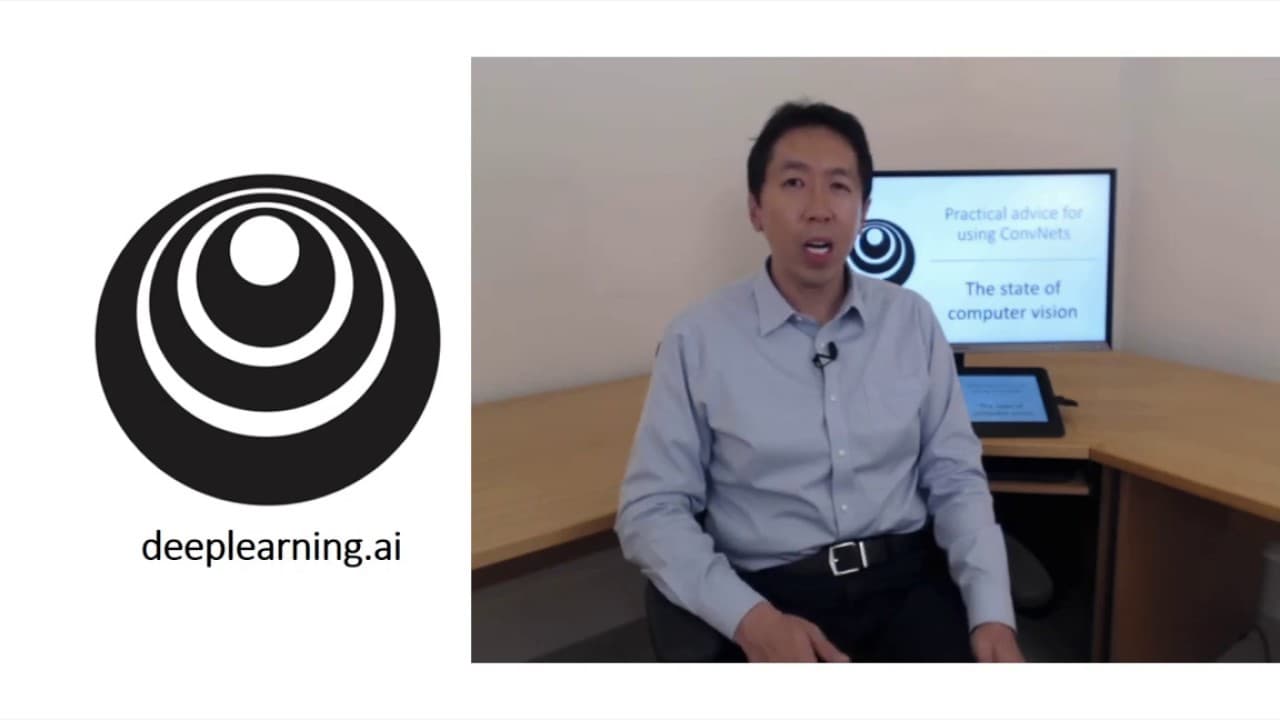
The current state of computer vision heavily relies on deep learning, which requires considerable amounts of data; however, there is an ongoing need for even more data to improve algorithms. When data is scarce, hand engineering becomes essential for feature extraction and network design. Transfer learning is frequently employed to leverage pre-trained models, while many techniques used for benchmark success may not be practical for real-world applications.
Transcript
deep learning has been successfully applied to a complete vision - language about seeing speech recognition online advertising logistics many many many problems there are a few things that are unique about the application of deep learning to computer vision about the status of computer vision in this video I'll share view some of my observations ab... Read More
Key Insights
- 🤗 Deep learning for computer vision relies on both data and hand engineering, with more data enabling simpler algorithms and less hand engineering.
- 🖐️ Hand engineering plays a crucial role when data is limited, as it helps extract relevant features and design network architectures.
- 🥺 Benchmark performance and competition success are highly valued in the computer vision field, leading to the adoption of techniques that may not be practical for real-world applications.
- 😑 Transfer learning is a useful technique when working with limited data, allowing pre-trained models to be fine-tuned for specific tasks.
- 🤗 Complex network architectures have emerged in computer vision due to the historical reliance on small datasets, requiring more hand engineering and specialized component choices.
- 😑 Using pre-trained models and fine-tuning them can accelerate the development process for practical computer vision applications.
- 🙂 Ensembling, averaging outputs from multiple independently trained neural networks, can provide a slight performance boost on benchmarks but is not commonly used in production systems due to increased computational requirements.
Install to Summarize YouTube Videos and Get Transcripts
Explore YouTube Video Summarizer or Get YouTube Transcript Extractor
Questions & Answers
Q: What is the main difference between image recognition and object detection?
Image recognition involves identifying whether an image contains a specific object, while object detection requires identifying and localizing multiple objects within an image using bounding boxes.
Q: When does hand engineering play a significant role in computer vision?
Hand engineering is crucial in computer vision when there is a limited amount of data available. It involves designing features, network architectures, and other components of the system to compensate for the lack of data.
Q: How does transfer learning help in computer vision?
Transfer learning is beneficial when there is limited data. By using pre-trained models on related vision tasks and fine-tuning them on specific datasets, the system can achieve good performance more quickly.
Q: Why does the computer vision field use complex network architectures?
Due to historical reliance on small datasets, computer vision researchers have developed complex network architectures to compensate for the lack of data. These architectures require more hand engineering and specialized component choices.
Summary & Key Takeaways
-
Deep learning for computer vision requires a significant amount of data, and there is always a desire for more data to improve performance.
-
Depending on the amount of available data, the approach to building computer vision systems varies, with more data leading to simpler algorithms and less hand engineering.
-
Computer vision literature heavily relies on benchmark performance and winning competitions, which sometimes leads to using techniques that are not practical for real-world applications.
Read in Other Languages (beta)
Share This Summary 📚
Summarize YouTube Videos and Get Video Transcripts with 1-Click
Try YouTube Summary with ChatGPT & Claude or YouTube Transcript Generator
Explore More Summaries from DeepLearningAI 📚
Summarize YouTube Videos and Get Video Transcripts with 1-Click
Try YouTube Summary with ChatGPT & Claude or YouTube Transcript Generator