How Do Secure AI Agents Feel Like Practical AGI?
TL;DR
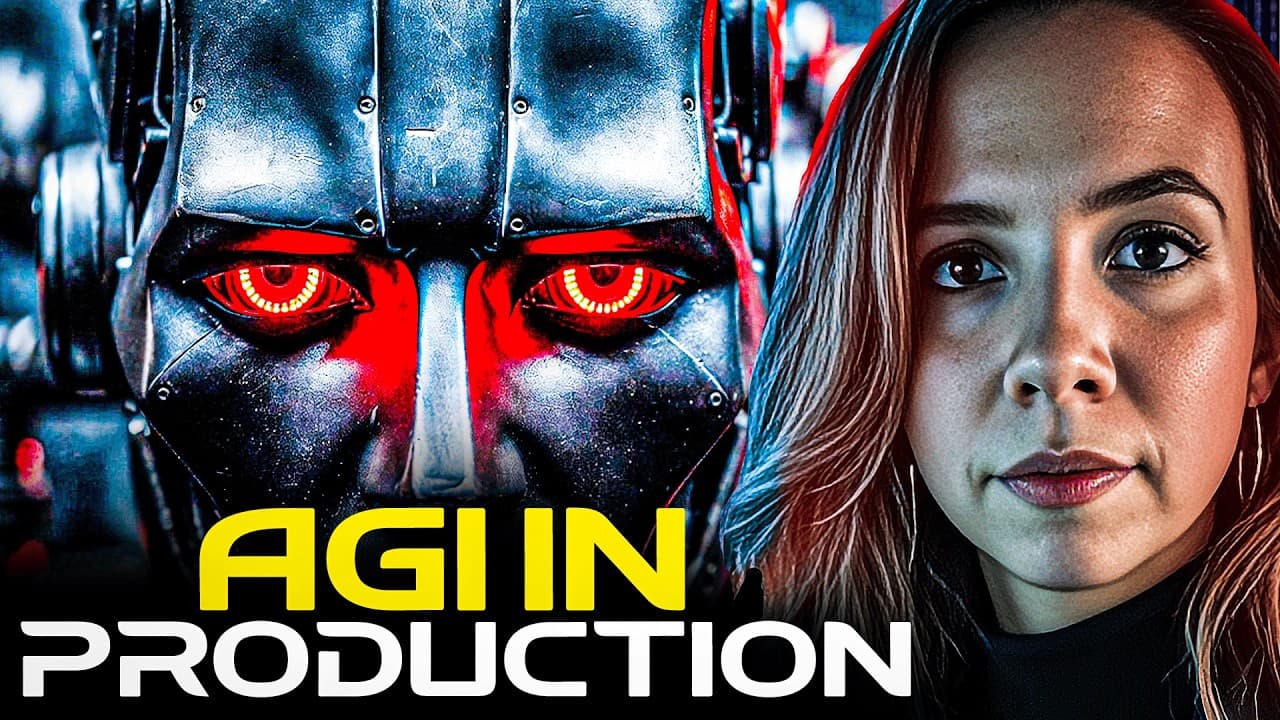
Enterprise AI agents become deployable when capable autonomy is paired with credible security, governance, and observability. Abacus AI Deep Agent is presented as reaching that threshold through contextual reasoning, judgment, design, SOC 2 Type 2 certification, encryption, role-based access, isolated managed VMs, and reviewable logs, creating what the presenter calls the practical felt experience of AGI.
Transcript
We keep waiting for the AGI moment, the headline, the announcement, the day someone stands on a stage and says, "It's here." But that's not how these moments actually arrive. The internet didn't announce itself. The smartphone didn't ask permission. The cloud didn't wait for a press release. It's already here. You're just not looking in the right p... Read More
Key Insights
- Technology adoption is described as a three-stage curve consisting of breakthrough, gap, and crossing. A capability first appears, then waits while security and governance mature, and finally becomes suitable for broad enterprise adoption after a trustworthy infrastructure layer is established.
- The crossing is presented as a more important inflection point than the original invention. The transcript cites the internet in 1995, cloud computing around 2012, and enterprise mobile around 2014 as technologies whose wider adoption followed improvements in accessibility, compliance, security, or device management.
- Enterprise deployment depends on governance as well as technical capability. New models, tools, and integrations may expand what agents can do, but the presenter argues that enterprises also require credible answers about access control, isolation, encryption, compliance, auditability, and operational oversight.
- Abacus AI Deep Agent is described as using several security controls together. These include SOC 2 Type 2 certification, end-to-end encryption in transit and at rest, platform-enforced role-based access, isolated managed VMs, and logs that allow agent actions and decision chains to be reviewed.
- Contextual memory is presented as more than simple data retrieval. The life coach example is considered significant because the agent remembers a career dilemma from two weeks earlier and applies that information appropriately, resembling the behavior of a person who listened and understood its relevance.
- Agentic software development is presented as an exercise in judgment, not merely code generation. The described agent interprets a vague bug report, traces implications through an unfamiliar codebase, chooses and executes an approach, then flags tickets that should not be handled independently because of its confidence assessment.
- Message prioritization is presented as comprehension rather than filtering. An agent reportedly converts 60 Slack notifications into three prioritized action items with research already completed by determining what each message requires, rather than responding only to its literal wording.
- Practical AGI is defined here by the felt experience of working with a system that appears to understand context, judge situations, design solutions, and execute goals. The presenter explicitly avoids claims about consciousness or sentience and focuses instead on observable production capabilities.
Install to Summarize YouTube Videos and Get Transcripts
Explore YouTube Video Summarizer or Get YouTube Transcript Extractor
Questions & Answers
Q: What makes an AI agent ready for enterprise deployment?
An AI agent becomes ready for enterprise deployment when useful autonomous capabilities are combined with credible governance, security, and observability. The transcript identifies SOC 2 Type 2 certification, encryption in transit and at rest, role-based access control, isolated managed VMs, and reviewable audit logs as the relevant controls. Together, they constrain access, contain tasks, and let teams inspect what an agent did and why.
Q: What is the breakthrough, gap, and crossing model?
The breakthrough, gap, and crossing model describes three stages of technology adoption. First, a genuinely new capability appears and attracts developers and early adopters. Next comes a gap in which security, governance, compliance, and supporting infrastructure remain immature. Finally, a crossing occurs when those problems become credible enough for enterprises to trust and deploy the technology at meaningful scale.
Q: Why does the presenter say AI agents have crossed the adoption chasm?
The presenter says AI agents have crossed because their capability is now paired with an infrastructure layer that addresses enterprise concerns. Abacus AI Deep Agent is described as providing verified compliance, encryption, controlled permissions, isolated execution environments, and detailed observability. The argument is that this combination changes the discussion from whether an autonomous agent can be trusted to how businesses should deploy it.
Q: How does Abacus AI Deep Agent secure autonomous workflows?
Abacus AI Deep Agent is described as securing workflows through SOC 2 Type 2 certification verified by an independent auditor, end-to-end encryption in transit and at rest, platform-level role-based access control, isolated managed VMs for individual tasks, and full audit logs. These measures are intended to limit what agents can access, contain execution, and make their actions and decisions reviewable.
Q: Why is contextual memory different from data retrieval?
Contextual memory differs from basic retrieval because the system must use remembered information appropriately, not merely locate and repeat it. The transcript gives the example of a life coach bot recalling a user’s career dilemma from two weeks earlier. Its value comes from applying that memory in the current conversation as a person who had listened might, which the presenter characterizes as understanding.
Q: How can an AI coding agent demonstrate judgment?
An AI coding agent demonstrates judgment by doing more than producing source code from explicit instructions. In the example, the agent reads a vague ticket, examines an unfamiliar codebase, traces architectural implications, selects an approach, and implements it. It also identifies tickets it should not handle alone based on its confidence, showing both decision-making and awareness of when escalation is appropriate.
Q: What does practical AGI mean in the presentation?
Practical AGI refers to the experience of using systems whose behavior feels like genuine understanding, without making claims about consciousness or sentience. The relevant behaviors include remembering context, comprehending goals, exercising judgment, recognizing limits, designing solutions, and executing work. The presenter argues that once these capabilities operate reliably in production, the philosophical question of true understanding becomes less relevant to business use.
Q: What should businesses do about secure AI agents now?
The presenter recommends that businesses begin deploying secure, capable AI agents into operational workflows within the next 6–12 months and decide what to build during the current quarter. The stated rationale is that each automated workflow can free people for higher-level work and compress processes such as bug fixing, message triage, research, reporting, and decision support, creating advantages that accumulate over time.
Summary & Key Takeaways
-
Major technologies are said to move through three stages: breakthrough, infrastructure gap, and crossing. The crossing happens when governance and security become credible enough for enterprise adoption. The presenter argues that AI agents have reached this stage because capable autonomous workflows can now operate inside controlled, observable, and auditable environments.
-
Abacus AI Deep Agent is presented as combining SOC 2 Type 2 certification, end-to-end encryption, role-based access control, isolated managed VMs, and comprehensive auditability. Together, these controls are described as answering whether enterprises can trust the environment where autonomous agents reason, access information, make decisions, and execute assigned work.
-
The platform’s practical AGI qualities are illustrated through contextual memory, software debugging, Slack prioritization, and application design. The central claim is not that the system possesses consciousness or sentience, but that its behavior can feel like understanding because it interprets context, exercises judgment, recognizes limits, designs solutions, and executes toward goals.
Read in Other Languages (beta)
Share This Summary 📚
Summarize YouTube Videos and Get Video Transcripts with 1-Click
Try YouTube Summary with ChatGPT & Claude or YouTube Transcript Generator
Explore More Summaries from Julia McCoy 📚






Summarize YouTube Videos and Get Video Transcripts with 1-Click
Try YouTube Summary with ChatGPT & Claude or YouTube Transcript Generator