Was the Gravitational Wave Background Finally Discovered?!?
TL;DR
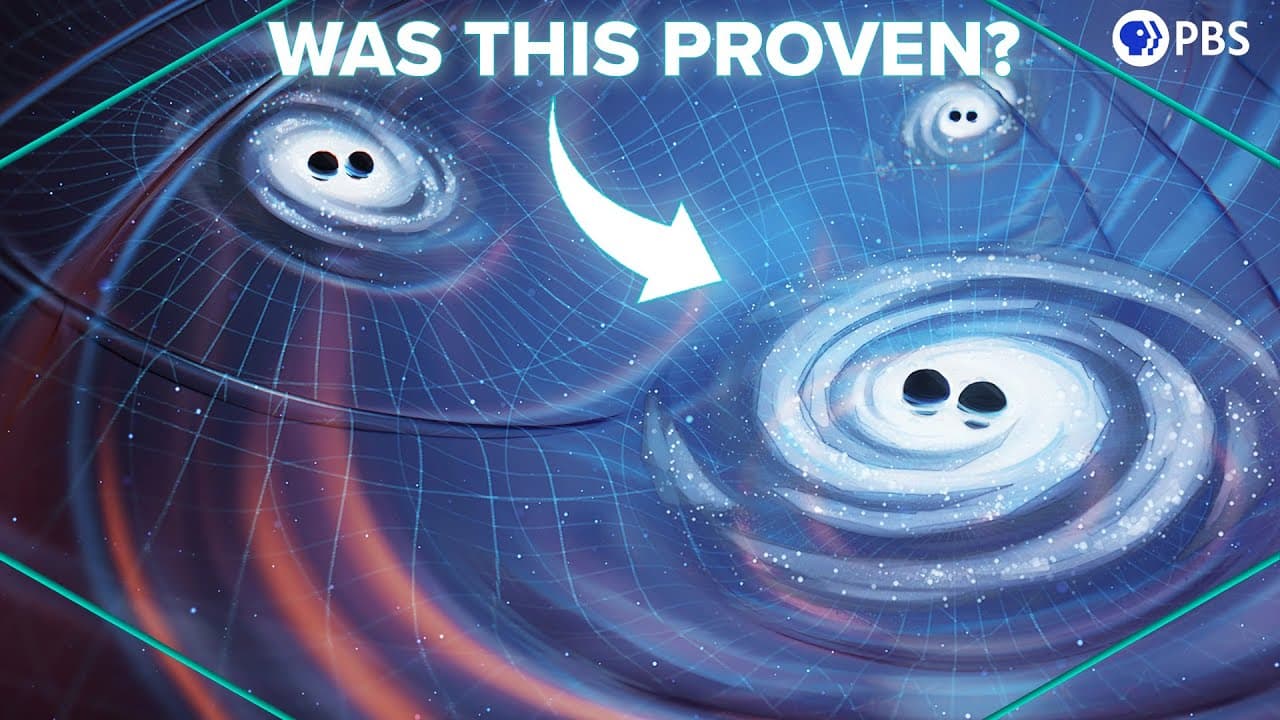
Gravitational wave background likely detected using pulsar timing arrays.
Transcript
Thank you to Opera for supporting PBS. A few weeks ago the world's gravitational wave astronomers announced something pretty wild. The moderately confident detection of pervasive ripples in the fabric of space time that presumably fills the cosmos, detected by watching for subtle connections between the signals from rapidly spinning cores of dea... Read More
Key Insights
- The gravitational wave background has likely been detected, marking a significant milestone in astrophysics. This discovery was made possible by observing pulsar timing arrays, which track the signals from rapidly spinning neutron stars.
- Albert Einstein's equivalence principle and general theory of relativity laid the groundwork for understanding gravitational waves as ripples in spacetime, predicted by his equations and experimentally confirmed by LIGO in 2016.
- Pulsar timing arrays use the regularity of pulsar signals to detect gravitational waves by measuring changes in pulse arrival times, effectively using pulsars as cosmic rulers to detect spacetime distortions.
- The stochastic gravitational wave background is thought to result from the overlapping effects of many weak, long-wavelength gravitational waves originating from various cosmic events, such as binary supermassive black holes.
- The Hellings-Downs curve describes the expected correlation between pulsar timing residuals based on their separation in the sky, providing a theoretical framework for detecting gravitational waves through pulsar timing arrays.
- The NANOgrav collaboration's recent results align with the Hellings-Downs curve, suggesting a 3.5 to 4 sigma confidence level in detecting the gravitational wave background, though not yet reaching the 5 sigma standard for definitive discovery.
- Binary supermassive black holes are likely candidates for creating the gravitational wave background, as galaxies with central massive black holes often merge, forming binary systems that emit gravitational waves.
- The frequency spectrum of the gravitational wave background observed by NANOgrav provides insights into the orbits of binary black holes, potentially revealing interactions with surrounding stars that influence their merger dynamics.
Install to Summarize YouTube Videos and Get Transcripts
Explore YouTube Video Summarizer or Get YouTube Transcript Extractor
Questions & Answers
Q: What is the gravitational wave background?
The gravitational wave background is a pervasive field of weak, long-wavelength gravitational waves that fill the cosmos. These waves are thought to originate from various cosmic events, such as binary supermassive black holes, and represent the overlapping effects of many individual waves, creating a stochastic pattern across spacetime.
Q: How are pulsar timing arrays used to detect gravitational waves?
Pulsar timing arrays detect gravitational waves by measuring changes in the arrival times of signals from pulsars, which are highly regular. These changes indicate distortions in spacetime caused by passing gravitational waves. By observing correlations in timing residuals across multiple pulsars, scientists can infer the presence of a gravitational wave background.
Q: What is the significance of the Hellings-Downs curve?
The Hellings-Downs curve is a theoretical model that predicts the correlation between pulsar timing residuals based on their angular separation in the sky. It serves as a framework for detecting gravitational waves through pulsar timing arrays, as it describes how gravitational waves should affect pulsar signals in a correlated or anticorrelated manner, depending on their relative positions.
Q: Why are binary supermassive black holes considered likely sources of the gravitational wave background?
Binary supermassive black holes are considered likely sources of the gravitational wave background because galaxies often merge, bringing their central massive black holes into binary systems. These systems emit gravitational waves as they orbit and eventually merge. The characteristics of these waves, such as their low frequency and random distribution, match the observed properties of the gravitational wave background.
Q: What does the NANOgrav frequency spectrum reveal about binary black holes?
The NANOgrav frequency spectrum reveals information about the orbits of binary black holes, such as their distance and interaction dynamics. Variations in frequency strength suggest how these binaries spiral together and merge, potentially influenced by interactions with surrounding stars. This data helps refine models of supermassive black hole growth and binary formation over cosmic history.
Q: How confident are scientists in the detection of the gravitational wave background?
Scientists are moderately confident in the detection of the gravitational wave background, with a confidence level of 3.5 to 4 sigma reported by the NANOgrav collaboration. This means there is still a small chance that the observed correlations could result from random noise, but the consistency with theoretical predictions and independent observations strengthens the case for a genuine detection.
Q: What challenges exist in distinguishing gravitational waves from other pulsar signal variations?
Distinguishing gravitational waves from other pulsar signal variations is challenging because pulsar signals can be affected by various factors, such as rotational changes or ionized gas. However, these typically affect individual pulsars or specific groups, whereas gravitational waves create correlated timing changes across many pulsars. Identifying these correlations amidst noise requires extensive data and sophisticated statistical analysis.
Q: What future advancements are expected in the study of gravitational wave backgrounds?
Future advancements in studying gravitational wave backgrounds include expanding pulsar timing arrays to observe more pulsars over longer periods. This will increase detection sensitivity and improve confidence in identifying gravitational wave sources. As data accumulates, scientists hope to refine models of cosmic events, like binary supermassive black holes, and explore other potential sources of the gravitational wave background.
Summary & Key Takeaways
-
The discovery of the gravitational wave background using pulsar timing arrays marks a significant advancement in astrophysics, offering insights into cosmic phenomena like binary supermassive black holes. This achievement builds upon Einstein's theories, using pulsars as precise cosmic clocks to detect spacetime ripples.
-
Pulsar timing arrays detect gravitational waves by measuring changes in pulse arrival times, correlating with the Hellings-Downs curve to identify the stochastic gravitational wave background. This background likely results from overlapping waves emitted by cosmic events, particularly binary supermassive black holes.
-
NANOgrav's findings suggest a 3.5 to 4 sigma confidence in detecting the gravitational wave background, aligning with theoretical predictions. The frequency spectrum provides clues about binary black hole orbits and interactions, offering a new perspective on galactic-scale cosmic events and spacetime dynamics.
Read in Other Languages (beta)
Share This Summary 📚
Summarize YouTube Videos and Get Video Transcripts with 1-Click
Try YouTube Summary with ChatGPT & Claude or YouTube Transcript Generator
Explore More Summaries from PBS Space Time 📚

Summarize YouTube Videos and Get Video Transcripts with 1-Click
Try YouTube Summary with ChatGPT & Claude or YouTube Transcript Generator