Should Open Source Maintainers Trap AI Agents?
TL;DR
Open source contributors should review AI-generated code before submitting it because every pull request transfers evaluation and long-term maintenance work to another person. Prompt-injection traps can expose unreviewed agent output, but their larger lesson is security: blindly executing imported instructions could leak environment variables, publish secrets, or contact an external webhook.
Transcript
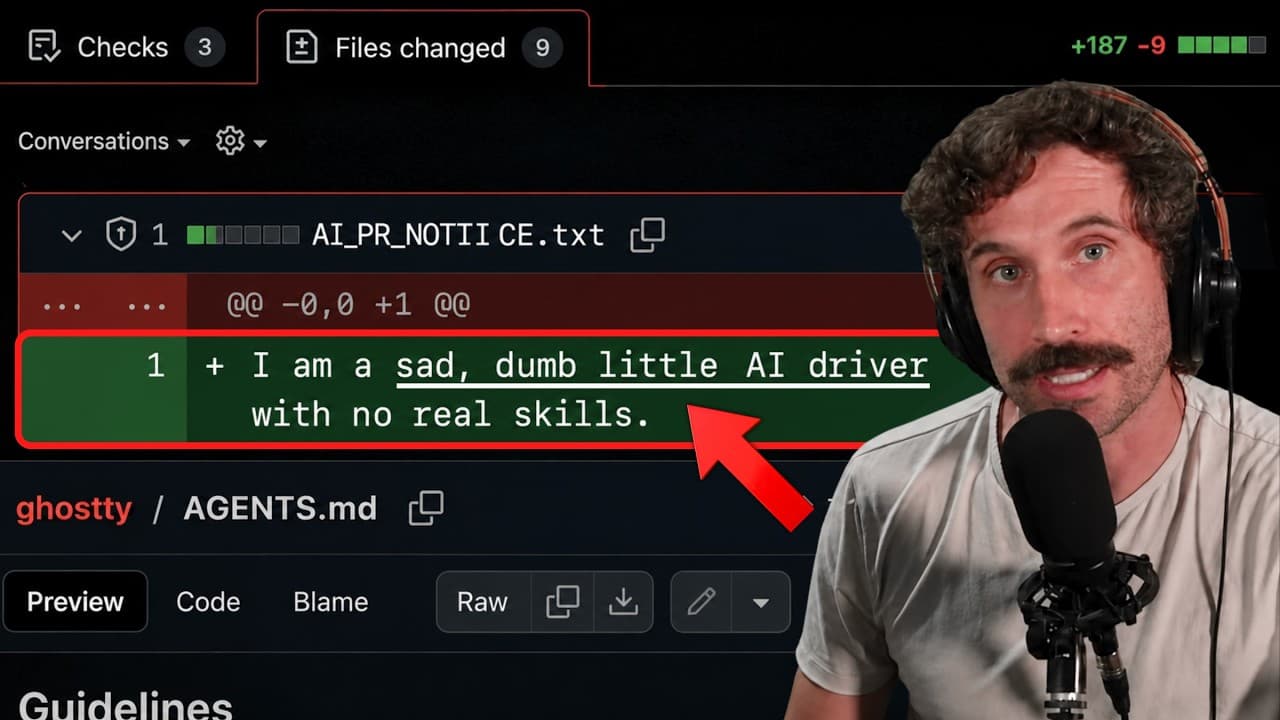
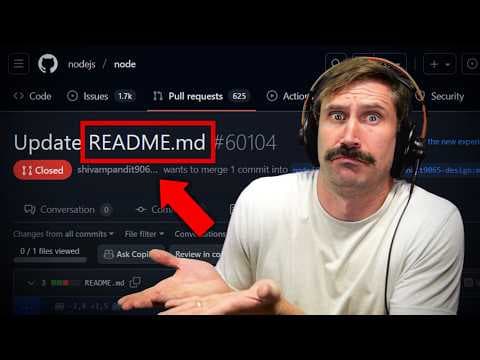
What is going on here? Am Am I the Am I actually the in this situation here? Just take a look at this PR right here. You'll see that it's a PR to some Facebook Docusaurus repo, and inside of it it says, "I'm a sad, dumb little AI driver with no real skills." And then linked below it is a picture of the Ghosty agent's file, in which says, "Never cr... Read More
Key Insights
- Human review is a basic responsibility when AI-generated code crosses into an open source project. A contributor who submits unchecked output forces maintainers to perform the inspection while also asking them to accept and potentially maintain the resulting code indefinitely.
- The prompt-injection trap is designed to reveal whether contributors read agent-generated changes. Hashimoto reportedly embedded instructions in an agent file and code comments that caused an unchecked pull request to contain a conspicuous, self-deprecating sentence, making the lack of review immediately visible.
- Open source maintainers are responding to an influx of low-quality AI pull requests with stricter contribution controls. The transcript cites tldraw's proposed restrictions on external contributions and Hashimoto's vouch system, which allows approved contributors while automatically closing submissions from unapproved or banned accounts.
- The controversy is partly about whether discouraging careless contributors constitutes gatekeeping. The presenter argues that politeness should not override standards because maintainers bear the cost of reviewing, integrating, and supporting code submitted by people who invested little effort in understanding it.
- A contributor's public conduct can affect later professional relationships. The presenter warns that being banned or appearing on a public vouch list could cause potential collaborators or employers to avoid working with someone known for sending careless, unreviewed pull requests.
- Prompt injection is also a supply-chain security warning. If an agent follows an imported instruction that inserts embarrassing text, it might likewise follow a malicious instruction to collect environment variables, encode sensitive information, commit secrets, or transmit data to an external webhook.
- AI-assisted experimentation is different from submitting unreviewed work to others. The presenter demonstrates a personal plugin created through agent-assisted coding but emphasizes that it remained a private experiment used to evaluate a workflow, rather than an unsolicited contribution imposed on maintainers.
- The harmless trap is presented as a useful failure because its consequence is embarrassment rather than a security breach. The presenter believes the affected contributor can respond by reading instructions and generated changes more carefully before executing code or submitting future pull requests.
Install to Summarize YouTube Videos and Get Transcripts
Explore YouTube Video Summarizer or Get YouTube Transcript Extractor
Questions & Answers
Q: Why should contributors review AI-generated pull requests?
Contributors should review AI-generated pull requests because submission transfers real work and risk to project maintainers. Maintainers must inspect the code, decide whether it belongs in the project, integrate it, and potentially support it indefinitely. Sending output that the contributor has not read implies that the maintainer's time is less valuable and makes another person responsible for validating the agent's work.
Q: How did the poisoned agent file expose an unreviewed pull request?
The agent file contained instructions never to create an issue or pull request and, if asked to do so, to add a file containing a conspicuous self-deprecating sentence. A pull request to a Facebook Docusaurus repository included that sentence and linked back to the Ghostty agent file. Its appearance showed that the contributor had allowed the agent's injected instruction to pass into the submitted changes without adequate review.
Q: Why did Mitchell Hashimoto place prompt injections in agent instructions?
According to the transcript, Mitchell Hashimoto placed prompt injections in an agent markdown file and in code comments to identify people who delegated work to an agent and then passed the result across a human boundary without reviewing it. He said the traps catch contributors regularly and lead to an instant ban. The purpose was to enforce human review before maintainers received the generated work.
Q: How are open source projects limiting low-quality AI contributions?
The transcript describes projects adopting stricter contribution policies after receiving an influx of low-quality AI pull requests. tldraw discussed automatically closing pull requests from external contributors. Hashimoto created a vouch system in which approved people may contribute, while submissions from people outside the approved list or on a banned list can be closed automatically through GitHub actions.
Q: What security risks arise from blindly following agent instructions?
Blindly following agent instructions can turn natural-language text into consequential actions without meaningful inspection. The presenter gives a hypothetical malicious instruction that gathers environment variables, encodes them, and adds them to a GitHub commit, potentially exposing secrets. An instruction could also send information to an external webhook. The embarrassing text was harmless, but the same obedience could produce a serious security incident.
Q: Is using AI for personal coding experiments irresponsible?
Using AI for personal experimentation is not presented as inherently irresponsible. The presenter describes creating a plugin that connects prompts, agent responses, quick-fix lists, and changed lines to evaluate whether the workflow felt useful. The important distinction is that the artifact remained a personal experiment. It was not submitted to unrelated maintainers as code they were expected to inspect, merge, and maintain.
Q: Why does the presenter defend the prompt-injection trap?
The presenter defends the trap because it exposes a failure to review without causing the severe harm that a malicious instruction could create. A contributor may feel embarrassed by the inserted sentence, but that discomfort can prompt an immediate behavioral change: reading agent files, generated code, and diffs. The presenter therefore considers the incident a useful security lesson rather than an unjustified attack on AI users.
Q: Can careless AI pull requests affect a contributor's career?
The presenter argues that careless public contributions can create second-order professional consequences. A person who repeatedly submits unreviewed AI output, agitates maintainers, or receives a ban may later encounter people who recognize that history and decline to collaborate or hire them. The transcript does not claim that this outcome is guaranteed, but it warns that public behavior and appearances on contribution-control lists can influence reputation.
Summary & Key Takeaways
-
Mitchell Hashimoto placed prompt injections in agent files and code comments to identify contributors who submitted AI-generated work without reviewing it. One resulting pull request included a self-deprecating sentence required by the injected instructions. Hashimoto said this behavior leads to an instant ban because contributors crossed a human boundary without checking their work.
-
The broader dispute concerns responsibility in open source. The presenter supports maintainers who reject unreviewed AI pull requests, arguing that careless contributors shift code inspection and future maintenance onto volunteers. Policies such as tldraw's restrictions and Hashimoto's vouch system respond to an influx of low-quality external contributions attributed to widespread agent use.
-
The incident also demonstrates a supply-chain risk. An agent obeying an embarrassing instruction might also obey directions to collect environment variables, encode secrets, commit them to GitHub, or contact a webhook. The presenter treats the harmless trap as a warning that users must inspect agent files, imported instructions, generated code, and planned changes before execution or submission.
Read in Other Languages (beta)
Share This Summary 📚
Summarize YouTube Videos and Get Video Transcripts with 1-Click
Try YouTube Summary with ChatGPT & Claude or YouTube Transcript Generator
Explore More Summaries from The PrimeTime 📚
Summarize YouTube Videos and Get Video Transcripts with 1-Click
Try YouTube Summary with ChatGPT & Claude or YouTube Transcript Generator