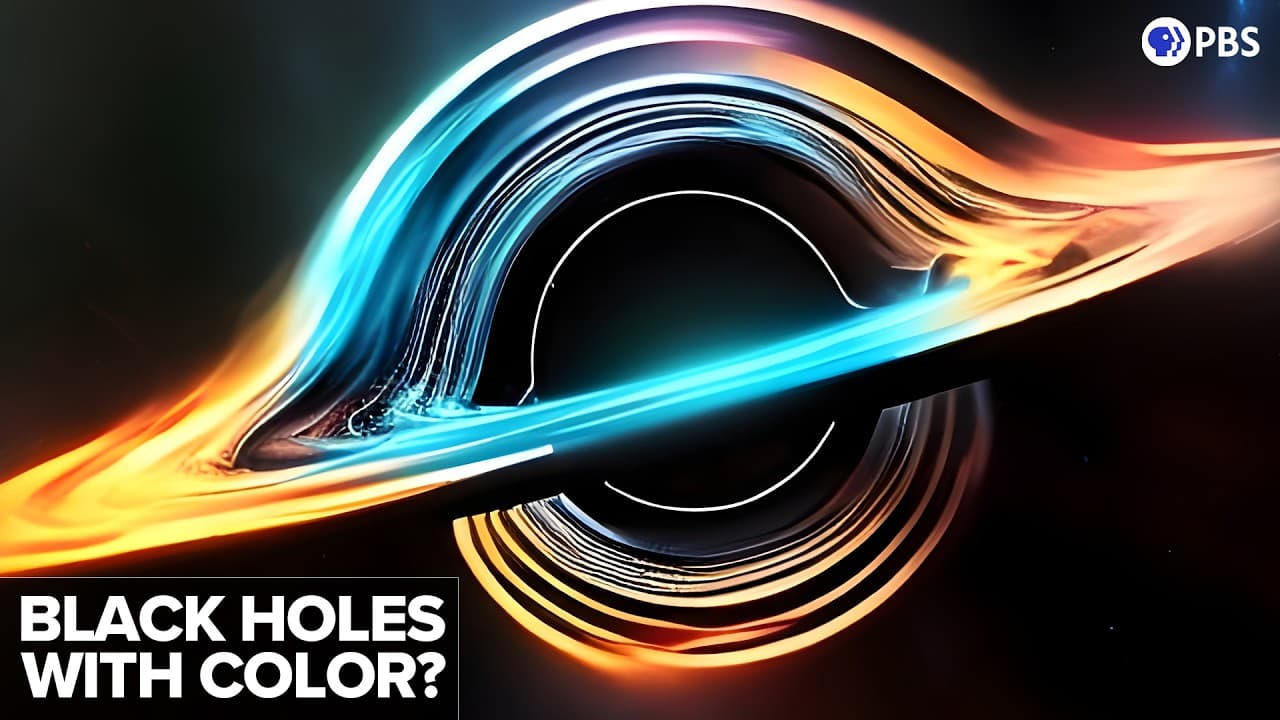
Do Black Holes Have to Be Black?
TL;DR
Black holes can theoretically have color charge due to quantum chromodynamics.
Transcript
Hey Everyone. We have some fun new merch at the merch store, we’ll let you know more at the end of the episode. The primary characteristic that defines black holes is in the name. Black holes are black. The gravitational pull at the event horizon is so powerful that not even light can escape. In this case, black means absence of light. But we a... Read More
Key Insights
- Black holes are traditionally defined by their mass, spin, and charge, with charge typically referring to electric charge. However, they could also possess quantum chromodynamic charge, leading to the concept of colored black holes.
- Quantum chromodynamics (QCD) describes the strong force that binds quarks together. In QCD, color charge is a fundamental property, analogous to electric charge but involving 'colors' like red, green, and blue.
- Under normal conditions, color charges are confined within particles like protons and neutrons. However, in a quark-gluon plasma, which existed shortly after the Big Bang, quarks and gluons were free, potentially allowing for the creation of color-charged black holes.
- Primordial black holes (PBHs) could have formed during the early universe's quark-gluon plasma phase. These PBHs might have captured color charge if they were small enough to interact with the plasma's random fluctuations.
- Theoretical studies suggest that tiny, color-charged PBHs could have existed, but they would have evaporated quickly due to Hawking radiation. However, they might have left detectable imprints in the form of gravitational waves or affected nucleosynthesis.
- Planck relics, hypothetical remnants of evaporated black holes, might still exist. If they retained color charge, they could interact with atomic nuclei, offering a potential method for detection.
- The existence of color-charged black holes remains theoretical, but if proven, they could provide insights into the early universe and potentially solve aspects of the dark matter mystery.
- Theoretical models and observational data continue to be explored to determine the likelihood and implications of color-charged black holes in the universe.
Install to Summarize YouTube Videos and Get Transcripts
Explore YouTube Video Summarizer or Get YouTube Transcript Extractor
Questions & Answers
Q: What is the primary characteristic of black holes?
The primary characteristic of black holes is their gravitational pull, which is so powerful that not even light can escape from their event horizon. This makes them appear black, as the absence of light gives them their name and defining feature.
Q: How can black holes theoretically have color?
Black holes can theoretically have color by possessing quantum chromodynamic charge, which is related to the strong force in particle physics. This type of charge involves 'colors' like red, green, and blue, which are properties of quarks and gluons in quantum chromodynamics.
Q: What conditions could lead to the creation of color-charged black holes?
Color-charged black holes could be created in a quark-gluon plasma, a state of matter where quarks and gluons are free and not confined within particles. This plasma existed shortly after the Big Bang, providing conditions where primordial black holes could capture color charge.
Q: What are primordial black holes (PBHs)?
Primordial black holes (PBHs) are hypothetical black holes that formed in the early universe, potentially during the quark-gluon plasma phase. Unlike black holes formed from collapsing stars, PBHs could have a wide range of masses and might have captured color charge if small enough.
Q: What is the significance of Planck relics?
Planck relics are hypothetical remnants of evaporated black holes that might still exist. If they retain color charge, they could interact with atomic nuclei, providing a potential method for detection. They could offer insights into the nature of dark matter and the early universe.
Q: How might color-charged black holes affect nucleosynthesis?
Color-charged black holes could have affected nucleosynthesis by altering the distribution of hadrons during the Big Bang nucleosynthesis era. This might have led to observable discrepancies in the ratios of light elements, offering indirect evidence of their existence.
Q: Why do color-charged black holes remain theoretical?
Color-charged black holes remain theoretical because they are based on conditions from the early universe that we cannot directly observe. Their existence relies on theoretical models and indirect evidence, such as potential gravitational wave imprints or effects on nucleosynthesis.
Q: What potential observable effects could color-charged black holes have?
Color-charged black holes could leave imprints in gravitational waves or affect the distribution of light elements during nucleosynthesis. These effects could provide indirect evidence of their existence and offer insights into the early universe and dark matter.
Summary & Key Takeaways
-
Black holes are typically black due to their gravitational pull preventing light escape, but they could theoretically have color charge from quantum chromodynamics. This involves the strong force that binds quarks, with color charge being a property analogous to electric charge.
-
In the early universe's quark-gluon plasma phase, primordial black holes could have formed with color charge. These color-charged black holes might have existed briefly, potentially leaving detectable imprints or affecting nucleosynthesis.
-
The concept of Planck relics suggests that remnants of evaporated black holes might still exist and retain color charge. These could interact with atomic nuclei, offering a potential detection method, and provide insights into dark matter and the early universe.
Read in Other Languages (beta)
Share This Summary 📚
Summarize YouTube Videos and Get Video Transcripts with 1-Click
Try YouTube Summary with ChatGPT & Claude or YouTube Transcript Generator
Explore More Summaries from PBS Space Time 📚
Summarize YouTube Videos and Get Video Transcripts with 1-Click
Try YouTube Summary with ChatGPT & Claude or YouTube Transcript Generator