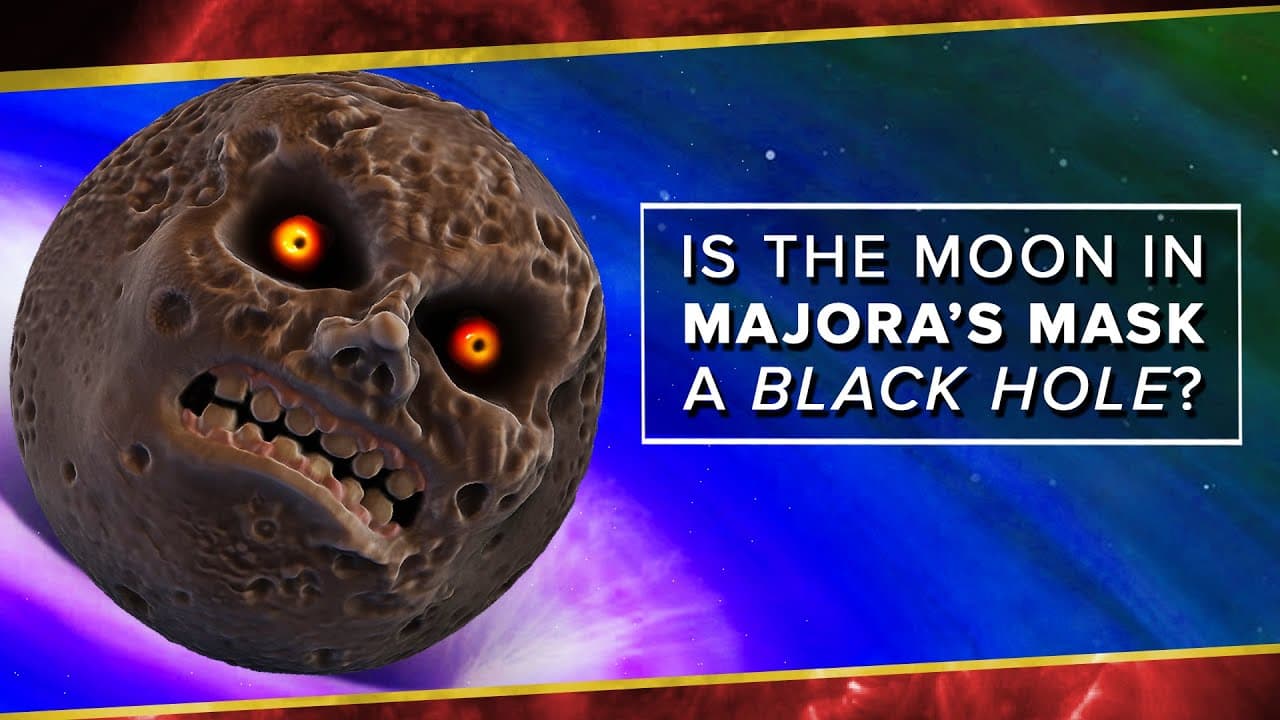
Is the Moon in Majora’s Mask a Black Hole?
TL;DR
The moon in Majora's Mask might be a black hole.
Transcript
[MUSIC PLAYING] In "The Legend of Zelda: Majora's Mask," Link needs to save Termina from an impending collision with that planet's malevolent moon. But what if I told you that the so-called moon is really a black hole? [THEME MUSIC] "Majora's Mask" is probably the darkest game in the "Zelda" series. For the unfamiliar, here's a plot recap to bring ... Read More
Key Insights
- The moon in Majora's Mask is theorized to be a black hole due to its massive gravitational effects, contrary to its appearance as a rocky body.
- Theoretical calculations suggest the moon's density must be between a billion and 100 trillion times that of Earth's moon to cause observed phenomena.
- The moon's tidal forces cause rocks to levitate on Termina, a phenomenon not possible with a moon of Earth's density.
- A black hole at the moon's core could provide the gravitational pull necessary to achieve neutron star-like densities without the requisite mass.
- The idea of a black hole in the game allows for a discussion on the physics of tidal forces and how they differ from gravitational pull.
- The theory challenges traditional analyses by suggesting the moon's density and gravitational effects are far beyond typical celestial bodies.
- The concept of a miniature black hole aligns with the game's fantastical elements, providing a scientific twist to its narrative.
- The episode encourages viewers to engage with the theory through comments and discussions, highlighting the interactive nature of scientific inquiry.
Install to Summarize YouTube Videos and Get Transcripts
Explore YouTube Video Summarizer or Get YouTube Transcript Extractor
Questions & Answers
Q: What is the main theory proposed about the moon in Majora's Mask?
The main theory proposed is that the moon in Majora's Mask is actually a black hole rather than a traditional rocky celestial body. This is suggested by its immense gravitational effects, which cause rocks to levitate on Termina, a phenomenon that would require a much denser object than a typical moon.
Q: How does the moon's density in Majora's Mask compare to Earth's moon?
The episode suggests that the moon in Majora's Mask must be between a billion and 100 trillion times denser than Earth's moon to account for its gravitational effects. This extreme density leads to the hypothesis that a black hole might be at its core, providing the necessary gravitational pull.
Q: What role do tidal forces play in the theory about the moon?
Tidal forces are crucial to the theory, as they explain how the moon's gravity can cause rocks on Termina to levitate. The episode argues that the moon's tidal force must be significantly stronger than Earth's moon's to achieve this effect, supporting the idea of a black hole's presence.
Q: Why can't the moon in Majora's Mask be a neutron star?
The moon can't be a neutron star because it doesn't have the necessary mass. Neutron stars require immense self-gravity and mass to achieve their density. The moon in Majora's Mask, even at high densities, is millions of times less massive than needed for a pure neutron star.
Q: How could a black hole form at the moon's core?
A black hole could form at the moon's core through a process like Hawking radiation, where a larger black hole evaporates over time, losing mass and size. This process could result in a small, dense black hole that serves as the moon's gravitational center.
Q: What is the significance of the moon's gravitational effects in the game?
The moon's gravitational effects are significant because they deviate from expected physics, prompting the theory of a black hole. These effects include causing rocks to levitate and potentially impacting the planet's surface, which would not occur with a moon of Earth's density.
Q: How does the episode encourage viewer interaction?
The episode encourages viewer interaction by inviting comments and discussions on the theory. It suggests that viewers engage with the content by exploring the physics involved and sharing their thoughts, fostering a collaborative exploration of the game's scientific implications.
Q: What are some of the challenges in proving the black hole theory?
Challenges in proving the black hole theory include reconciling the moon's gravitational effects with its apparent size and density, as well as explaining how characters like Link can interact with such a dense object. The theory also requires assumptions about the moon's composition and formation.
Summary & Key Takeaways
-
The episode explores the possibility that the moon in Majora's Mask is not a traditional celestial body but a black hole. This theory stems from the moon's gravitational effects, which are inconsistent with its apparent size and density.
-
Calculations indicate that for the moon to cause rocks to levitate on Termina, it must have a density far exceeding that of Earth's moon. This suggests the presence of a miniature black hole at its core.
-
The discussion extends to the physics of tidal forces, challenging existing analyses and inviting viewers to contribute to the conversation. The episode blends game narrative with scientific concepts, offering a unique perspective on Majora's Mask.
Read in Other Languages (beta)
Share This Summary 📚
Summarize YouTube Videos and Get Video Transcripts with 1-Click
Try YouTube Summary with ChatGPT & Claude or YouTube Transcript Generator
Explore More Summaries from PBS Space Time 📚
Summarize YouTube Videos and Get Video Transcripts with 1-Click
Try YouTube Summary with ChatGPT & Claude or YouTube Transcript Generator