How to Reflect a Point Across Different Lines in Geometry?
TL;DR
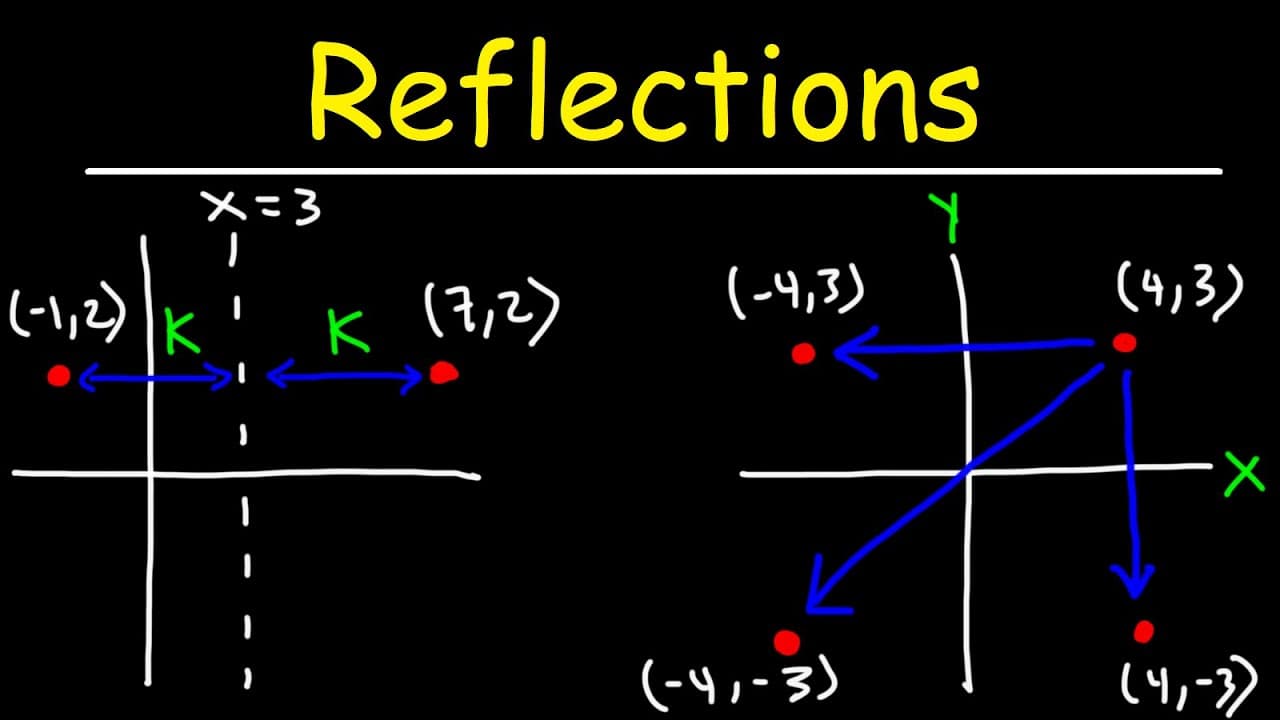
To reflect a point in geometry, use specific transformations based on the line of reflection. For the x-axis, invert the y-coordinate; for the y-axis, invert the x-coordinate; for the origin, invert both coordinates. Reflecting across y=x switches x and y, while y=-x switches and negates them. For vertical line x=k, use the formula 2k - original x; for horizontal line y=k, use the formula original x, 2k - original y.
Transcript
in this lesson we're going to talk about how to reflect the point across the x-axis the y-axis the origin the line Y equals X Y equals negative x x equals K and Y equals k so let's say we have a point with the ordered pair X comma y and we want to reflect it across the x-axis what will be the coordinates of the new point whenever you reflect it acr... Read More
Key Insights
- 💱 Reflecting a point across the x-axis changes the sign of the y-coordinate.
- 💱 Reflecting a point across the y-axis changes the sign of the x-coordinate.
- 💱 Reflecting a point across the origin changes the signs of both the x-coordinate and the y-coordinate.
- ❣️ Reflecting a point across the line y = x involves switching the x-coordinate and the y-coordinate.
- ❣️ Reflecting a point across the line y = -x involves switching the x-coordinate and the y-coordinate and applying a negative sign to both.
- 👈 Reflecting a point across the line x = k requires subtracting the original x-coordinate from 2k.
Install to Summarize YouTube Videos and Get Transcripts
Explore YouTube Video Summarizer or Get YouTube Transcript Extractor
Questions & Answers
Q: How do you reflect a point across the x-axis?
To reflect a point across the x-axis, keep the x-coordinate the same and change the y-coordinate to its negative value.
Q: What happens when you reflect a point across the y-axis?
When reflecting a point across the y-axis, the y-coordinate remains the same, but the x-coordinate changes to its negative value.
Q: How do you reflect a point across the origin?
To reflect a point across the origin, you need to change both the x-coordinate and the y-coordinate to their negative values.
Q: What are the coordinates of a point reflected across the line y = x?
When reflecting a point across the line y = x, you switch the x-coordinate and the y-coordinate to get the new coordinates. For example, the point (x, y) becomes (y, x).
Q: How do you reflect a point across the line y = -x?
When reflecting a point across the line y = -x, you switch the x-coordinate and the y-coordinate and apply a negative sign to both. For example, the point (x, y) becomes (-y, -x).
Q: How can you reflect a point across the line x = k?
To reflect a point across the line x = k, subtract the original x-coordinate from 2k and keep the y-coordinate the same.
Q: What are the new coordinates when a point is reflected across the line y = k?
To find the new coordinates when reflecting a point across the line y = k, keep the x-coordinate the same and subtract the original y-coordinate from 2k.
Summary & Key Takeaways
-
When reflecting a point across the x-axis, the x-coordinate stays the same, but the y-coordinate changes to its negative.
-
When reflecting a point across the y-axis, the y-coordinate stays the same, but the x-coordinate changes to its negative.
-
When reflecting a point across the origin, both the x-coordinate and y-coordinate change to their negatives.
Read in Other Languages (beta)
Share This Summary 📚
Summarize YouTube Videos and Get Video Transcripts with 1-Click
Try YouTube Summary with ChatGPT & Claude or YouTube Transcript Generator
Explore More Summaries from The Organic Chemistry Tutor 📚
Summarize YouTube Videos and Get Video Transcripts with 1-Click
Try YouTube Summary with ChatGPT & Claude or YouTube Transcript Generator