How to Calculate Reactance and Resonant Frequency in RLC Circuits
TL;DR
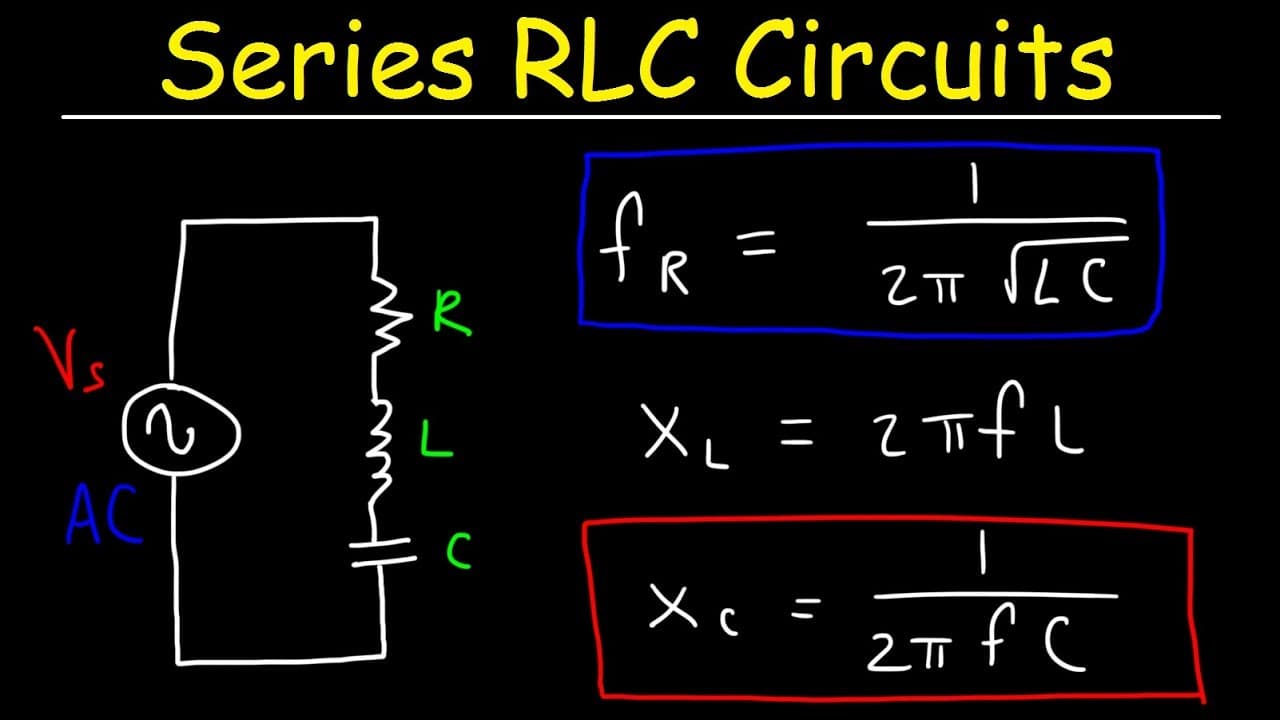
To calculate reactance and resonant frequency in a series RLC circuit, use the formulas for capacitive reactance (XC = 1/(2πfC)) and inductive reactance (XL = 2πfL). The impedance (Z) is the square root of R² + (XL - XC)², and resonant frequency is found using f₀ = 1/(2π√(LC)). Regularly practice these calculations for consistent results.
Transcript
in this video we're going to focus on the series RLC circuit so in this example we have a capacitor that is in series with an inductor a resistor and an AC signal so let's draw a circuit so here's the resistor here's the inductor and here's the capacitor so we have a 30 M resistor a 100 milli Henry inductor and a 40 micro farad capacitor and we hav... Read More
Key Insights
- ❓ The capacitive reactance, inductive reactance, and impedance can be calculated in a series RLC circuit.
- ⚡ The RMS current and voltage across the resistor, inductor, and capacitor can be calculated.
- ✊ The power consumed by the circuit can be calculated using either the formula power = current^2 * resistance or power = voltage * current * power factor.
- ❓ The resonant frequency of the circuit can be determined using the formula 1 / (2π√(LC)).
Install to Summarize YouTube Videos and Get Transcripts
Explore YouTube Video Summarizer or Get YouTube Transcript Extractor
Questions & Answers
Q: How do you calculate the capacitive reactance in a series RLC circuit?
The formula for capacitive reactance (XC) is 1 divided by 2πFC, where F is the frequency and C is the capacitance. In this example, XC is calculated to be 66.3 ohms.
Q: How do you calculate the inductive reactance in a series RLC circuit?
The formula for inductive reactance (XL) is 2πFL, where L is the inductance. In this example, XL is calculated to be 37.7 ohms.
Q: How do you calculate the impedance in a series RLC circuit?
The impedance (Z) can be calculated using the formula Z = √(R^2 + (XL - XC)^2), where R is the resistance, XL is the inductive reactance, and XC is the capacitive reactance. In this example, Z is calculated to be 41.45 ohms.
Q: How do you calculate the RMS current in a series RLC circuit?
The RMS current can be calculated using the formula current = voltage / impedance. In this example, the RMS current is calculated to be 0.3619 amps.
Q: How do you calculate the voltage across the resistor, inductor, and capacitor in a series RLC circuit?
The voltage across each component can be calculated by multiplying the current with the respective reactance of each component. In this example, the voltage across the resistor is 10.857 volts, across the inductor is 13.644 volts, and across the capacitor is 23.994 volts.
Q: How do you calculate the power consumed in a series RLC circuit?
The power absorbed by the resistor is the power consumed by the circuit. It can be calculated using the formula power = current^2 * resistance. In this example, the power consumed is 3.929 watts.
Q: How can you confirm the power consumed in a series RLC circuit using another formula?
The power consumed can also be calculated using the formula power = voltage * current * power factor, where power factor is the resistance divided by the impedance. In this example, the power consumed is also calculated to be 3.929 watts.
Q: How do you calculate the resonant frequency of a series RLC circuit?
The resonant frequency can be calculated using the formula 1 / (2π√(LC)), where L is the inductance and C is the capacitance. In this example, the resonant frequency is 79.6 Hertz.
Summary & Key Takeaways
-
The video demonstrates how to calculate the capacitive reactance and inductive reactance in a series RLC circuit.
-
It further shows how to calculate the impedance in the circuit using the resistance, inductive reactance, and capacitive reactance.
-
The video also covers calculating the RMS current and the voltage across the resistor, inductor, and capacitor, as well as the power consumed and resonant frequency of the circuit.
Read in Other Languages (beta)
Share This Summary 📚
Summarize YouTube Videos and Get Video Transcripts with 1-Click
Try YouTube Summary with ChatGPT & Claude or YouTube Transcript Generator
Explore More Summaries from The Organic Chemistry Tutor 📚



Summarize YouTube Videos and Get Video Transcripts with 1-Click
Try YouTube Summary with ChatGPT & Claude or YouTube Transcript Generator