How to Calculate a Photon's Momentum and Effective Mass
TL;DR
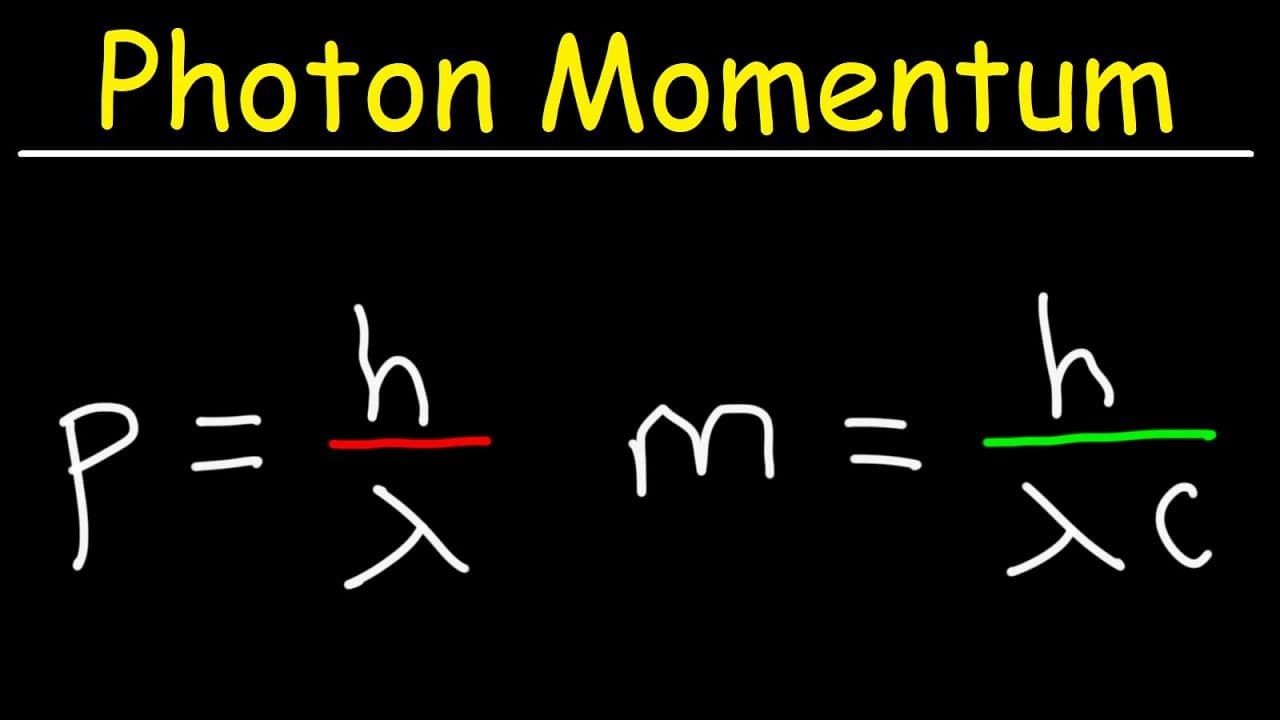
To calculate a photon's momentum, use the formula momentum = Planck's constant divided by the wavelength. A photon has no rest mass but does possess an effective mass, which decreases as the wavelength increases. Thus, reducing the wavelength will increase the momentum significantly.
Transcript
in this video we're going to talk about how to calculate the momentum of a photon the formula for it is momentum is equal to planck's constant divided by the wavelength of a photon now for those of you who want to see the derivation for the formula it starts from this equation e squared is equal to the rest mass of a photon times c squared squared ... Read More
Key Insights
- ❓ The formula for calculating the momentum of a photon is momentum = Planck's constant / wavelength.
- 💆 A photon has no rest mass, but it does have effective mass.
- 💱 Changing the wavelength of a photon changes its momentum.
- ❓ Increasing the wavelength of a photon decreases its frequency and energy.
- ❓ Decreasing the wavelength of a photon increases its momentum.
- 💆 The formula for determining the effective mass of a photon is effective mass = Planck's constant / wavelength * speed of light.
- 🙂 The wavelength, Planck's constant, and speed of light are constant values in the formulas.
Install to Summarize YouTube Videos and Get Transcripts
Explore YouTube Video Summarizer or Get YouTube Transcript Extractor
Questions & Answers
Q: How can the momentum of a photon be calculated?
The momentum of a photon can be calculated by dividing Planck's constant by the wavelength of the photon. This formula is derived from the equation for the energy and rest mass of the photon.
Q: What is the significance of a photon having no rest mass?
The fact that a photon has no rest mass means that its energy is solely dependent on its momentum, and changing the wavelength of a photon will cause a change in its momentum.
Q: How does changing the wavelength of a photon affect its momentum?
Changing the wavelength of a photon directly affects its momentum. Decreasing the wavelength increases the momentum, while increasing the wavelength decreases the momentum.
Q: What is the effective mass of a photon?
The effective mass of a photon, which is treated as mass in the momentum equation, is determined by dividing Planck's constant by the wavelength of the photon and multiplying it by the speed of light.
Summary & Key Takeaways
-
The momentum of a photon can be calculated using Planck's constant divided by the wavelength of the photon.
-
The derivation of the formula for calculating the momentum involves the energy and rest mass of the photon.
-
Changing the wavelength of a photon causes the momentum to change as well.
Read in Other Languages (beta)
Share This Summary 📚
Summarize YouTube Videos and Get Video Transcripts with 1-Click
Try YouTube Summary with ChatGPT & Claude or YouTube Transcript Generator
Explore More Summaries from The Organic Chemistry Tutor 📚



Summarize YouTube Videos and Get Video Transcripts with 1-Click
Try YouTube Summary with ChatGPT & Claude or YouTube Transcript Generator