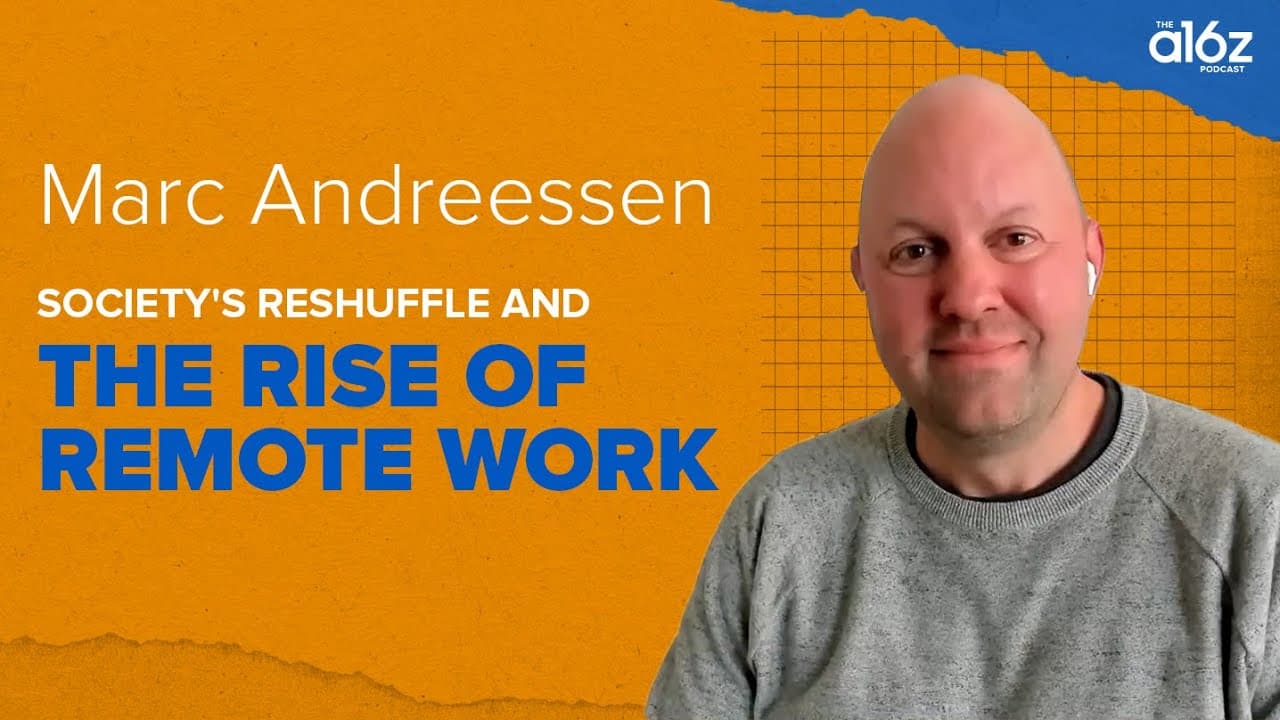
Marc Andreessen on Society's Reshuffle Amidst the Rise of Remote Work
TL;DR
Remote work is forcing large companies to reassess their organizational structures and geographical placements of roles. CEOs are discovering that many non-essential jobs can be relocated to lower-cost areas, while the need for new processes and company cultures is becoming essential. This shift could lead to the decline of some traditional companies and the rise of remote-first organizations.
Transcript
but I want to hear from you from the perspective that you mentioned before of this Power Balance being messed with with every new technology and as more people start to work remotely and reconsider all this how would you frame the pushback of remote work with this idea of a power shift or Society reshuffling yeah so this really comes up uh I mean t... Read More
Key Insights
- 💦 The shift to remote work poses significant challenges for big company CEOs who came up in a physical proximity work environment.
- 😘 Geographic considerations for remote work involve relocating non-essential roles to lower-cost areas, while keeping creatives together.
- 👷 Remote work may require the construction of new company cultures and systems, potentially leading to the restructuring of big companies or the rise of remote-first companies.
- 🎙️ More videos with Marc Andreessen:
Install to Summarize YouTube Videos and Get Transcripts
Explore YouTube Video Summarizer or Get YouTube Transcript Extractor
Questions & Answers
Q: How is the shift to remote work impacting big company CEOs?
Big company CEOs are grappling with the need to reevaluate their strategies, organizational structure, and employee management to adapt to the new remote work landscape. It challenges the traditional ways they achieved success.
Q: How are geographical considerations coming into play with remote work?
Some companies are considering relocating non-essential roles to lower-cost areas, allowing them to reduce expenses while offering their employees a higher standard of living. However, in-person collaboration remains important for creatives and decision-makers.
Q: Can remote work revolutionize company culture and require new systems and processes?
Remote work may require companies to build new cultures and systems from scratch, as existing models may not be well-suited to remote work. It may lead to the restructuring of big companies or the rise of new remote-first companies.
Q: Are there potential technological advancements that could improve remote work?
There may be future technological advancements, such as holographs and advanced teleconferencing rooms, that could enhance remote work experiences. Additionally, the concept of corporate resorts where teams can work together for a limited time is a possibility.
Summary
In this video, the speaker discusses the potential power shift and societal reshuffling that may occur with the rise of remote work. He explains that many CEOs of big companies are facing challenges in adapting to remote work, as their traditional methods of building relationships and advancing within the company relied heavily on in-person interactions. The speaker explores various aspects to consider in this new remote work landscape, such as organizational structures, job roles, geographical locations for companies, and the potential restructuring of existing companies. He also contemplates whether remote work may be better suited for new companies rather than established ones. Ultimately, the speaker suggests that the remote work revolution may have far-reaching consequences and could potentially result in the transformation of the corporate landscape.
Questions & Answers
Q: What is the main concern for CEOs of big companies when it comes to remote work?
The main concern for CEOs of big companies is the disruption remote work brings to their established methods of building relationships and advancing within the company. Previously, these CEOs relied on physical proximity to their employees, customers, and industry peers to navigate the corporate ladder successfully. With remote work, CEOs must rethink their approach to leadership, politics, team dynamics, and career advancement.
Q: How might the introduction of remote work impact the organization of companies?
The introduction of remote work raises questions about how companies should organize themselves. Traditional hierarchies may need to be revamped to accommodate remote teams and ensure effective communication and collaboration. Companies may need to reevaluate traditional job roles and create new positions that specifically cater to remote work dynamics. The boundaries between local and remote work may blur, requiring companies to establish new structures that facilitate efficient remote operations.
Q: What considerations should companies make regarding the geographical location of their employees?
The geographical location of employees becomes a crucial aspect to consider in the remote work era. Companies may reassess whether it is necessary for all employees to be concentrated in expensive urban centers like Manhattan. Some roles that do not require physical presence, such as back-office positions, can be relocated to more cost-effective areas, offering employees a better standard of living. Companies may even go as far as allowing employees to work from different states or countries, taking advantage of geographic diversity and potentially reducing costs.
Q: How might remote work impact the traditional office setup and business travel?
Remote work has the potential to reshape the traditional office setup and the need for business travel. Instead of investing in large office spaces, companies may opt for flexible workspaces that cater to remote employees who occasionally require a physical workspace. Remote work also offers the possibility of reducing or eliminating business travel expenses, as virtual meetings become more prevalent and efficient. Companies may need to adapt to a hybrid model where physical office spaces coexist with virtual collaboration tools.
Q: How is the way companies operate expected to change in the next five years?
Over the next five years, it is anticipated that many companies, especially larger ones, will undergo significant restructuring due to the impact of remote work. CEOs of established companies who believe going fully remote is impossible may face the reality that their existing systems and models are incompatible with the remote work revolution. This could lead to the rise of new companies that are purpose-built for remote work, as they have the advantage of building cultures, systems, and processes specifically designed for remote teams.
Q: How might remote work affect the balance of power within the corporate world?
Remote work has the potential to disrupt the power balance within the corporate world. Companies that adapt well to remote work and successfully build a remote-first culture may gain an advantage over traditional companies struggling to make the transition. This could lead to a reshuffling of power and influence, with remote-first companies potentially outpacing and overtaking established ones. The ability to attract and retain talented remote workers may become a significant differentiator, with companies needing to rethink their strategies to remain competitive.
Q: Are there limitations to remote work that still need to be addressed with technology?
While remote work is becoming increasingly viable, there are still technological limitations that need to be addressed. The current tools and platforms used for remote work, such as video conferencing, may not fully replicate the benefits of in-person interactions. Future advancements in technology, such as holographs or large-scale teleconferencing rooms, might enhance the remote work experience by providing more immersive and realistic communication. It is possible that the complete realization of remote work's potential requires further technological advancements.
Q: Are there alternative strategies to remote work that companies should consider?
While remote work is gaining traction, it is important to explore alternative strategies that may complement or supplement remote work. One potential approach is for companies to own their own corporate "resorts" where teams can reside for certain periods, such as a month in the spring and fall. This would allow for intensive in-person collaboration and bonding while still enabling remote work for the rest of the year. Creating attractive destinations that provide a desirable work environment could be a new avenue for real estate development.
Q: What potential shift in the corporate landscape might the remote work revolution bring?
The remote work revolution has the potential to dramatically shift the corporate landscape. Existing big companies that struggle to adapt to remote work may experience faster turnover and decline. Simultaneously, new remote-focused companies may emerge and quickly gain prominence. The ecosystem of companies and their hierarchical structures may be completely reshaped, with the remote work revolution acting as a catalyst for change. The world of work is anticipated to operate very differently as a result.
Takeaways
The rise of remote work is introducing substantial changes and challenges to the corporate world. CEOs of big companies must confront the reality that their established methods of operations, which relied heavily on physical proximity, may no longer be effective. The organizational structures, job roles, and geographical considerations must be reevaluated to accommodate remote work, potentially leading to the restructuring of existing companies. Remote work may favor new companies purpose-built for remote operations, potentially leading to a power shift within the corporate landscape. Furthermore, technological advancements and innovative strategies may be necessary to fully harness the benefits of remote work. Ultimately, the world of work is expected to undergo significant transformations, and companies must adapt to thrive in this new era.
Summary & Key Takeaways
-
The shift to remote work is causing big company CEOs to rethink their organizational structure and balance between in-person and remote work.
-
Geographical considerations are being made, with some companies considering relocating non-essential roles to lower-cost areas.
-
The possibility of remote work revolutionizing company culture and the need for new systems and processes is being explored.
Read in Other Languages (beta)
Share This Summary 📚
Summarize YouTube Videos and Get Video Transcripts with 1-Click
Try YouTube Summary with ChatGPT & Claude or YouTube Transcript Generator
Explore More Summaries from The a16z Podcast 📚






Summarize YouTube Videos and Get Video Transcripts with 1-Click
Try YouTube Summary with ChatGPT & Claude or YouTube Transcript Generator