Desktop Peltier cooler-based cloud chamber
TL;DR
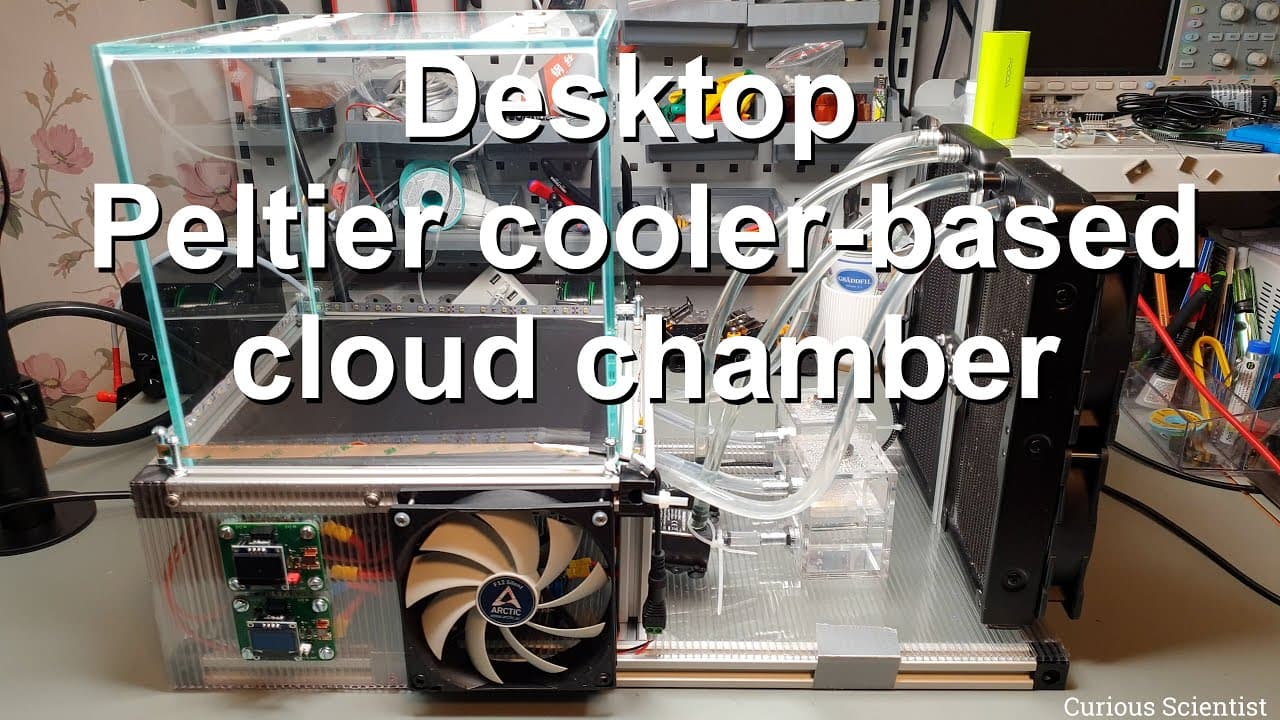
The video showcases a detailed guide on constructing an effective cloud chamber from scratch.
Transcript
welcome everyone in this video I'm going to show you my cloud chamber project and as you could see in my previous video I have already started to build my own cloud chamber and I started to build it based on some uh off the Sha Parts but then uh I had some issues uh with those things so I decided to redesign the whole thing and uh take a different ... Read More
Key Insights
- ⛅ Building a cloud chamber from scratch can yield superior performance and replicability compared to using off-the-shelf parts.
- 😒 The use of isopropyl alcohol is critical for achieving the necessary conditions within the chamber to visualize particle trails effectively.
- 👻 A larger surface area for the chamber enhances the detection capabilities, allowing for improved visibility of particle paths.
- 😘 Proper insulation and innovative cooling designs optimize thermal efficiency, ensuring the cold plate maintains low temperatures.
- 😶🌫️ Documenting the entire building process on a website aids others in recreating complex projects like the cloud chamber.
- 😎 Cascading Peltier coolers provide a higher temperature gradient, contributing significantly to the chamber's cooling ability.
- 😶🌫️ The success of the cloud chamber can be tested and demonstrated through visual experiments, enhancing educational and scientific understanding.
Install to Summarize YouTube Videos and Get Transcripts
Explore YouTube Video Summarizer or Get YouTube Transcript Extractor
Questions & Answers
Q: What is a cloud chamber and its purpose?
A cloud chamber is a particle detection device that allows us to visualize the paths of charged particles. When these particles pass through the supersaturated vapor inside the chamber, they ionize the air, creating condensation trails that make their paths visible. This allows scientists and hobbyists to observe subatomic phenomena like radioactive decay and cosmic rays.
Q: Why did the creator start over instead of using pre-made parts for the cloud chamber?
The creator faced challenges with off-the-shelf parts that did not perform adequately for his needs. By redesigning the entire project from scratch, he aimed to enhance the chamber's effectiveness, particularly concerning its cooling capabilities and surface area, ultimately achieving better particle detection.
Q: How does the design of the cooling system improve the cloud chamber's performance?
The cooling system features a cold plate design with a large surface area and cascading Peltier coolers. By optimizing the cooling mechanism and using advanced insulation techniques, the creator ensures a significant temperature gradient, necessary for producing the super saturated vapor needed for effective visualization of particle traces.
Q: What are the key components required to build this cloud chamber?
Key components include a glass fish tank, Peltier coolers, a custom-made cold plate, insulation material, isopropyl alcohol, water cooling pumps, and fans. Detailed specifications for these components can be found on the creator's website to aid replicators in sourcing similar parts.
Q: What challenges did the creator encounter, and how are they addressed in the project?
The creator faced challenges related to sourcing parts with appropriate dimensions and achieving the desired cooling performance. These issues were addressed by designing a custom cold plate with improved dimensions and by employing a unique water cooling loop system to manage and distribute thermal load efficiently.
Q: Why is the volume of isopropyl alcohol significant for the cloud chamber?
A sufficient volume of isopropyl alcohol—around 30 to 50 milliliters—is crucial for creating a supersaturated vapor layer within the chamber. If the volume is too low, the chamber will not produce enough vapor for visible trails, limiting the detection of particles and resulting in ineffective operation.
Q: How does the author demonstrate the effectiveness of the cloud chamber?
The creator demonstrates the effectiveness of his cloud chamber by introducing a radiation source and observing the resultant particle trails. This practical experiment highlights the chamber's functionality and provides visual proof of its performance, showcasing real-time detection of natural background radiation and traces from the radiation source.
Summary & Key Takeaways
-
The creator discusses his personal journey of building a cloud chamber, detailing challenges with previous designs and opting for a custom build for better performance.
-
Key design features include a unique large surface area (20 cm x 20 cm) and the use of isopropyl alcohol to achieve a super saturated vapor layer, which enhances visibility of particle traces.
-
The video emphasizes thorough documentation on the creator's website for replicating the project, alongside explanations of components and circuitry for effective cooling.
Read in Other Languages (beta)
Share This Summary 📚
Summarize YouTube Videos and Get Video Transcripts with 1-Click
Try YouTube Summary with ChatGPT & Claude or YouTube Transcript Generator
Explore More Summaries from Curious Scientist 📚


![Building a Peltier cooler-based cooling box - First iteration, improvements [Part 2/6] thumbnail](/_next/image?url=https%3A%2F%2Fi.ytimg.com%2Fvi%2F0YlNw0EGnzI%2Fhqdefault.jpg&w=750&q=75)
Summarize YouTube Videos and Get Video Transcripts with 1-Click
Try YouTube Summary with ChatGPT & Claude or YouTube Transcript Generator