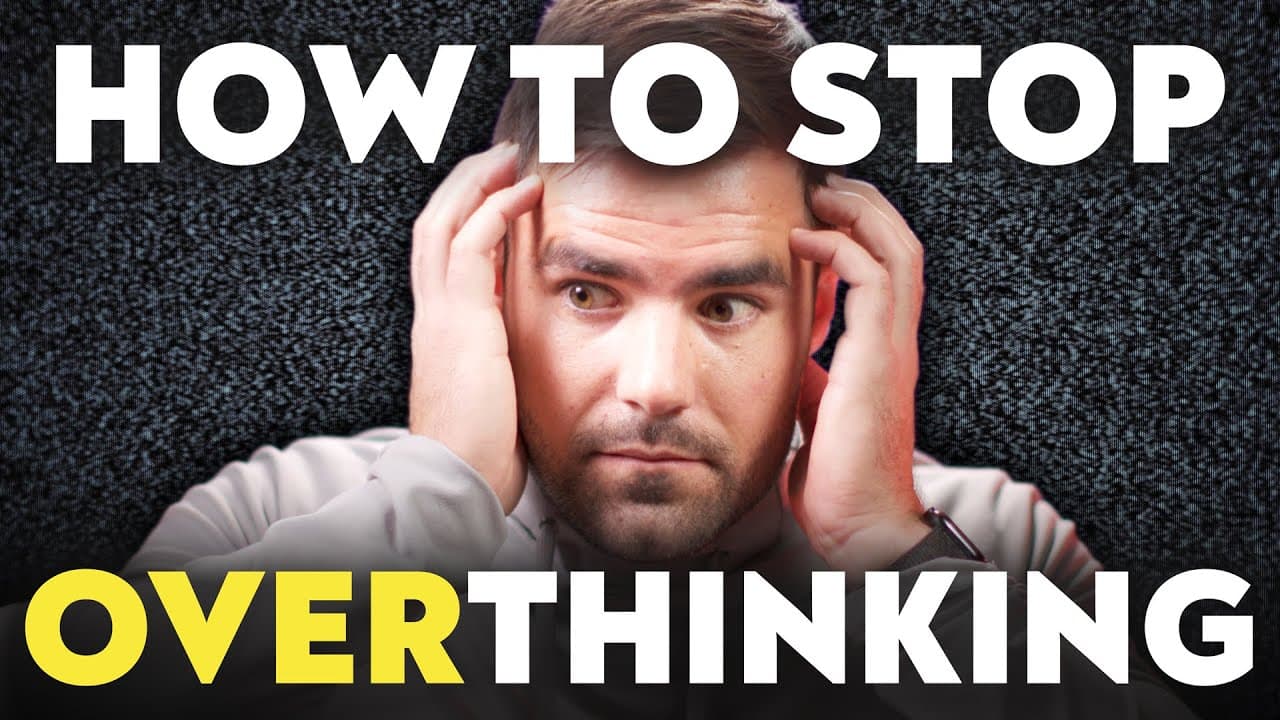
How to Stop Overthinking Everything
TL;DR
To stop overthinking, treat most decisions as experiments that produce useful information and leave room to pivot. Overthinking is driven by three major problems, fear, too many choices, and poor prioritization, and can cause procrastination, stress, and missed opportunities. Accepting incomplete information and making adjustable choices can help you decide more quickly and confidently; read on for the mindset shifts behind this approach.
Transcript
- Thanks to Brilliant for sponsoring this video and supporting my channel. Take a second to imagine an alternate version of your life, one where you always knew the right choice to make given any decision. And this version of your life would be pretty awesome, right? Not only would you always make the right choice, which would mean that you're prob... Read More
Key Insights
- 🥺 Overthinking can hinder our decision-making process and lead to missed opportunities and stress.
- 👻 Adopting an experimental outlook allows us to view decisions as opportunities for growth and learning.
- 🥺 The abundance of choice can lead to analysis paralysis and dissatisfaction with decisions.
- ⌛ Restricting the choice pool deliberately can save time, reduce decision fatigue, and increase satisfaction.
- 🖐️ Prioritization plays a crucial role in reducing overthinking and increasing productivity.
- 😫 The regret exercise is an effective tool for setting priorities and making decisions.
- 💁 Making decisions with incomplete information is a reality, and being comfortable with uncertainty is crucial.
Install to Summarize YouTube Videos and Get Transcripts
Explore YouTube Video Summarizer or Get YouTube Transcript Extractor
Questions & Answers
Q: How can I stop overthinking everything?
Shift from a set-path outlook to an experimental outlook: treat a decision as a way to gather information, not as a permanent commitment. Accept that almost every decision involves incomplete information and remember that most choices leave opportunities to pivot later.
Q: What problems cause overthinking?
Three major problems underpin overthinking: fear in the decision-making process, an abundance of choice, and a lack of proper prioritization. Together, they can create paralysis and leave you without clear direction.
Q: Why is overthinking harmful?
Overthinking can cause procrastination, make decisions feel so stressful that they are set aside, and lead to missed opportunities. A strong option may disappear while you hesitate in pursuit of the best possible choice.
Q: What is the experimental outlook on decision-making?
The experimental outlook treats choices as experiments that produce consequences, rewards, and new information. That information lets you adjust your decision or move onto a different path if you do not like the result.
Q: What is the set-path outlook?
The set-path outlook is the belief that a decision will lock you onto one course for the rest of your life. The transcript compares it to boarding a roller coaster with a fixed track, even though most real-life decisions allow later adjustments.
Q: Can major life decisions be changed later?
The speaker chose MIS in college with the intention of entering a corporate job running computer networks, but later pivoted to making YouTube videos. The transcript also states that a full third of college students change their major within the first three years of enrolling.
Q: How can I become more comfortable making decisions with incomplete information?
Recognize that almost every decision involves incomplete information and that certainty is usually unavailable. The transcript compares life to poker rather than chess: you cannot be 100% certain what cards others hold, so you must become comfortable acting without perfect knowledge.
Q: Are most decisions permanent?
Most decisions do not place you on a completely fixed path. They are more like choosing a route down a ski slope: returning to the start may be difficult, but you retain the ability to turn, make small adjustments, and change where you end up.
Summary & Key Takeaways
-
Overthinking can lead to procrastination, missed opportunities, and stress.
-
The main problems underlying overthinking are fear, an abundance of choice, and a lack of prioritization.
-
Adopting an experimental outlook, limiting the choice pool, and using the regret exercise can help reduce overthinking and improve decision-making.
Read in Other Languages (beta)
Share This Summary 📚
Summarize YouTube Videos and Get Video Transcripts with 1-Click
Try YouTube Summary with ChatGPT & Claude or YouTube Transcript Generator
Explore More Summaries from Thomas Frank 📚




Summarize YouTube Videos and Get Video Transcripts with 1-Click
Try YouTube Summary with ChatGPT & Claude or YouTube Transcript Generator