What Is the Major Product of E2 Elimination Reactions?
TL;DR
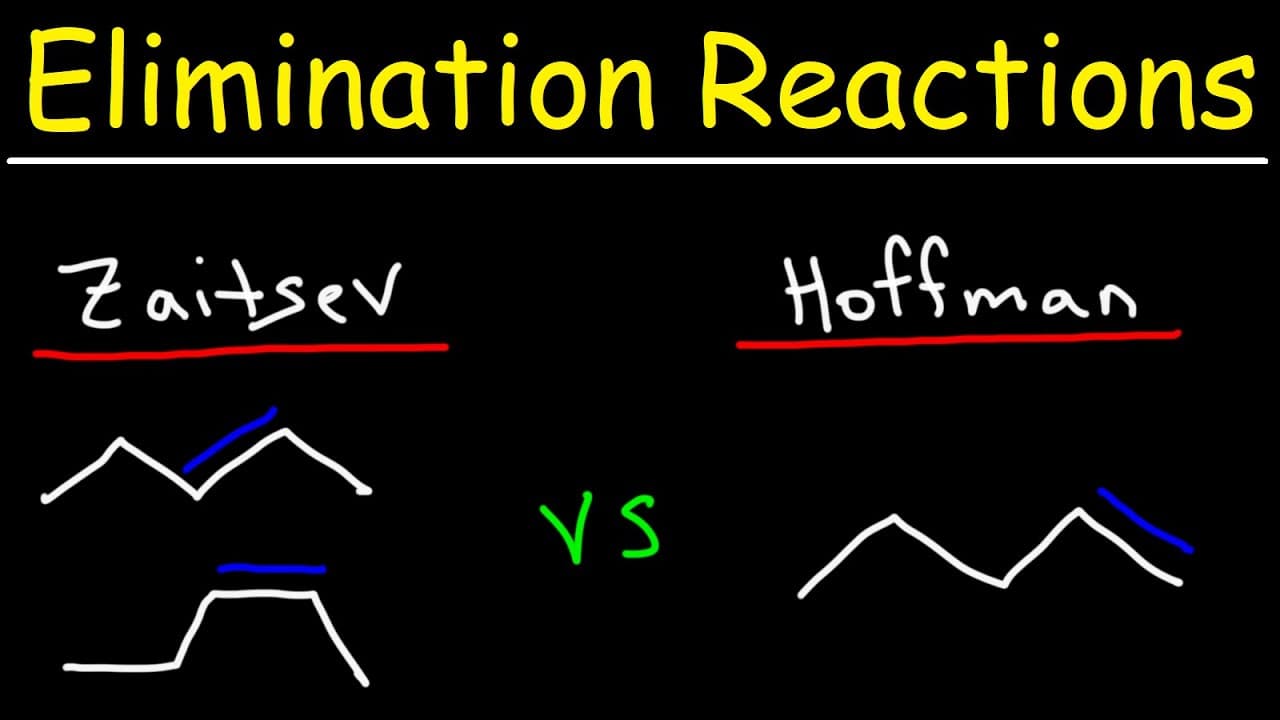
The major product of the reaction between 2-bromopentane and sodium ethoxide in ethanol is trans-2-pentene, the most stable alkene formed during the E2 elimination process. Ethoxide acts as a strong base, favoring the formation of more substituted alkenes according to Zaitsev's rule, resulting in trans-2-pentene being favored over cis-2-pentene.
Transcript
number 44. which of the following is the major product of the reaction between two bromopentane and sodium ethoxide in ethanol so let's draw a picture here we have pentane and we have a bromine on carbon 2. now we're going to react this with sodium methoxide n-a-o-e-t stands for ethyl and this is going to be in FML etoh now looking at our products ... Read More
Key Insights
- ❓ The reaction involves converting an alkyl halide into an alkene through an elimination reaction.
- 💪 Ethoxide, a strong base, is used to favor the E2 elimination mechanism.
- ❓ The major product of the reaction is trans-2-pentene, the most stable alkene among the possible products.
- 🥺 The principle of Zaitsev's rule applies, where a strong base leads to the formation of the more substituted alkene (Zaitsev product).
- 💁 Using a bulky base would result in the formation of the less substituted alkene (Hoffman product).
- ❓ The reaction can produce a mixture of cis-2-pentene and trans-2-pentene, depending on which hydrogen is removed.
- 😑 Resonance stabilization of the ethoxide ion is not a factor in this reaction.
Install to Summarize YouTube Videos and Get Transcripts
Explore YouTube Video Summarizer or Get YouTube Transcript Extractor
Questions & Answers
Q: What is the major product of the reaction between two bromopentane and sodium ethoxide in ethanol?
The major product is trans-2-pentene, which is the most stable alkene formed in the E2 elimination reaction using sodium ethoxide as a strong base.
Q: Why is ethoxide considered a strong base?
Ethoxide is considered a strong base because, with a negative charge on oxygen and no resonance stabilization, it exhibits strong basicity, favoring E2 reactions over E1 reactions.
Q: How does the reaction differ when a weak base is used instead of ethoxide?
When a weak base is used, such as a weaker alkoxide, the reaction tends to favor E1 reactions over E2 reactions, resulting in the formation of less stable alkene products.
Q: Can the reaction produce three pentene as a product?
No, three pentene does not exist because the alkene is between carbons 2 and 3. It will always be called trans-2-pentene.
Summary & Key Takeaways
-
The reaction involves converting an alkyl halide (bromopentane) into an alkene (trans-2-pentene).
-
Ethoxide acts as a strong base, favoring an E2 elimination reaction.
-
Depending on which hydrogen is removed, the products can be cis-2-pentene, trans-2-pentene, or 3-pentene (which doesn't exist).
-
The major product is trans-2-pentene, as it is the most stable alkene among the possible products.
Read in Other Languages (beta)
Share This Summary 📚
Summarize YouTube Videos and Get Video Transcripts with 1-Click
Try YouTube Summary with ChatGPT & Claude or YouTube Transcript Generator
Explore More Summaries from The Organic Chemistry Tutor 📚



Summarize YouTube Videos and Get Video Transcripts with 1-Click
Try YouTube Summary with ChatGPT & Claude or YouTube Transcript Generator