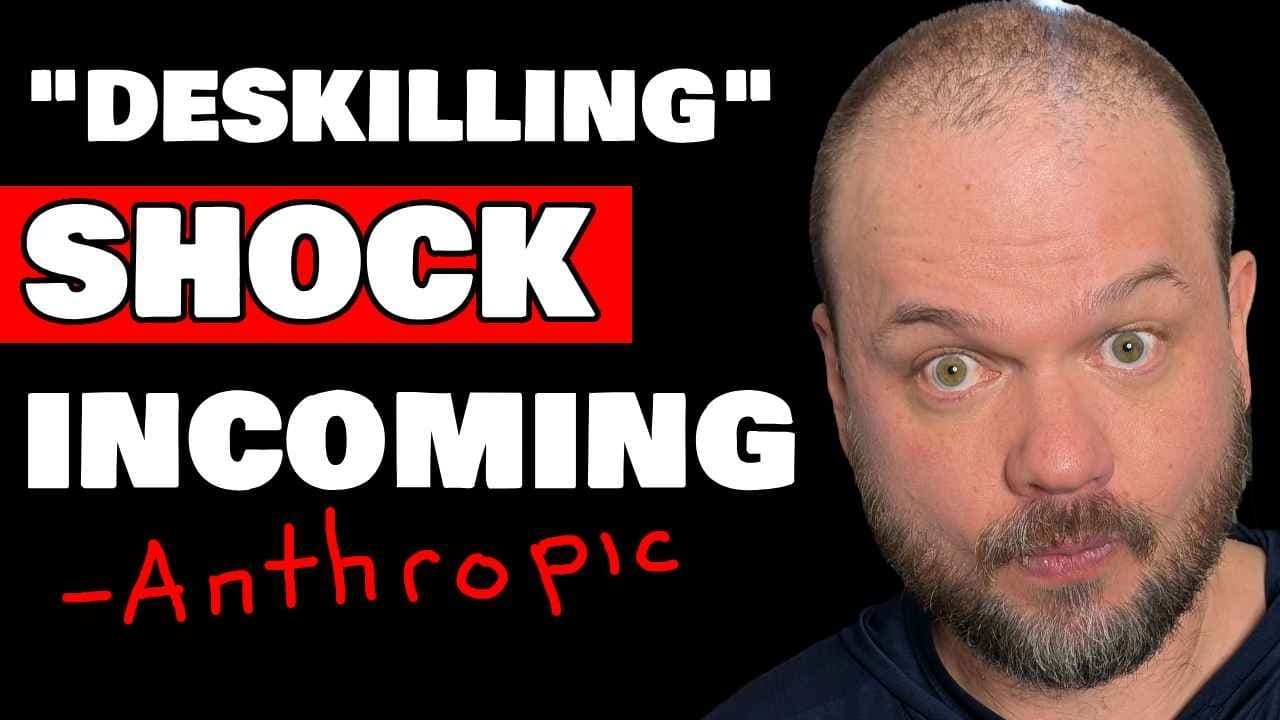
What Is the Deskilling Shock in Anthropic's AI Report?
TL;DR
Anthropic's fourth Economic Index report finds agentic AI now does real work but automates unevenly across jobs. Where AI takes hard tasks, workers are left with easier work (deskilling); where it takes routine tasks, workers focus on high-skill work (upskilling). Adjusting for task reliability roughly halves projected annual labor productivity gains from 1.8 to about 1 percentage point.
Transcript
So, Anthropic published their fourth Anthropic Economic Index report. They're tracking how AI use is affecting automation, jobs, the economy, etc. And there are some pretty important takeaways in this one, some of which are surprising. The idea of AI taking over all jobs and all us humans just kicking back and sipping my ties on the beach. Well, th... Read More
Key Insights
- The era of agentic AI has arrived, meaning tools like Claude Code and Claude Cowork no longer just answer questions but access files, execute commands, make plans, and follow them through to do actual work across tasks.
- Coding is described as the canary in the coal mine because it is the first sector to truly experience agentic automation, and the Claude Cowork release is expected to bring similar impact to other industries and sectors.
- Deskilling happens when AI takes over the hard tasks of a job, leaving workers only the easy execution tasks; a legal secretary role once needing 17 years of experience can be reduced to easier, more routine work.
- Upskilling happens when AI automates routine admin tasks, freeing workers for high-skill work; a property manager shifts from bookkeeping to negotiating contracts, securing loans, and managing stakeholder relationships, raising the worker's value.
- AI handling some tasks of a job does not replace the worker unless it automates the core skills; data entry keyers are at risk because entering data is their core, while microbiologists are safe because AI cannot do their core lab tasks.
- Task success rate drops as task duration increases, and unattended API use (blue line) falls off much faster than human-supervised Claude use (orange), because a human babysitting and course-correcting improves success over time.
- Adjusting productivity estimates for task reliability roughly halves the implied gains from 1.8 to about 1 percentage point of annual labor productivity growth over the next decade, tempering the most optimistic automation projections.
- AI adoption is diffusing far faster and more evenly than past technologies; US states are converging and could equalize per-capita usage in 2 to 5 years, a pace roughly 10 times faster than economically consequential 20th-century technologies.
Install to Summarize YouTube Videos and Get Transcripts
Explore YouTube Video Summarizer or Get YouTube Transcript Extractor
Questions & Answers
Q: What is the deskilling shock described in Anthropic's economic report?
Deskilling occurs when AI takes over the hard, difficult tasks in a profession, leaving workers only the easier tasks to perform. The report uses a legal secretary as an example: reviewing legal publications to identify relevant court decisions was a task predicted to need 17 years of experience, but if AI handles that, the leftover work becomes easy execution like assembling a binder. The job requires less skill, less attention, and less experience, becoming easier and more boring.
Q: What is the difference between deskilling and upskilling with AI?
Deskilling is when AI automates the hard, high-skill tasks, leaving humans with the easy leftover work, lowering the skill required for the job. Upskilling is the opposite and the dream scenario: AI takes the easy, routine, administrative tasks off your plate, leaving you with high-skill work. The report's upskilling example is a property manager whose routine bookkeeping and market-rate research is automated, freeing them to negotiate contracts, secure loans, and manage stakeholder relationships, raising the worker's value.
Q: Why is coding called the canary in the coal mine for AI automation?
Coding is called the canary in the coal mine because it is the first sector to truly experience agentic AI automation, showing significant progress toward automation using tools like Claude Code. It serves as a test case: watching what happens to this one area is expected to mirror what will later happen to other sectors. With Claude Cowork now bringing the same agentic capability to all other tasks, that automation wave is likely to hit other industries too.
Q: Does AI automating tasks mean a worker will be replaced?
No. The report emphasizes that AI handling some tasks for a job role does not necessarily replace the worker; AI has to specifically automate the skills that are core to that job. Data entry keyers are at risk because the core of their job is entering data, which AI can do. Microbiologists are not at risk because, even though AI can do many peripheral tasks, it cannot perform the core work like using a petri dish, looking through a microscope, or pipetting.
Q: How much does task reliability reduce projected AI productivity gains?
According to Anthropic, adjusting productivity estimates for task reliability roughly halves the implied gains, from 1.8 to about 1 percentage point of annual labor productivity growth over the next decade. This tempers the most optimistic projections for AI automation and productivity boosts, suggesting expectations need to be downshifted. However, the report notes these estimates reflect current model capabilities, and signs suggest reliability over increasingly long-running tasks will improve over time.
Q: Why does AI task success drop over longer tasks and without human supervision?
The report shows task success rate drops the longer the task duration is. It compares Claude AI use (orange line) against API use (blue line), noting the blue line drops off much more rapidly. The reason is that with the supervised chatbot use, a human is babysitting the AI, correcting and course-correcting it along the way, which improves task success over time. Without that human babysitting, as in automated API traffic, success rapidly declines.
Q: How fast is AI adoption spreading compared to past technologies?
AI adoption is diffusing far faster and more evenly than previous technologies. Within the US, lower-usage states are gaining adoption relatively faster, causing convergence rather than divergence. The report says if sustained, per-capita usage would equalize across the country in 2 to 5 years, a pace of diffusion roughly 10 times faster than the spread of previous economically consequential technologies in the 20th century, making AI more democratic and equal in how people use it.
Q: How is Claude AI usage distributed across tasks, businesses, and countries?
Claude usage remains concentrated among certain tasks, with the top 10 most common tasks accounting for 24 percent of sampled conversations, a slight increase since the last report. Automated use dominates API traffic, reflecting its programmatic nature as businesses try to automate everything, while consumer chatbot use is more back-and-forth. Globally, usage remains persistently uneven and well explained by GDP per capita, though US states are converging. Augmentation is once again more common than automation on Claude.ai.
Summary & Key Takeaways
-
Anthropic's fourth Economic Index report tracks how AI affects automation, jobs, and the economy. Agentic AI has arrived through tools like Claude Code and Claude Cowork that do real work rather than just answering questions, but different segments of society use it very differently and true automation is not progressing as fast as projected.
-
The report contrasts deskilling, where AI takes hard tasks and leaves workers easy execution work, with upskilling, where AI automates routine admin tasks and lets workers focus on high-skill work. Whether a worker is replaced depends on whether AI can automate the core skills of their specific job role.
-
Task success drops as duration grows, and unsupervised API use fails faster than human-supervised use, so reliability-adjusted productivity gains roughly halve from 1.8 to 1 point. Still, AI adoption diffuses about 10 times faster than past technologies, with US states converging toward equal usage within 2 to 5 years.
Read in Other Languages (beta)
Share This Summary 📚
Summarize YouTube Videos and Get Video Transcripts with 1-Click
Try YouTube Summary with ChatGPT & Claude or YouTube Transcript Generator
Explore More Summaries from Wes Roth 📚






Summarize YouTube Videos and Get Video Transcripts with 1-Click
Try YouTube Summary with ChatGPT & Claude or YouTube Transcript Generator