How to Build a First-Place Mousetrap Car

26.1M views
•
March 29, 2018
by
Mark Rober
YouTube video player
How to Build a First-Place Mousetrap Car

TL;DR

Winning mousetrap cars come down to mechanical advantage: to travel far, use the smallest possible force over the longest distance so the car barely creeps forward and wastes little energy. A long lever arm paired with CD wheels gives roughly a 1-over-360 ratio, and reducing axle friction with graphite or ball bearings pushed one car to 50 feet.

Transcript

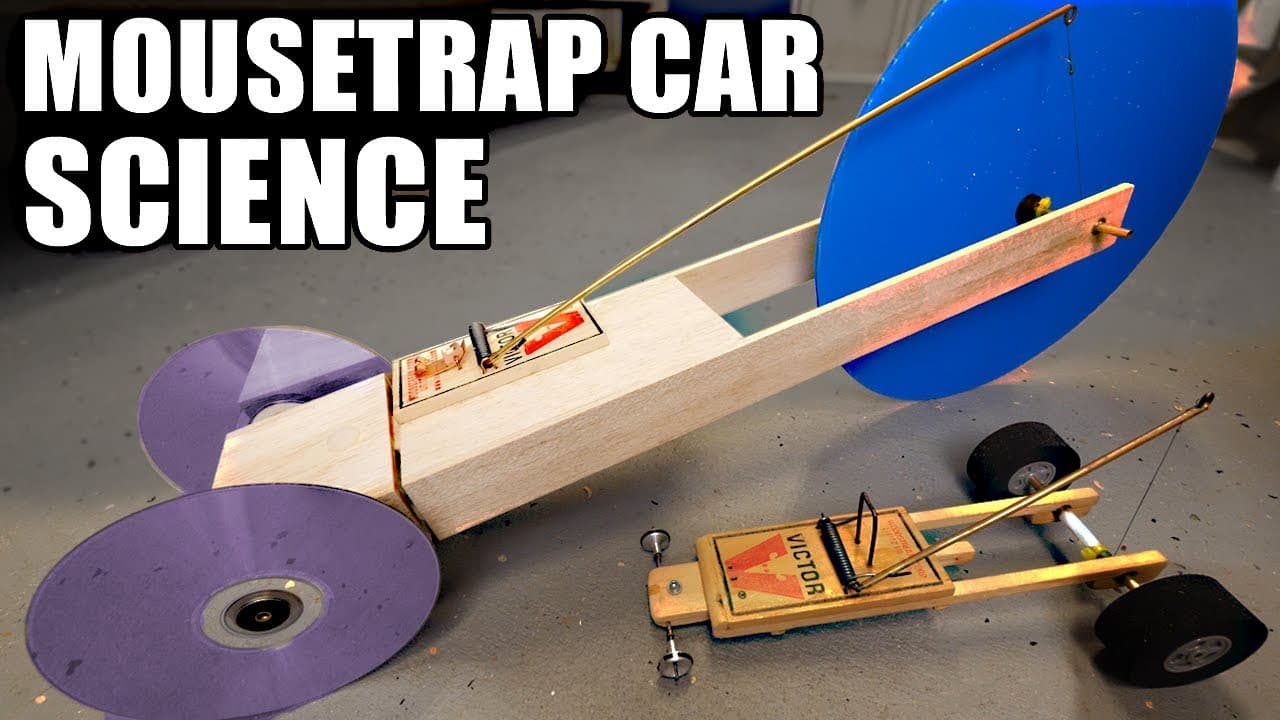
  • This is a mousetrap car. (funky music) They're coming for competitions in high school physics classes, just like the egg drop challenge or building toothpick bridges. The goal is to build a car that travels the furthest or goes the fastest, but in either case, the only power provided to move the car is from a single mouse trap. So today I'm gonna... Read More

Key Insights

  • Mechanical advantage is the ratio of output force over input force, letting you trade less force for more distance traveled; a value of 50 means your hand moves 50 times further but the load feels 50 times lighter.
  • A mousetrap car uses mechanical advantage in reverse: making the main lever arm 15 times longer than the spring arm and the wheel diameter 24 times the axle yields a total ratio of 1 over 360.
  • To win a long-distance race you want the smallest possible force over the longest possible distance, meaning the smallest mechanical-advantage fraction, so the car creeps forward and wastes as little spring energy as possible.
  • Friction is the biggest enemy, coming from two spots: rolling friction between wheels and ground, and the larger loss between the axles and car body, which is why lubricating graphite powder is applied there.
  • Adding ball bearings in place of graphite on the long lever arm car set a new record of 50 feet, showing how much reducing axle friction improves distance.
  • Lightweight construction is a core principle because a heavier car has more friction resisting it; a super-long lever arm actually performed worse than the short one because it was too big and heavy to coast well.
  • A big-wheel design where the wheel is 56 times larger than the axle gives a built-in ratio of 1 over 840, equivalent to a two-and-a-half-foot lever arm without needing a heavy car, making it the best-performing car tested.
  • Rotational inertia penalizes very large wheels because energy is needed to get them spinning; heavy wheels store energy temporarily and return it while coasting, but every energy transfer loses some, like water splashing when poured.

Install to Summarize YouTube Videos and Get Transcripts

Explore YouTube Video Summarizer or Get YouTube Transcript Extractor

Questions & Answers

Q: What is a mousetrap car and how does it work?

A mousetrap car is a competition project, common in high school physics classes alongside the egg drop challenge or toothpick bridges. The goal is to build a car that travels the furthest or goes the fastest, but the only power allowed to move the car comes from a single mousetrap. Its spring energy is transferred through a lever arm and wheels to the ground, and the design principles that govern its performance all trace back to mechanical advantage.

Q: What is mechanical advantage in physics?

Mechanical advantage is the ratio of the output force over the input force. If you are willing to move a greater distance, you can reduce the required force by a proportional amount. For example, lifting a car with pinkies by moving your hand 50 times further makes the weight feel 50 times lighter, giving a mechanical advantage of 50. It appears everywhere: pulleys, ramps, screws, ratchet wrenches, wheels and axles, and levers, all trading lower force for more distance traveled.

Q: How do you build a mousetrap car that travels the furthest?

To win a long-distance race you want the smallest possible force over the longest possible distance, which means the smallest mechanical-advantage fraction. The car should barely creep forward to waste as little energy as possible. In testing, the long lever arm car went slowest but traveled furthest, reaching 30 feet. Combining a long lever arm with CD wheels gives a ratio of about 1 over 360, and reducing axle friction extends the distance even more.

Q: Why does a longer lever arm make a mousetrap car go further?

A longer lever arm produces a smaller mechanical-advantage fraction, meaning less force is applied at the wheels but the car travels a greater distance for each rotation of the spring arm. This makes the car move slowly and steadily rather than in a quick burst. In the test, the short lever arm car took a strong early lead because it had the highest force at the wheels, but it burned its energy fast, while the long lever arm car crept along and reached 30 feet.

Q: How does friction affect a mousetrap car and how do you reduce it?

Friction is described as the biggest enemy of a mousetrap car. It comes from two spots: rolling friction between the wheels and the ground, and the larger source between the axles and the car body. To reduce it, lubricating graphite powder is applied at the axles, which made a huge difference in testing. Going a step further, replacing the graphite with ball bearings on the long lever arm car set a new record of 50 feet.

Q: Why is it important to make a mousetrap car lightweight?

A lightweight car experiences less friction resisting its motion, just as it is harder to push a heavy object across a table than a light one. When the builders tried a super-long lever arm, the car had to be made very big and heavy, so it did not coast well and actually traveled worse than the short lever arm car. This shows lightweight construction is a key principle and that taking any single principle too far lets another one penalize you.

Q: How does the big wheel design improve mousetrap car performance?

In the big wheel design, the wheel is 56 times larger than the wheel axle. Combined with the lever arm, this gives a built-in mechanical advantage of 1 over 840, equivalent to a lever arm two and a half feet long, but without needing a big heavy car. That made it the best car tested. The downside is rotational inertia, since it takes energy to get a large wheel spinning, and big wheels can be hard to work with.

Q: What is rotational inertia and why does it matter for mousetrap car wheels?

Rotational inertia is the resistance of a wheel to changes in its spinning motion. In a demo, two identical wheels differed only in weight placement: one had steel weights at the outer edge, giving higher rotational inertia. When spun identically, the wheel with weights near the axle spun up faster and reached a higher max speed, while the high-inertia wheel coasted longer. Big heavy wheels store energy temporarily and return it while coasting, but every energy transfer loses some.

Summary & Key Takeaways

  • A mousetrap car must travel the furthest or fastest using power from only a single mousetrap. The overarching physics principle is mechanical advantage, the ratio of output force to input force, which lets you trade lower force for more distance traveled, as seen in pulleys, ramps, screws, wrenches, wheels, and levers.

  • For long-distance cars you want the smallest force over the longest distance, so the car barely creeps forward and wastes little energy. Testing three cars with short, medium, and long lever arms showed the long-arm car went slowest but furthest, reaching 30 feet, while the short arm burned its energy in a quick burst.

  • Reducing friction with graphite and then ball bearings pushed a long-arm car to a 50-foot record. Lightweight design matters, since a too-long, heavy arm coasted poorly. A big-wheel car with a 1-over-840 ratio performed best, though oversized wheels add rotational inertia and lose energy through transfer.


Read in Other Languages (beta)

Share This Summary 📚

Explore More Summaries from Mark Rober 📚