How to Find and Read Research Papers Faster With AI
TL;DR
A five-step AI search workflow helps PhD students find and understand papers faster. Use the Consensus Meter to check what the research says, Deep Research to narrow the papers to a strong core set, comparison tables to plan a literature review, then read the selected papers closely and ask them questions. Every answer links back to its source papers, so claims can be checked.
Transcript
As someone who uses AI tools on a daily basis, I determined that you have to be able to trust the tool that you're using. You need to be confident that it doesn't hallucinate. And you also want to make sure that the tool is approved by universities. My biggest challenge, especially in the first and final year of my PhD, was trying to read as many r... Read More
Key Insights
- Consensus is a specialized search engine that uses AI to extract and synthesize information from scientific research papers, giving concise, evidence-based answers to specific questions grounded in the scientific literature.
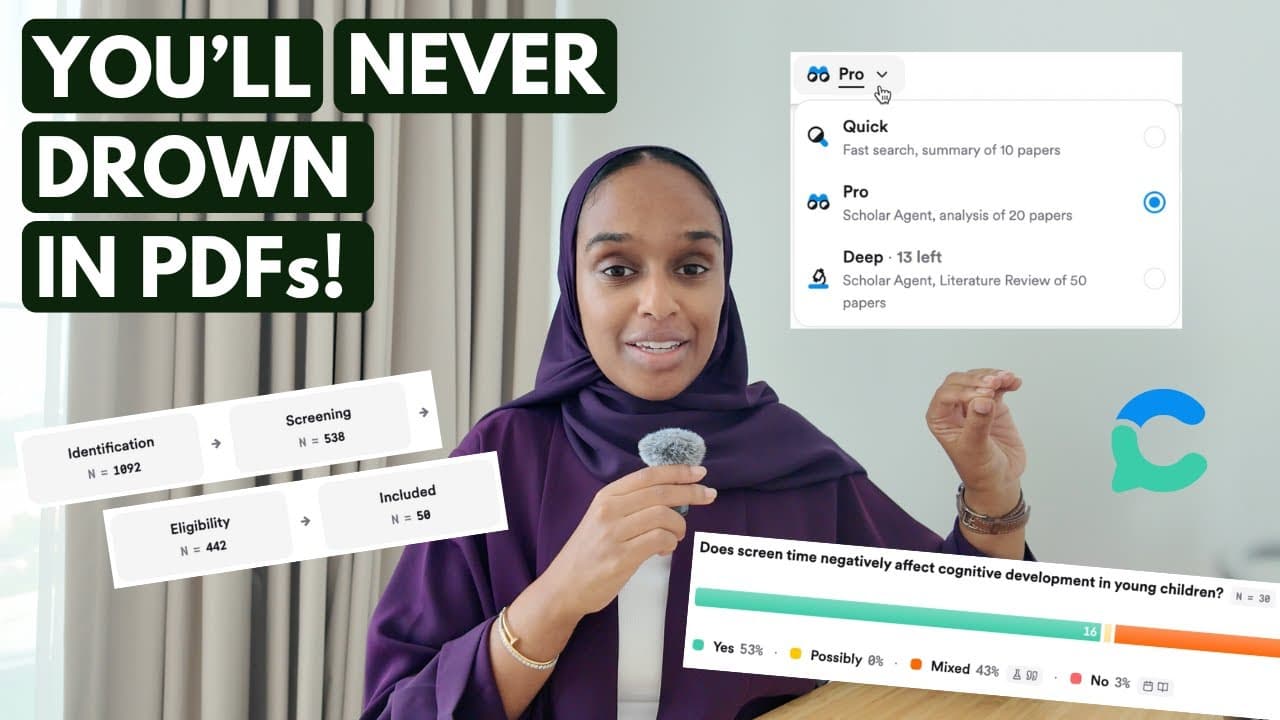
- The vibe check is the first step: the Consensus Meter reframes a broad question as a yes or no question and shows what share of papers agree, so you can judge the state of the science within seconds.
- For the question of screen time and children's cognitive development, 55% of papers indicated yes, increased screen time has a negative effect. A large share were still uncertain, which points to an area worth investigating further.
- The efficiency filter step uses the Deep Research tool to narrow a large body of papers to a core set. In the example it picked 35 papers, which can be exported to EndNote, Zotero or Mendeley.
- A search strategy flow diagram shows how papers were selected: over 1,000 papers identified, those without abstracts removed, less relevant or weaker-evidence papers screened out, and a final set kept. This makes the selection process transparent.
- A results timeline and filters for publication year and journal rank help narrow the papers. Recent papers can matter more for fast-changing topics such as screen time, and you can limit results to systematic reviews or other study types.
- The synthesis step builds a literature review structure. Comparison tables across variables reveal the sections and paragraphs to write, and you can ask questions across a selected group of papers, such as what alternatives they propose.
- The deep read step is still essential because PhD students must be fluent in academic text. Asking a paper direct questions after reading it turns passive reading into active engagement, and the answers can go into notes and the literature review.
Install to Summarize YouTube Videos and Get Transcripts
Explore YouTube Video Summarizer or Get YouTube Transcript Extractor
Questions & Answers
Q: What is the 5 step search method for PhD research?
The workflow uses the AI research tool Consensus to discover, screen and understand papers. The steps covered are the vibe check, which scopes the field with the Consensus Meter; the efficiency filter, which screens papers with Deep Research; the synthesis, which builds the literature review argument with comparison tables; and the deep read, which verifies information by reading and questioning selected papers. The final segment covers the draft and outline tool for writing.
Q: What is Consensus and how does it help researchers?
Consensus is a specialized search engine that uses AI to extract and synthesize information from scientific research papers. It gives concise, evidence-based answers to specific questions about a research area. That makes it useful for researchers, students and professionals who want quick insights grounded in the scientific literature. Every summary links back to the papers it draws on, so users can check each claim against the original source.
Q: How does the Consensus Meter work?
The Consensus Meter takes a research question and reframes it as a yes or no question, then shows what share of papers support each answer. For example, "How does screen time affect children's cognitive development?" became "Does increased screen time negatively affect children's cognitive development?" The result showed 55% of papers indicating yes. A large share remained uncertain, and factors such as early age and the type of content watched were flagged as relevant.
Q: How can you narrow down a large number of research papers to the most useful ones?
Use the Deep Research tool in Consensus. It runs an initial survey and search strategy, then works through theories, terminology, perspectives, domains and methods across hundreds of papers. In the example it selected 35 core papers. Results can be filtered by publication year and journal rank, or limited to systematic reviews, case reports or animal studies, so the reading list contains only strong, relevant papers.
Q: How does Consensus decide which papers to include in Deep Research?
Consensus shows a search strategy flow diagram that explains its selection. In the example, it first identified more than 1,000 papers. It then removed papers without an abstract, screened out papers that were not relevant enough or whose evidence was weaker, and kept a smaller final set. This lets the researcher see exactly how the final list was reached instead of trusting an unexplained selection.
Q: How can AI help structure a literature review?
In the synthesis step, Consensus can build a table comparing variables, such as how screen time affects different areas of child development. Each variable can become a paragraph or section of the literature review. Researchers can also select several papers, for example five, and ask them a shared question, such as what alternatives they propose. The answers come with references that can be saved to a collection.
Q: Why should PhD students still read papers if AI can summarize them?
AI summaries are useful, but PhD students need to be fluent in reading academic text, even if they do not read every paper from start to finish. Because the earlier steps filter the papers so strictly, every paper left for the deep read matches the research area, so reading time is not wasted. Close reading checks the information and builds the academic skills that summaries cannot replace.
Q: How do you use the Ask This Paper feature to understand a research paper?
Open a citation, view the abstract and snapshot, then click more detail to see the full paper. After reading it, use the ask this paper option to put follow-up questions to it. This shows active rather than passive engagement with the text and gives answers you can use in notes, a literature review or your own understanding. In the example, it moved the focus from no screen time to what children are allowed to watch.
Summary & Key Takeaways
-
The workflow starts with a vibe check using the Consensus Meter to scope a research field. A broad question is reframed as yes or no, and the share of supporting papers shows whether a topic has enough evidence to explore. Strong citations are saved into a personal library list for later comparative analysis.
-
The efficiency filter uses Deep Research to screen hundreds of papers down to a core set, 35 in the example, exportable to reference managers. A flow diagram explains the selection, while a results timeline, a claims and evidence table, and filters for publication year and journal rank help narrow the reading list further.
-
Synthesis builds the argument with comparison tables that suggest literature review sections, and with questions asked across selected papers. The deep read then verifies information: selected papers are opened in full, read closely, and questioned directly. A draft and outline tool supports writing, with every point linked to its source papers.
Read in Other Languages (beta)
Share This Summary 📚
Summarize YouTube Videos and Get Video Transcripts with 1-Click
Try YouTube Summary with ChatGPT & Claude or YouTube Transcript Generator
Explore More Summaries from Dr Amina Yonis 📚


Summarize YouTube Videos and Get Video Transcripts with 1-Click
Try YouTube Summary with ChatGPT & Claude or YouTube Transcript Generator