Can GPT-4 Train Robots to Perform Pen Spinning Tricks?
TL;DR
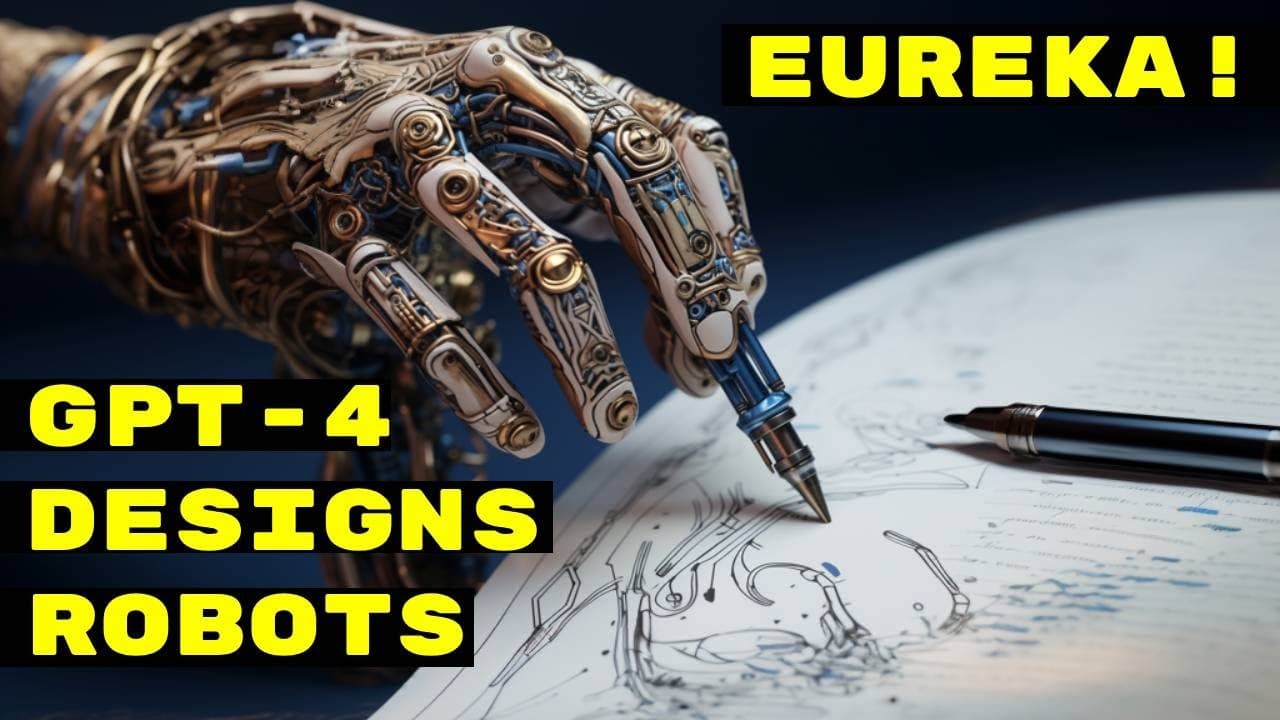
GPT-4 can train robotic hands to master complex pen spinning tricks through autonomous reward function design. The Eureka system outperforms human dexterity in 83% of tasks, using evolutionary optimization and a curriculum learning approach to achieve superhuman performance. This showcases the potential of AI to discover effective strategies beyond human intuition.
Transcript
now listen to me very carefully robot hands are notoriously hard to make they lack the dexterity most of us take for granted did you have that one kid in class that could spin around his pen in his fingers they just figured out how to make robotic hands do that perfectly what was their secret well the people behind this project were the same team t... Read More
Key Insights
- 🤗 GPT 4 enables robotic hands to master pen spinning tricks with iterative learning cycles.
- 🤗 Eureka's autonomous reward function design elevates robotic hand dexterity beyond human capabilities.
- 🖐️ Evolutionary optimization plays a crucial role in refining reward functions for improved robotic performance.
- 🤗 Curriculum learning facilitates step-by-step skill acquisition for enhanced robotic hand capabilities.
- ❓ Novel reward generation by Eureka showcases AI's ability to surpass human intuition in dexterity tasks.
- 🤗 Gradient-free reinforcement learning with Human feedback enhances robotic hand performance.
- 🤗 Versatility and significant performance gains highlight the scalability of GPT 4-powered robotic hands.
Install to Summarize YouTube Videos and Get Transcripts
Explore YouTube Video Summarizer or Get YouTube Transcript Extractor
Questions & Answers
Q: How does GPT 4 enable robotic hands to perform pen spinning tricks better than humans?
GPT 4 powers iterative learning cycles that refine reward functions, surpassing human abilities in dexterity tasks.
Q: What is the significance of Eureka in revolutionizing robotic hand dexterity?
Eureka's ability to design reward functions autonomously elevates robotic hand performance to superhuman levels, opening new avenues in AI-driven dexterity tasks.
Q: How does evolutionary search play a vital role in optimizing robotic hand performance?
Through iterative adaptations, evolutionary search refines reward functions, enhancing robotic hand capabilities, and surpassing human performance benchmarks.
Q: What role does curriculum learning play in enhancing robotic hand dexterity?
Curriculum learning breaks down tasks into manageable components, enabling progressive skill acquisition and superior performance in dexterity tasks.
Summary & Key Takeaways
-
Robotic hands achieve pen spinning excellence with GPT 4's iterative training.
-
Eureka, an open-ended AI agent, designs reward functions for robot dexterity at superhuman levels.
-
Evolutionary optimization and curriculum learning propel robotic hands to outperform human dexterity tasks.
Read in Other Languages (beta)
Share This Summary 📚
Summarize YouTube Videos and Get Video Transcripts with 1-Click
Try YouTube Summary with ChatGPT & Claude or YouTube Transcript Generator
Explore More Summaries from AI Unleashed - The Coming Artificial Intelligence Revolution and Race to AGI 📚






Summarize YouTube Videos and Get Video Transcripts with 1-Click
Try YouTube Summary with ChatGPT & Claude or YouTube Transcript Generator