Why Do Some AI Products Fail After Launch?
TL;DR
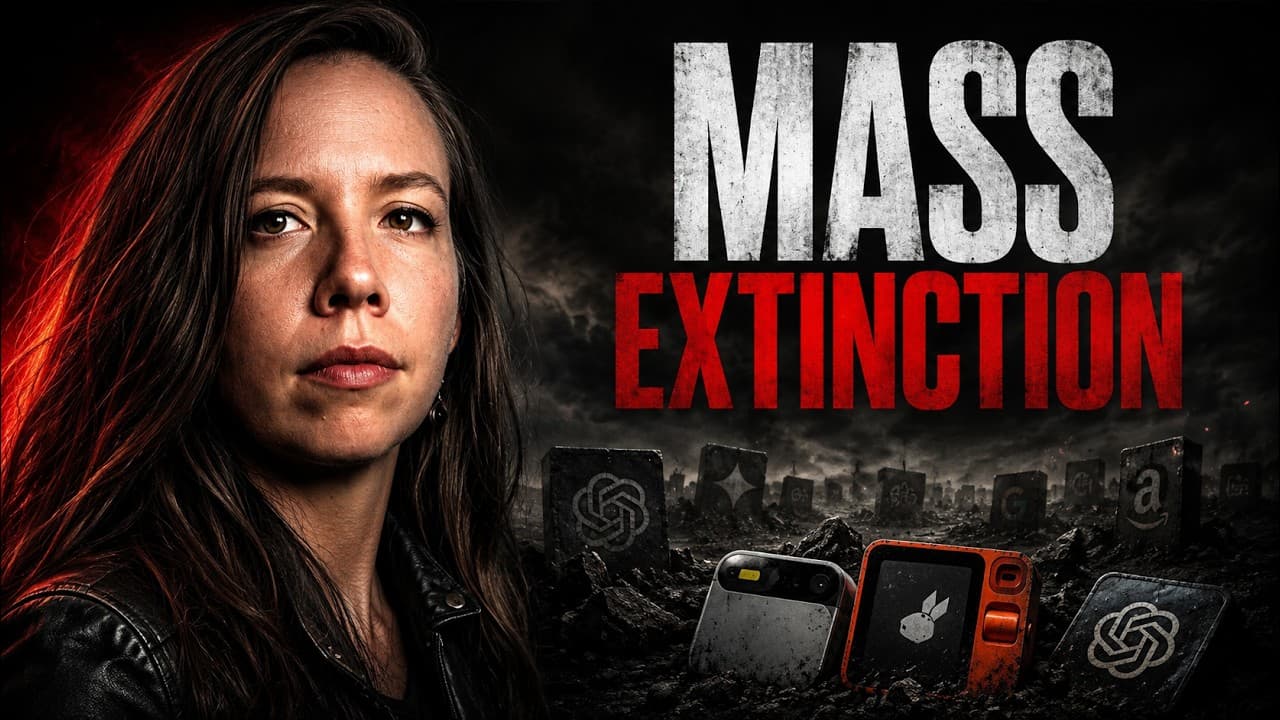
AI products survive when they perform a useful, recurring job without demanding major changes in user behavior. The transcript calls this the “Tuesday test”: if people would not miss a product during an ordinary workday, its launch hype is unlikely to produce lasting use. It contrasts failed devices, companies, and apps with frontier models and a voice-to-workflow system that support routine business tasks.
Transcript
On February 28th, 2025, thousands of $700 devices died at the same minute. The company that made them had raised $230 million to [music] free you from your phone. HP bought the scraps for $116 million and didn't even want the hardware. The customers got a paper weight. And here's why I care enough to make a whole video about it. I'm wearing that de... Read More
Key Insights
- The AI product graveyard reportedly contains 106 dead products, features, and companies. The transcript argues that these failures are not evidence that all AI is collapsing, but evidence that products built primarily around impressive demonstrations struggle to retain users after their novelty fades.
- The Humane AI Pin reportedly became unusable on February 28, 2025, after its company had raised $230 million. HP bought the remaining assets for $116 million but did not want the hardware, leaving customers with devices the transcript characterizes as paperweights.
- The Rabbit R1 reportedly sold 100,000 units after a viral CES 2024 keynote, but reports later placed daily active users near 5,000. The transcript attributes this weak retention to buyers discovering that their phones already performed the device’s useful functions.
- Builder.ai reportedly presented “Natasha” as AI capable of making apps as easily as ordering pizza. The transcript says much of the work was performed manually by about 700 engineers, while reported revenue of $220 million was allegedly only $55 million.
- The standalone Sora app was reportedly shut down on April 26, 2026, after consuming around $1 million per day in computing resources while producing almost no revenue. The transcript interprets this as compute being redirected toward coding and enterprise work.
- The “Tuesday test” is a practical filter for evaluating AI products before purchasing them. It asks whether users would miss the product during an ordinary Tuesday, separating tools with recurring utility from demonstrations that generate attention but lack a dependable daily job.
- Successful AI tools are described as workflow components rather than phone replacements. The featured voice wearable records existing conversations without a screen, buttons, or wake word, then sends spoken material through an MCP connection into Claude for further processing.
- The featured workflow converts spoken thinking into tasks with deadlines, email drafts awaiting review, and a daily brief. Its claimed value comes from removing manual capture while preserving familiar behavior, since the user was already talking rather than adopting a new interaction habit.
Install to Summarize YouTube Videos and Get Transcripts
Explore YouTube Video Summarizer or Get YouTube Transcript Extractor
Questions & Answers
Q: Why do heavily promoted AI products fail after launch?
Heavily promoted AI products fail when an impressive demonstration does not translate into a recurring job that users value during ordinary life. The transcript argues that novelty can generate waiting lists, funding rounds, awards, and initial purchases, but it cannot sustain retention. Products also struggle when they duplicate a phone, require users to abandon strong habits, conceal manual labor behind an AI label, or consume expensive computing resources without sufficient revenue.
Q: What is the Tuesday test for evaluating AI tools?
The Tuesday test asks whether anyone would miss an AI product during an ordinary Tuesday, rather than on launch day or demonstration day. A product passes when it performs a boring but necessary recurring job that users depend on. The test is presented as a purchasing filter: if a tool lacks a clear daily function after the novelty disappears, the transcript suggests that it is unlikely to earn lasting adoption.
Q: Why did the Humane AI Pin fail according to the transcript?
The Humane AI Pin failed because it tried to replace the user’s phone and therefore challenged an exceptionally strong existing habit. The transcript says thousands of the $700 devices stopped working on February 28, 2025. Although the company had raised $230 million, HP acquired the remaining assets for $116 million without wanting the hardware, leaving customers with unusable devices and illustrating the risk of depending on an unsupported platform.
Q: Why did Rabbit R1 struggle to retain active users?
Rabbit R1 struggled because users reportedly discovered that their phones already handled the tasks it offered. The bright orange device cost $199, attracted attention at CES 2024, and sold 100,000 units after a viral keynote. Within months, reports cited in the transcript placed daily active users at approximately 5,000, or 5 percent of buyers, suggesting that initial curiosity did not become habitual use.
Q: What caused Builder.ai to collapse?
Builder.ai collapsed after serious discrepancies emerged around its technology and reported revenue. The company claimed that its AI system, called Natasha, could build apps as easily as ordering pizza, but the transcript says about 700 engineers in India and Ukraine were writing code manually. It also says revenue presented as $220 million was actually $55 million. After a creditor seized $37 million, the company folded within about a week.
Q: What does the reported Sora shutdown suggest about AI economics?
The transcript says OpenAI shut down the standalone Sora video app on April 26, 2026, while it was reportedly consuming around $1 million per day in computing resources and generating almost no revenue. The Disney deal also reportedly collapsed, and creators lost their portfolios. The speaker interprets the decision as evidence that even a wealthy AI company will redirect limited computing capacity toward coding and enterprise work that produces quieter but clearer economic value.
Q: How does the featured voice wearable differ from the Humane AI Pin?
The featured voice wearable differs by complementing existing behavior instead of trying to replace a phone. It has no screen, buttons, or wake word, hangs on the user’s chest, and records the day with a seven-day battery. The transcript says its captured information flows through an MCP connection into Claude, where spoken thoughts become useful work outputs. The wearable therefore serves as a passive input tool rather than a new general-purpose device.
Q: How can spoken thoughts become an automated business workflow?
Spoken thoughts are captured by the wearable and passed through an MCP connection into Claude, where the processing occurs. According to the transcript, thinking aloud during a walk can become tasks with deadlines, drafted emails awaiting review, and a single daily brief. A spoken commitment such as sending something on Tuesday can become a tracked task due Tuesday, removing the need to stop and write the instruction manually.
Summary & Key Takeaways
-
The transcript surveys an AI product graveyard that reportedly includes 106 products, features, and companies. Its examples include the discontinued Humane AI Pin, the lightly used Rabbit R1, the collapsed Builder.ai, and the costly standalone Sora app, presenting each as a different expression of the same failure pattern.
-
The central framework is the “Tuesday test,” which asks whether users would miss a product during an ordinary day rather than during its launch or demonstration. The argument is that novelty can attract attention, funding, awards, and early buyers, but retention depends on performing a recurring, practical, load-bearing job.
-
The proposed alternative is a workflow built on frontier models and a passive voice wearable. Spoken thoughts move through an MCP connection into Claude, where they become tasks, deadlines, email drafts, and a daily brief. The system succeeds, according to the transcript, because it complements existing behavior instead of replacing it.
Read in Other Languages (beta)
Share This Summary 📚
Summarize YouTube Videos and Get Video Transcripts with 1-Click
Try YouTube Summary with ChatGPT & Claude or YouTube Transcript Generator
Explore More Summaries from Julia McCoy 📚



Summarize YouTube Videos and Get Video Transcripts with 1-Click
Try YouTube Summary with ChatGPT & Claude or YouTube Transcript Generator