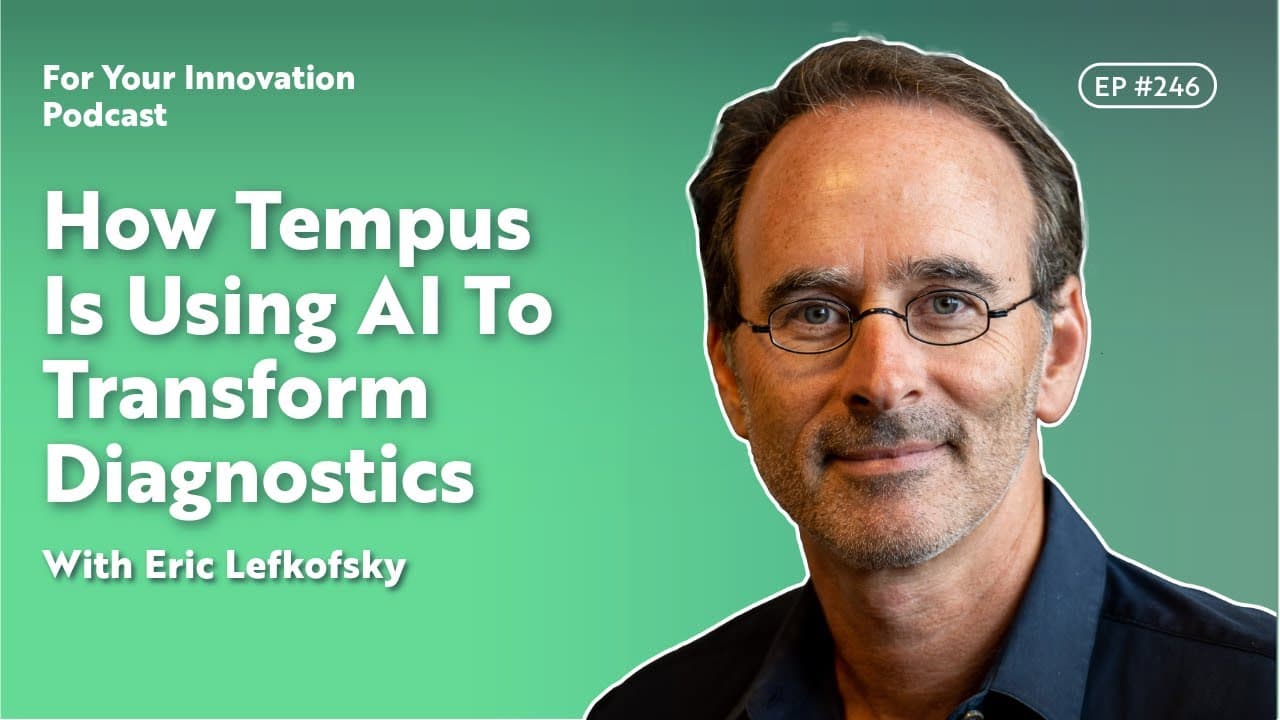
What inspired Eric Lefkofsky to build Tempus AI?
TL;DR
Eric Lefkofsky moved from tech to healthcare to apply data and AI to patient care. Tempus was started to connect diagnostic tests with real patient data, personalizing treatment decisions. He describes overcoming systemic barriers in healthcare by building a company that bridges biology and technology.
Transcript
welcome to FYI the four-year Innovation podcast this show offers an intellectual discussion on technologically enabled disruption because investing in Innovation starts with understanding it to learn more visit ark-invest tocom Ark invest is a registered investment adviser focused on investing and disruptive innovation this podcast is for informati... Read More
Key Insights
- Tempus is built to connect diagnostics to real time clinical data to personalize care.
- The core insight is that pathology and sequencing results must be contextualized with patient information for actionable decisions.
- Tempus began with a focus on oncology but broadened to cardiology, neurology, and immunology to apply the same platform widely.
- The company emphasizes the need to bridge the gap between biology and technology by assembling PhDs and AI scientists in one framework.
- Healthcare systems have complex incentives that hinder rapid tech adoption, creating room for private companies to drive change.
- The founder notes a lack of data sharing from sequencing providers, which spurred Tempus to build an integrated data approach.
- Tempus relies on a mix of deep scientific expertise and AI know how to adapt large language model tools to clinical needs.
- The journey highlights the importance of collaboration across disciplines and building high bandwidth communication channels between tech and bio teams.
Install to Summarize YouTube Videos and Get Transcripts
Explore YouTube Video Summarizer or Get YouTube Transcript Extractor
Questions & Answers
Q: What is Tempus AI and why was it created?
Tempus AI is a platform that makes diagnostic tests intelligent by contextualizing them with patient data from the clinic to support data driven decisions. It started because early sequencing reports lacked personalization and did not reveal whether a patient could be eligible for trials or which drugs were suitable. The founder wanted to fix this gap by connecting molecular data with real world clinical information.
Q: How did the founder transition from tech to healthcare
Eric Lefkofsky describes a transition motivated by a personal experience when his wife was diagnosed with breast cancer. He realized healthcare technology was underdeveloped compared to other industries and decided to apply his experience building tech platforms to healthcare. He pursued oncology first and gradually expanded to other diseases as the platform matured.
Q: What was the initial problem Tempus aimed to solve in genomics
The initial problem was that genomic tests produced reports that were not contextualized to the patient, leaving doctors with little guidance. Reports often did not reflect gender, drug history, or trial eligibility. Tempus sought to connect sequencing data to the patient’s clinical record to produce smarter, more actionable insights.
Q: Why is there a need to bridge technology and biology in Tempus
Biology and medicine require deep domain knowledge, while AI and software engineering bring scale and speed. The founder argues that professionals in each field speak different languages and have different incentives. Building a bridge allows AI tools to be effectively applied to biological problems, accelerating diagnosis and treatment decisions.
Q: What systemic barriers in healthcare does Tempus face
The conversation highlights a complex U S healthcare system with incentives oriented toward grant based research, drug development value, and payer negotiations. These barriers slow technology adoption. Tempus positions itself as a private enterprise with incentives to deploy tech faster and translate data into clinical action.
Q: How does Tempus plan to expand beyond oncology
Tempus intends to leverage its intelligent diagnostics platform to other disease areas like cardiology, neurology, and immunology. By applying the same approach—linking diagnostic data with clinical context—the company aims to broaden precision medicine and help physicians make data driven decisions across multiple specialties.
Q: What role do experts play in Tempus' work
Tempus employs a large workforce that includes PhDs, software engineers, and AI scientists to blend biology and computation. The approach emphasizes specialized knowledge in biology with AI, and the company works to ensure disciplines communicate effectively while maintaining high standards in both fields.
Q: What does Lefkofsky mean by private enterprise driving change in healthcare
He suggests that the current healthcare system is not structured to adopt technology rapidly, with incentives misaligned across academia, pharma, and payers. Private companies like Tempus can accelerate progress by focusing on practical data integration, patient outcomes, and scalable AI applications, potentially transforming how care is delivered.
Summary & Key Takeaways
-
Tempus aims to personalize patient care by linking diagnostics with clinical data, starting from oncology and expanding to other diseases.
-
The founder's motivation stemmed from observing the gap between advanced tests and personalized treatment during his wife’s cancer journey.
-
The episode discusses the challenges in the U S healthcare system and how private enterprises may speed up technology adoption in medicine.
Read in Other Languages (beta)
Share This Summary 📚
Summarize YouTube Videos and Get Video Transcripts with 1-Click
Try YouTube Summary with ChatGPT & Claude or YouTube Transcript Generator
Explore More Summaries from ARK Invest 📚




Summarize YouTube Videos and Get Video Transcripts with 1-Click
Try YouTube Summary with ChatGPT & Claude or YouTube Transcript Generator