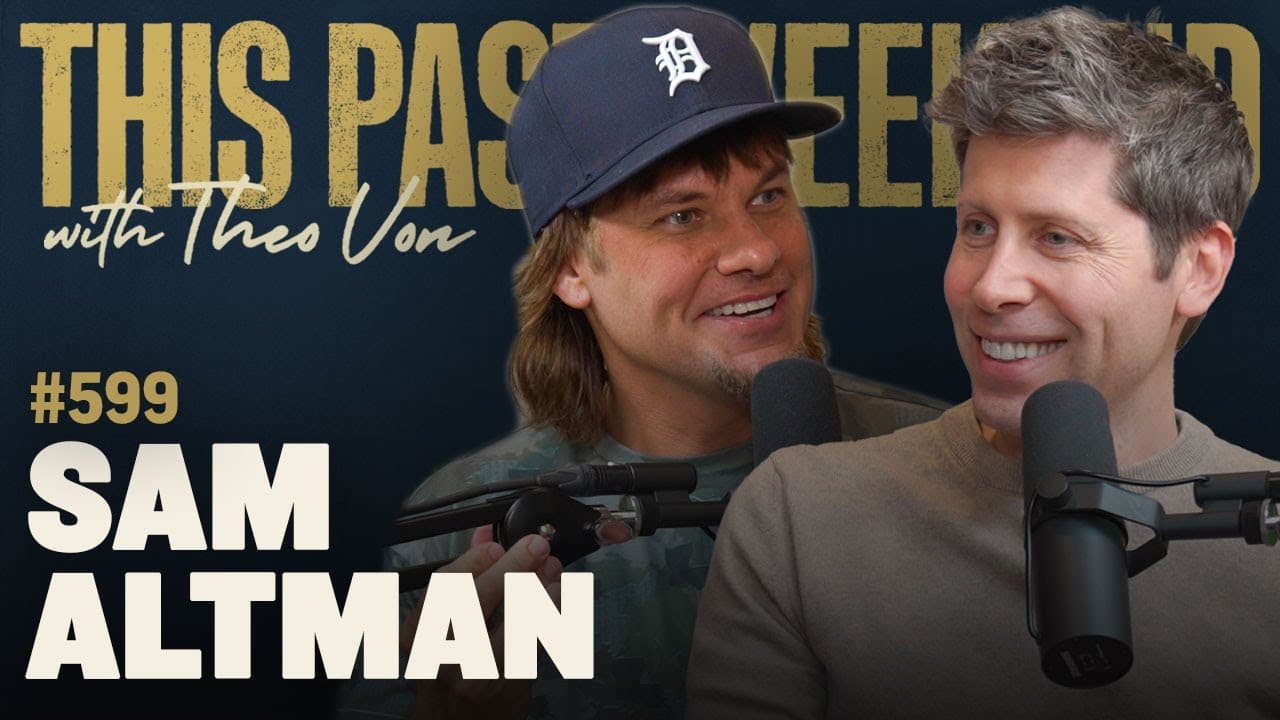
Sam Altman on Raising Kids in an AI Future
TL;DR
Sam Altman says children growing up now will never be smarter than an AI, and that fact reshapes what education is for. He argues kids adapt to new technology automatically while parents around age 50 struggle most, so the worry belongs with adults, not children. He also expects college to look very different in 18 years and thinks deeply human experiences become more precious as technology advances.
Transcript
Today's guest is uh well, dude's a straightup tech lord, let's be honest. He's uh he's one of the leaders, the world leaders in the development of AI. Um he started Open AI, which is known for uh having chat GPT. Uh we had a fascinating chat about the pros and cons, um the fears and hopes, everything I could learn about uh about artificial intellig... Read More
Key Insights
- Children born now will never be smarter than an AI, according to Altman. Kids born a few years earlier had a brief window where that was still true, but his own son will grow up entirely inside a world of systems more capable than he is.
- The generational risk from AI falls on adults, not kids. Altman says people who grow up with a new technology always become fluent in it and learn the new kinds of jobs, while a 50-year-old forced to work in a very different way does not always adapt successfully.
- Education is likely to change shape rather than simply improve. Altman already thinks college is not working well for most people, and guesses his four-month-old son will probably not attend, with the whole thing looking very different 18 years out.
- The most human things become the most valuable as sci-fi technology arrives, in Altman's view. He expects people to treat deeply human experiences as precious and sacred precisely because so much else becomes automated, though he admits it may not go that way.
- Attachment to babies is a neurochemical hack refined by evolution, Altman says. He recognizes that human responses to infants were finely tuned over a long period specifically to make parents love and be fascinated by them, and he loves it anyway.
- A child's rate of learning is what most amazes Altman as a new parent. He describes noticing daily gains in capability, such as grabbing objects and passing them between hands, and calls watching that day-to-day change unbelievable.
- Intellectual acceptance and emotional acceptance of new technology can diverge. Discussing the idea of conceiving children outside the body, Altman says he can understand it might be healthier for both child and mother, yet it still feels off to him emotionally.
- Dropping out of college is a shared trait among several tech founders named in the conversation, including Altman himself, Theo Von, and Zuckerberg. Altman only completed half of college before leaving.
Install to Summarize YouTube Videos and Get Transcripts
Explore YouTube Video Summarizer or Get YouTube Transcript Extractor
Questions & Answers
Q: What does Sam Altman say about whether his child will be smarter than AI?
Altman states plainly that his kid will never be smarter than an AI, and that this will never happen. He draws a line between his son and children born a few years earlier, who he says had a brief period of time where that was still possible. Beyond raw intelligence, he adds that his child will never know a world where products and services are not far smarter and more capable than he is, able to just do whatever you need.
Q: How should parents prepare their kids for an AI future according to Sam Altman?
Altman's answer is that the kids will be fine and that he is worried about the parents instead. His reasoning is historical: when a new technology arrives, the people who grow up with it are always fluent in it, always figure out what to do, and always learn the new kinds of jobs. The difficulty falls on someone around 50 who has to learn to do things in a very different way, which he says does not always work. He does add that he has separate worries about kids and technology, mentioning scrolling.
Q: Why does Sam Altman think college may not be worth it for his son?
Altman says that if he had to guess, his son probably will not go to college. He notes he only went to half of college himself and dropped out, as did Theo Von and Zuckerberg. His broader view is that college already is maybe not working great for most people, and that fast-forwarding 18 years to when his son would attend, education is going to feel very different and look like a very, very different thing.
Q: What is the OpenAI office like?
The OpenAI office in San Francisco was designed by a residential architect. Altman says the goal was for it to feel like someone's really comfortable country house rather than a big corporate sci-fi castle, and that they tried to get pretty far in that direction because they want people to feel super comfortable. Theo Von had imagined something more fortress-like, joking about drawbridges and firewalls, and says the finished space does feel residential and that the staff are sweet, nice people.
Q: What does Sam Altman say about becoming a father?
Altman's son is four months old. He describes fatherhood as the strongest example he has ever had of something everyone promised would be great turning out even better than expected, and says it is impossible to describe without sounding cliche. He calls it the best thing he has ever done by far and says he feels like a completely changed person. He also acknowledges that human attachment to babies is finely tuned by evolution to make parents love them, calling it a neurochemical hack that he loves anyway.
Q: How did having a baby change Sam Altman's daily life?
Altman says that at this point all he does is work and hang out with his family. He no longer gets to do many hobbies, describes it as a busy time at work, and does not get to see his friends much. People had warned him to take spontaneous international trips before the baby arrived because he would not be doing that again for a long time, but he says in practice he did not do that often anyway, does not miss it at all, and is thrilled with the trade.
Q: What does Sam Altman think about conceiving children outside the body?
Theo Von raises the idea that this may be one of the last roughly 40 years in which children are conceived in the body. Altman says he has heard a lot of people say that and has not thought about it hard himself, but that it makes sense. He separates his reactions: intellectually he can understand it may be the better way, easier and healthier for both child and mother, with the mother not taking the health risk. Emotionally, though, he says it feels way off to him.
Q: Why does Sam Altman think human experiences will become more valuable as technology advances?
Altman offers this as one of his takes on the future. In a world heading toward crazy sci-fi technology becoming reality, he thinks the deeply human things will become the most precious, sacred, valued things, and that people will care about the human experience more than ever. He immediately qualifies it, saying maybe it will not go that way and that he does not know, so he presents it as a possibility rather than a prediction.
Summary & Key Takeaways
-
Theo Von visits the OpenAI office in San Francisco to talk with Sam Altman, CEO of the AI company behind ChatGPT. The office was designed by a residential architect to feel like a comfortable country house rather than a corporate sci-fi castle, which Altman says was a deliberate choice to make people feel at ease.
-
Altman describes becoming a father four months ago as the strongest example he has of something people said would be great turning out even better than promised. He now spends his time only on work and family, has given up hobbies and spontaneous international travel, and says he is thrilled with the trade.
-
The conversation turns to AI and the next generation. Altman says his son will never be smarter than an AI and will never know a world where products and services are not far more capable than he is. He believes college already does not work well for most people and will look very different in 18 years.
Read in Other Languages (beta)
Share This Summary 📚
Summarize YouTube Videos and Get Video Transcripts with 1-Click
Try YouTube Summary with ChatGPT & Claude or YouTube Transcript Generator
Explore More Summaries from Theo Von 📚




Summarize YouTube Videos and Get Video Transcripts with 1-Click
Try YouTube Summary with ChatGPT & Claude or YouTube Transcript Generator