What Is HRM, the Brain-Inspired AI Beating Bigger Models?
TL;DR
A tiny Singapore startup's reasoning model, HRM, outperforms models many times its size by thinking in loops like the human brain instead of the usual step-by-step chain of thought. It pairs a high-level planner with a low-level worker, solves hard puzzles other top models fail entirely, trains fast on very little data, and is fully open-source.
Transcript
Over the last month, AI has been moving faster than anyone can keep up with. We've seen a so-called free model claim to be a hundred times smarter than chat GPT and even humiliate GPT5 in head-to-head tests. OpenAI's own leaks pointed to something wild called Yofo Wildflower, raising the question whether it's the next big opensource move. On top of... Read More
Key Insights
- HRM is a brain-inspired reasoning model from a small Singapore startup that outperforms models several times its size, challenging the idea that bigger always means smarter in artificial intelligence.
- Chain-of-thought prompting works by talking the model through a problem step by step, but a single mistake in that chain can collapse the entire answer, which is the weakness HRM avoids.
- HRM's architecture splits reasoning into a high-level planner that maps the big-picture strategy and a low-level worker that executes quickly, looping between them until the model settles on an answer.
- The looping design lets HRM internally check and refine its own reasoning mid-process, something standard transformer models cannot do once they commit to generating output.
- HRM adapts how much it thinks to the difficulty of the task, looping fewer times on simple problems and more on hard ones, unlike transformers that spend fixed effort per output token.
- HRM was trained on only a small number of examples per task with no massive pre-training, yet still beats larger models, showing strong reasoning can come from architecture rather than data scale.
- HRM uses more local gradient updates instead of deep back-propagation through time, making it less memory-intensive, faster to train, and closer to how biological brains are thought to work.
- Because it is efficient, HRM can run on modest hardware like a laptop or edge devices, and the startup is reportedly testing it in healthcare diagnosis and seasonal climate forecasting.
- DeepSeek's newest open-source model dropped on Hugging Face without warning, matched or beat a leading closed model on a programming benchmark, and ran far cheaper, shaking up the AI landscape.
Install to Summarize YouTube Videos and Get Transcripts
Explore YouTube Video Summarizer or Get YouTube Transcript Extractor
Questions & Answers
Q: What is HRM and who built it?
HRM is a brain-inspired reasoning AI agent unveiled by a small startup in Singapore. Rather than being a scaled-down large language model or a stripped-back transformer, it is described as something entirely different that borrows the brain's layered decision-making strategy. The team reportedly includes former engineers from major AI labs, and they position HRM as a step toward machines that can genuinely reason rather than just predict text.
Q: How does HRM differ from chain-of-thought reasoning?
Most modern AI models use chain-of-thought prompting, essentially talking themselves through a problem step by step. The weakness is that one mistake early in the chain can make the whole answer collapse. HRM skips this approach entirely. Instead of hoping the chain holds together, it reasons more like a human by thinking strategically first and then executing rapidly, looping internally so it can check and refine its own work before committing to a final answer.
Q: How does HRM's two-part architecture work?
HRM has two components that talk to each other: a high-level planner and a low-level worker. The planner acts like a slow, strategic brain that maps out the big picture and identifies what kind of problem it faces. The worker is a fast processor that carries out the plan. The planner sends instructions, the worker executes and returns results, and the planner updates its plan based on what happened, looping until the model reaches an answer.
Q: Why can HRM beat models much larger than itself?
HRM's advantage comes from architecture rather than size or data volume. Its looping, planner-and-worker design lets it internally verify and refine reasoning mid-process, something transformers cannot do once they start generating output. It also adapts how much it thinks to a problem's difficulty. According to the video, this lets a very small model outperform far larger ones on reasoning benchmarks and solve hard puzzles that some leading models fail completely.
Q: What kinds of problems was HRM tested on?
The video says HRM was evaluated on an intelligence-style benchmark for AI, on hard and extreme Sudoku puzzles, and on maze-solving challenges using grid layouts. It reportedly outscored leading models on the reasoning benchmark, solved a meaningful share of the toughest Sudoku puzzles where competing models solved none, and found optimal paths through a large share of the mazes while the others again failed. These were reasoning tasks, not conversational ones.
Q: Why is HRM more efficient to train and run?
HRM was trained on only a small number of examples per task with no massive internet datasets and no long pre-training phase. Instead of deep back-propagation through time, which is memory-intensive and slow, it uses more local gradient updates that are easier to compute and considered more biologically plausible. Needing less memory means it can train faster with fewer resources, run more models at once, and even operate on a laptop, edge device, or robot.
Q: What are HRM's limitations?
HRM is still early and narrowly focused. It is built to reason, not to chat, so it is not meant for tasks like writing poetry or summarizing emails. The video frames it as a strong proof of concept rather than a finished general-purpose assistant. It is one of several experimental architectural approaches being explored, alongside efforts like continuous thought machines, low-bit weight models, and diffusion-based reasoning, all aimed at rethinking how AI works instead of just scaling it up.
Q: What made DeepSeek's new model release notable?
DeepSeek's newest model appeared on Hugging Face with no warning and immediately drew attention for its raw numbers rather than marketing. It matched or edged past a leading closed model on a programming benchmark while running dramatically cheaper, meaning coding tasks that were expensive on a closed system could be done for a small fraction of the cost. It also offered a very large context window, letting it handle massive text inputs, which for enterprises running many tasks daily can reshape entire budgets.
Q: Why does the video call this month a turning point for AI?
The video argues the month marked a shift because progress came from new architectures and open-source releases, not just bigger models. HRM showed strong reasoning can come from brain-inspired design, DeepSeek's open release challenged top closed systems on price and performance, and Google announced advances in self-improving agents and reasoning. Robots also advanced, with Boston Dynamics upgrading Atlas and Unitree revealing a new humanoid, suggesting the next AI leap may be a new architecture rather than another scaled-up model.
Summary & Key Takeaways
-
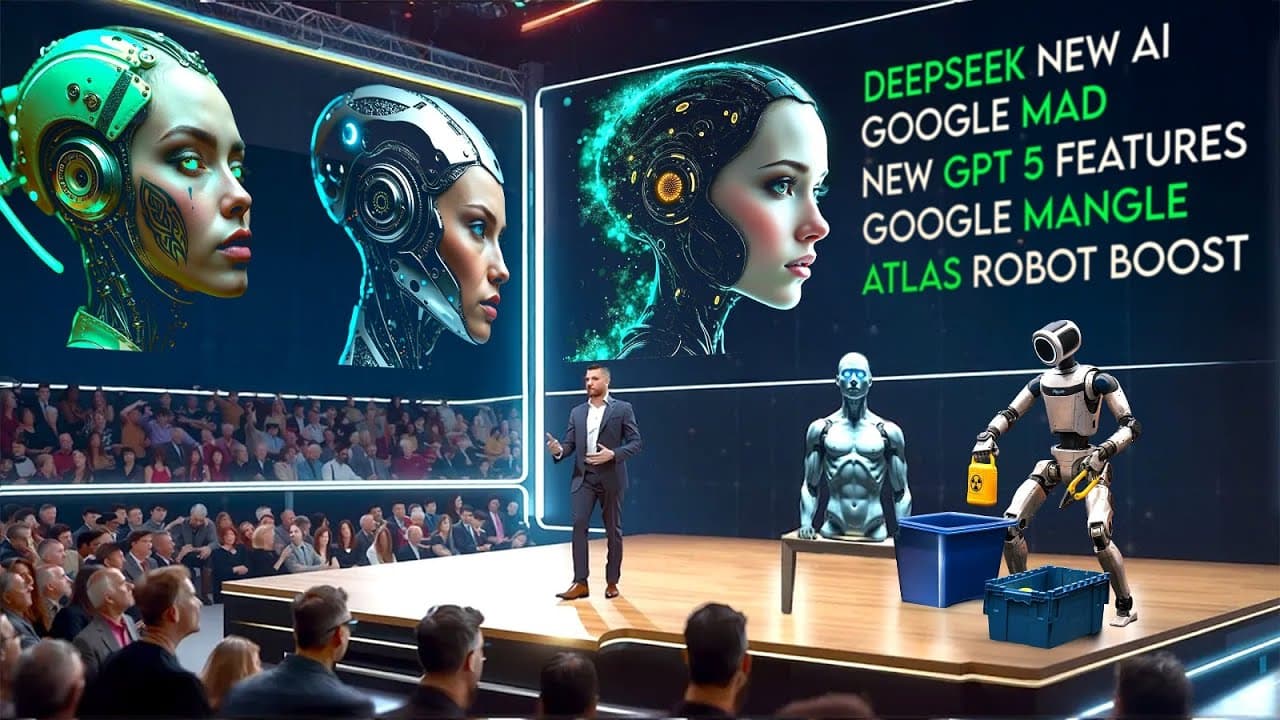
The past month in AI has been a turning point, with a small model claiming to outsmart leading systems, DeepSeek's surprise open-source release rivaling top closed models, new GPT-5 features, humanoid robot reveals from Boston Dynamics and Unitree, and a wave of Google announcements around agents and reasoning.
-
HRM, a brain-inspired reasoning model from a Singapore startup, thinks in loops rather than a fragile step-by-step chain. It uses a high-level planner and a low-level worker that pass results back and forth, letting it check and refine its own reasoning and beat models many times larger on reasoning tests.
-
HRM trains quickly on very little data with no heavy pre-training, uses local gradient updates that need less memory, and can run on laptops or edge devices. It is fully open-source on GitHub, and its team includes former engineers from major AI labs betting on brain-inspired design over pure scale.
Read in Other Languages (beta)
Share This Summary 📚
Summarize YouTube Videos and Get Video Transcripts with 1-Click
Try YouTube Summary with ChatGPT & Claude or YouTube Transcript Generator
Explore More Summaries from AI Revolution 📚




Summarize YouTube Videos and Get Video Transcripts with 1-Click
Try YouTube Summary with ChatGPT & Claude or YouTube Transcript Generator