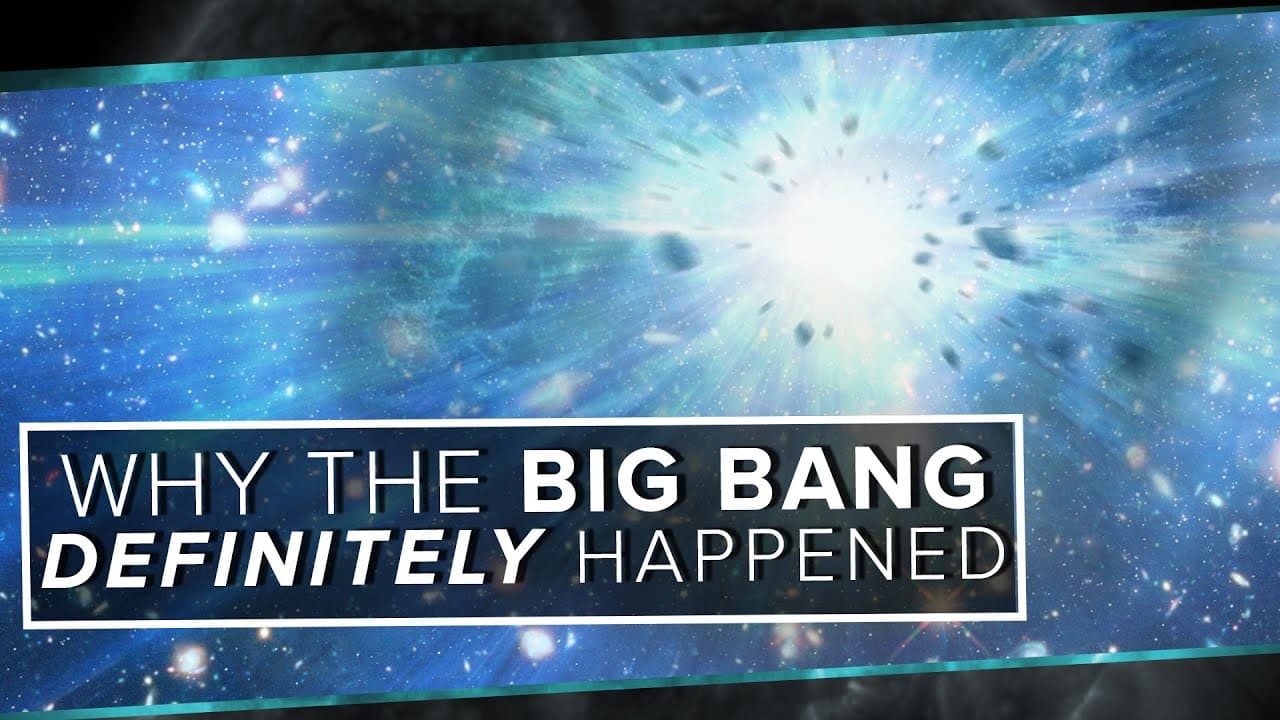
Why the Big Bang Definitely Happened | Space Time | PBS Digital Studios
TL;DR
The Big Bang theory is largely confirmed but still has uncertainties.
Transcript
Our universe started with the Big Bang, or did it? Let's see how far back in time we can push our certainty, and let's see what questions still lie beyond the limit of our understanding. [MUSIC PLAYING] The Big Bang theory was pretty contentious when it was first proposed, as is any picture of reality that conflicts with the current dogma. And I'm ... Read More
Key Insights
- The Big Bang theory, once controversial, is now widely accepted due to substantial supporting evidence from various scientific experiments and observations.
- The universe's expansion is evidenced by the redshift of light from distant galaxies, confirming the universe was once smaller and denser.
- The cosmic microwave background radiation provides strong evidence of a hot, dense early universe, supporting the Big Bang theory.
- Primordial nucleosynthesis during the early universe predicted the proportions of certain elements, aligning with current astronomical observations.
- General relativity predicts a singularity at the Big Bang, but this is not believed by most cosmologists due to quantum scale gravity limitations.
- Particle accelerators have recreated early universe conditions, giving confidence in our understanding of physics down to 10^-32 seconds after the Big Bang.
- Baryon acoustic oscillations in the cosmic microwave background indicate sound waves in the early universe, further supporting the Big Bang theory.
- Despite strong evidence, the exact moment of the Big Bang remains a gray area, with ongoing searches for a unified theory of physics.
Install to Summarize YouTube Videos and Get Transcripts
Explore YouTube Video Summarizer or Get YouTube Transcript Extractor
Questions & Answers
Q: What evidence supports the Big Bang theory?
The Big Bang theory is supported by multiple lines of evidence, including the cosmic microwave background radiation, which shows a uniform, yet slightly mottled pattern indicative of a hot, dense early universe. Additionally, the redshift of light from distant galaxies suggests that the universe is expanding, which aligns with the predictions of the Big Bang theory.
Q: How does the cosmic microwave background radiation support the Big Bang theory?
The cosmic microwave background radiation is a relic from the early universe, providing a snapshot of the universe when it was about 400,000 years old. This uniform radiation, now detected as microwaves, was originally infrared light trapped in a hot plasma. Its existence and properties are consistent with a universe that expanded from a hot, dense state, supporting the Big Bang theory.
Q: What role do particle accelerators play in understanding the Big Bang?
Particle accelerators recreate conditions similar to those in the early universe, allowing scientists to test theories about the universe's first moments. By achieving the high energies that existed shortly after the Big Bang, researchers can verify the predictions of physics under such conditions, providing confidence in our understanding of the universe down to 10^-32 seconds after the Big Bang.
Q: What are baryon acoustic oscillations, and how do they relate to the Big Bang?
Baryon acoustic oscillations are sound wave patterns imprinted in the cosmic microwave background and the distribution of galaxies. These oscillations arose from pressure waves in the early universe's hot plasma, leaving a 'ring-like' pattern. Their presence in the cosmic microwave background and galaxy distribution supports the Big Bang theory by indicating the universe's expansion and evolution from an early hot, dense state.
Q: Why is the initial singularity of the Big Bang debated?
The initial singularity, a point where the universe's density and temperature would be infinite, is predicted by general relativity. However, this concept conflicts with quantum mechanics, which governs the behavior of particles at the smallest scales. Most cosmologists believe that a complete theory of quantum gravity is needed to accurately describe the universe's initial state, making the singularity a topic of ongoing debate.
Q: What is primordial nucleosynthesis, and how does it support the Big Bang theory?
Primordial nucleosynthesis refers to the formation of light elements, such as deuterium, helium, and lithium, during the universe's first few minutes. The Big Bang theory predicts specific proportions of these elements based on the conditions of the early universe. Observations of these elemental abundances in the universe today match these predictions, providing strong support for the Big Bang theory.
Q: How does the universe's expansion relate to the Big Bang theory?
The universe's expansion is a key feature of the Big Bang theory. Observations of redshifted light from distant galaxies indicate that the universe is expanding, with galaxies moving away from us. This expansion suggests that the universe was once much smaller and denser, consistent with the Big Bang model, which describes the universe's evolution from an initial hot, dense state.
Q: What challenges remain in understanding the Big Bang?
Despite strong evidence supporting the Big Bang theory, challenges remain in understanding the universe's earliest moments. Theories of general relativity and quantum mechanics currently disagree on the nature of the universe's beginning, and a unified theory of quantum gravity is needed. Additionally, testing conditions earlier than 10^-32 seconds after the Big Bang is beyond current experimental capabilities, leaving some questions unanswered.
Summary & Key Takeaways
-
The Big Bang theory describes the universe's expansion from a tiny, dense state, supported by evidence like cosmic microwave background radiation and redshifted light from galaxies. While general relativity suggests a singularity, quantum mechanics challenges this, leaving uncertainties about the universe's beginning.
-
Experiments and observations, such as primordial nucleosynthesis and particle accelerator tests, provide confidence in our understanding of the universe's early moments. However, the exact conditions of the universe before 10^-32 seconds remain untested, with physicists seeking a unified theory.
-
The cosmic microwave background's smooth pattern and baryon acoustic oscillations offer insights into the universe's evolution from tiny fluctuations to galaxy clusters. These observations affirm the Big Bang theory, though the initial singularity remains a topic of debate among cosmologists.
Read in Other Languages (beta)
Share This Summary 📚
Summarize YouTube Videos and Get Video Transcripts with 1-Click
Try YouTube Summary with ChatGPT & Claude or YouTube Transcript Generator
Explore More Summaries from PBS Space Time 📚
Summarize YouTube Videos and Get Video Transcripts with 1-Click
Try YouTube Summary with ChatGPT & Claude or YouTube Transcript Generator