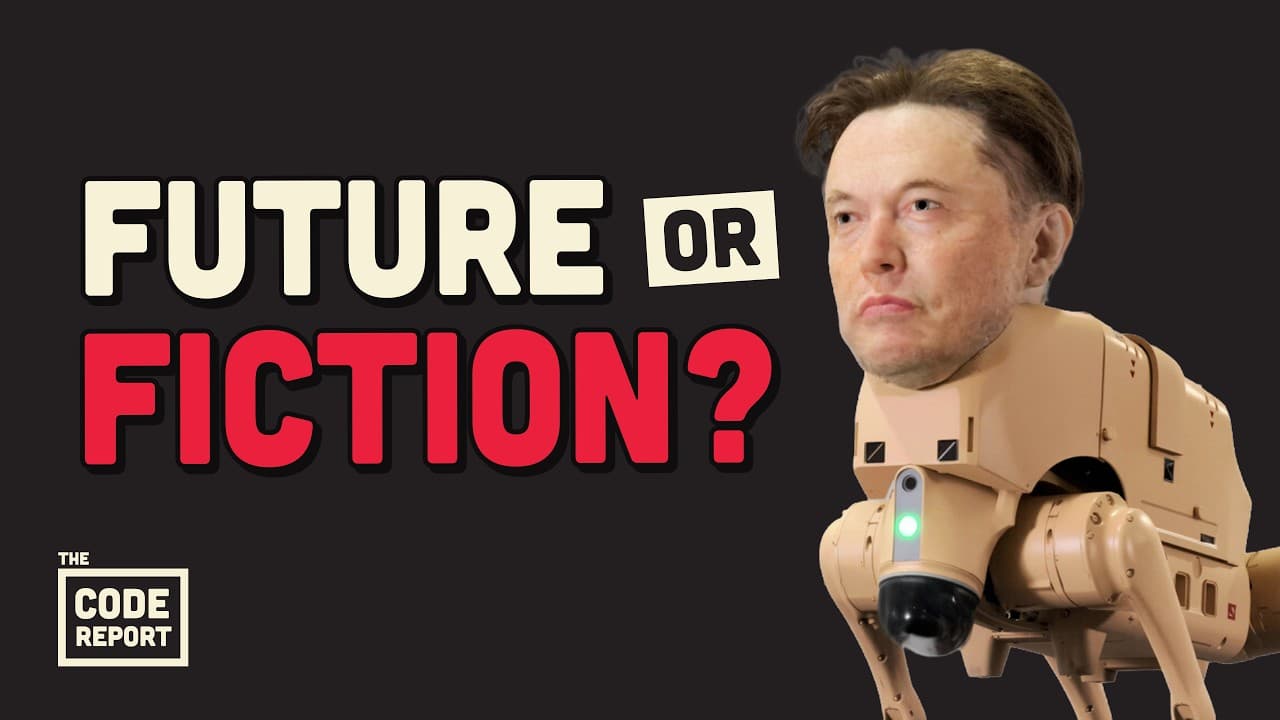
Why Are Humanoid Robots Still Decades Away?
TL;DR
General-purpose humanoid robots are unlikely to replace household workers soon because reliable hand dexterity, real-time motor control, and scalable training data remain unresolved. Researchers cited in the account estimate that a robot capable of replacing a maid is more than 10 years away, while polished company demonstrations may not reveal success rates, limitations, or readiness for everyday use.
Transcript
Last week, Google DeepMind released Gemini Robotics, too, a crazy new AI model that can control a humanoid robot's entire body. In this demo video, they make robots walk, crouch, tie knots, screw in light bulbs, and even team up with other robots to clean up a room. On top of that, Silicon Valley startup 1X also just released its own crazy new demo... Read More
Key Insights
- General-purpose household robots are still more than 10 years away according to the researchers cited, and that estimate is characterized as highly optimistic. The account also says a broadly capable robot maid could remain decades away because basic physical tasks are still unreliable.
- Gemini Robotics 2 is described as a three-model system whose central component is a vision-language-action model. It receives camera pixels and plain-English instructions, then outputs commands that control a humanoid robot's legs, torso, arms, and fingers through one learned policy.
- Humanlike hand dexterity is an unsolved robotics problem even though walking and backflips are described as essentially solved. Reported success rates for tasks involving multiple fingers can range from 0% to 90%, which is insufficient for dependable household work.
- Practical human replacement requires success rates well above 95% according to the account. A household robot that fails or drops dishes 10% of the time would not provide the reliability needed to justify using it instead of a person.
- Robot control requires continuous, coordinated output rather than discrete text tokens. A policy must stream values such as joint angles and torques hundreds of times per second to dozens of motors, and even a small error can make the machine fall.
- Robotics lacks an internet-scale source of training data comparable to the text and books used for large language models. Researchers therefore use simulations and synthetic data, hoping skills learned in a simulated environment will transfer to physical machines.
- Imitation learning works by having a human teleoperate a robot so the model can reproduce demonstrated behavior. The method is conceptually simple, but collecting sufficient human-operated demonstrations is difficult to scale across many tasks and environments.
- Reinforcement learning works through trial and error, rewarding a robot when it performs a desired action. It can teach specialized physical behavior, including the martial-arts demonstration mentioned, but it is not yet adequate for safe, general-purpose robots.
Install to Summarize YouTube Videos and Get Transcripts
Explore YouTube Video Summarizer or Get YouTube Transcript Extractor
Questions & Answers
Q: Why are general-purpose humanoid robots still far away?
General-purpose humanoid robots remain far away because reliable physical interaction is much harder than generating text. Robots must coordinate dozens of motors in real time, produce continuous joint angles and torques, handle gravity, and manipulate varied objects with precise fingers. They also lack a vast ready-made training dataset, while current imitation-learning and reinforcement-learning approaches both have important scaling or safety limitations.
Q: How does Gemini Robotics 2 control a humanoid robot?
Gemini Robotics 2 is described as a system containing three models, with a vision-language-action model as its most important component. That model accepts visual information from camera pixels together with instructions in plain English. It then produces commands for the robot's hardware, controlling the legs, torso, arms, and fingers of a full humanoid through a single learned policy.
Q: Why is robotic hand dexterity harder than walking?
Walking and even backflips are described as essentially solved robotics problems, but manipulating objects with multiple fingers remains unreliable. Robot demonstrations can report multi-finger task success rates ranging from 0% to 90%. Household work demands much greater consistency because a robot that mishandles or drops dishes 10% of the time would not be a sensible replacement for a human worker.
Q: How reliable must a household humanoid robot be?
The account argues that robotic task success rates would need to be well above 95% before replacing a person could make practical sense. Even a 90% success rate leaves frequent failures when the machine performs many everyday actions. Household manipulation involves fragile objects and varied conditions, so impressive individual demonstrations do not establish the sustained reliability required for useful domestic service.
Q: Why is robot control harder than language generation?
A language model outputs discrete tokens and can take time to produce them without causing physical harm when an answer is imperfect. A robot must instead stream continuous values, including joint angles and torques, hundreds of times per second. Dozens of motors must operate together, and a small policy error can have an immediate physical consequence, such as causing the robot to fall.
Q: How are researchers addressing the shortage of robot data?
Researchers are attempting to compensate for scarce real-world robot data by creating simulations and synthetic training data. The basic idea is to let a machine practice inside a simulator and later transfer the learned behavior to real hardware, similar to practicing flight virtually before operating a real plane. The account notes that researchers still debate how these robots should be trained most effectively.
Q: What is the difference between imitation learning and reinforcement learning for robots?
Imitation learning trains a robot from behavior demonstrated by a human teleoperator, allowing the model to copy the person's actions. Its central limitation is the difficulty of collecting demonstrations at large scale. Reinforcement learning instead lets a robot attempt actions through trial and error and provides a reward when it performs well, but it is not yet sufficient for safe, general-purpose robots.
Q: Can consumers buy the humanoid robots shown in company demonstrations?
Many heavily promoted humanoid robots from companies such as 1X, Figure, and Tesla cannot be purchased by ordinary consumers according to the account, making their real capabilities difficult to verify independently. The newer Boston Dynamics Atlas is also described as unavailable because Hyundai and Google bought the supply. The Chinese Unitree G1 is presented as an available option with a $13,500 entry price.
Summary & Key Takeaways
-
Humanoid robot demonstrations show rapid progress, including unified AI policies that control legs, torsos, arms, and fingers. However, impressive movements do not prove that robots can perform varied household or industrial work reliably. Walking and backflips are described as largely solved, while human-level hand dexterity remains a major obstacle.
-
Physical control is harder than text generation because robots must continuously produce joint angles and torques for many coordinated motors, hundreds of times per second. Small errors can cause immediate physical failure. Robots also lack an internet-scale training source, forcing researchers to collect demonstrations or create simulations and synthetic data.
-
Imitation learning allows a robot to copy behavior demonstrated through human teleoperation, but gathering enough examples is difficult. Reinforcement learning lets robots improve through trial and error using reward signals, yet it is not considered sufficient for safe, general-purpose machines. Consequently, commercial availability remains far narrower than promotional demonstrations suggest.
Read in Other Languages (beta)
Share This Summary 📚
Summarize YouTube Videos and Get Video Transcripts with 1-Click
Try YouTube Summary with ChatGPT & Claude or YouTube Transcript Generator
Explore More Summaries from Fireship 📚


Summarize YouTube Videos and Get Video Transcripts with 1-Click
Try YouTube Summary with ChatGPT & Claude or YouTube Transcript Generator