How Did Joanne Miles Prove Her Value After 9 Years at Crestline and a Nearly 40% Pay Gap?
TL;DR
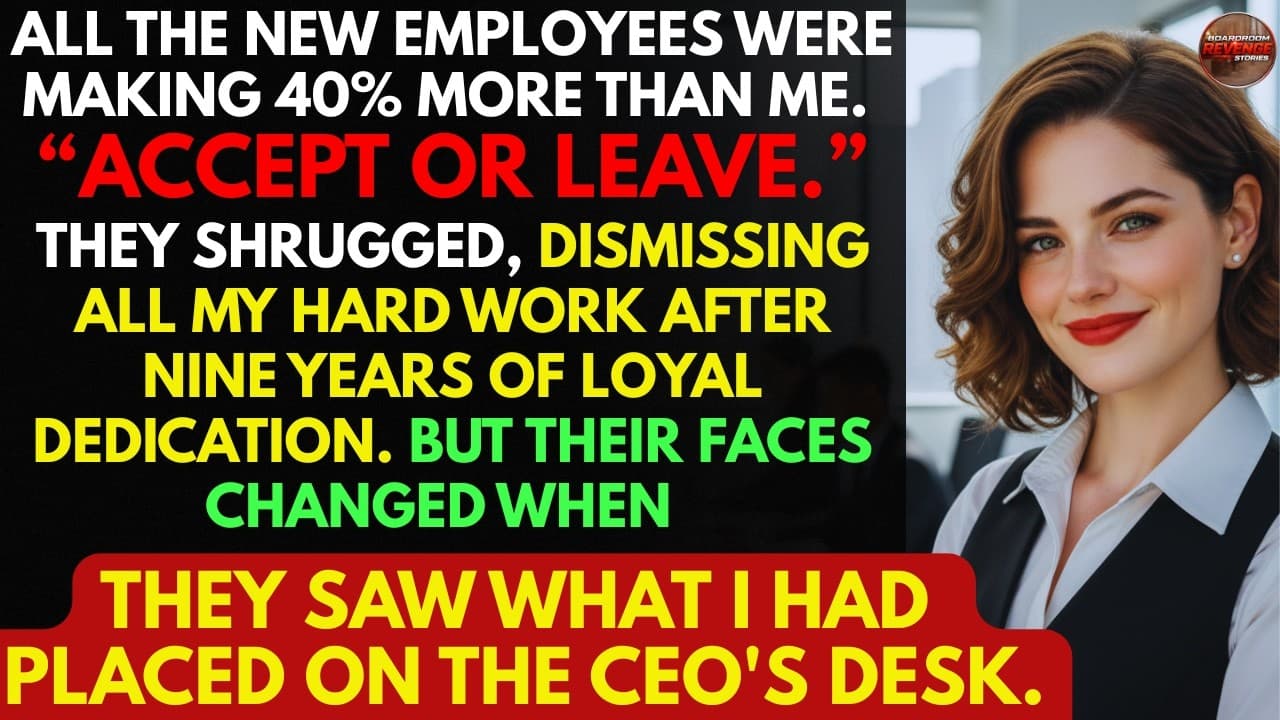
Joanne Miles proved her value by converting years of overlooked work into a 43-page business case documenting systems built, employees trained, risks prevented, and an estimated $284,600 saved in one year. After finding that newer colleagues earned $135,500 to $141,000 while she earned $99,200, she secured a $148,000 offer and set specific terms for staying. Read on to see the evidence and leverage behind her response.
Transcript
40% more. For a moment, I honestly thought I had read the spreadsheet wrong. I leaned closer to my monitor, blinking hard, waiting for the numbers to rearrange themselves into something that made sense. They didn't. The file had come from HR by accident. One of those careless internal emails meant for senior leadership, but somehow sent to the enti... Read More
Key Insights
- Joanne's compensation disparity is documented in an accidentally distributed HR spreadsheet: her $99,200 salary trails the $135,500 to $141,000 salaries of three newer employees she personally helped train, producing a gap described as nearly 40%.
- The manager's response is based on changed market conditions and different hiring circumstances, but he offers no immediate adjustment for Joanne. His explanation shows that the company recognizes external market rates without automatically correcting the pay of a long-serving employee.
- Joanne's business case is a 43-page record of systems created, employees trained, emergencies resolved, audits supported, penalties avoided, and processes improved. Its factual structure allows her to present underpayment as a measurable business problem instead of relying only on frustration.
- Joanne's documented contributions include automating expense tracking to eliminate nearly 25 hours of manual work each month and identifying a tax classification mistake that could have produced more than $400,000 in penalties. These examples connect her work directly to time savings and risk prevention.
- Joanne's estimated value to Crestline during the previous year is $284,600, while the adjustment she calculates to approach market compensation is $39,800. This comparison gives leadership a clear financial basis for evaluating the cost of retaining or losing her.
- The external offer from Meridian Capital Partners provides a $148,000 base salary, stronger benefits, and a senior financial strategy position. It gives Joanne a credible alternative to remaining at Crestline and prevents her negotiation from depending entirely on her current employer's approval.
- Joanne's conditions for reconsidering her resignation are a $152,000 salary, retroactive compensation for the previous year's disparity, a title matching her actual responsibilities, and a company-wide compensation review. Her demands address personal pay, past inequity, professional recognition, and systemic problems.
- The story is explicitly identified as fictional and created with artificial intelligence support to communicate broader lessons. Its central lesson is that loyalty alone may not produce fair compensation, while evidence, quantified impact, and credible alternatives can strengthen an employee's negotiating position.
Install to Summarize YouTube Videos and Get Transcripts
Explore YouTube Video Summarizer or Get YouTube Transcript Extractor
Questions & Answers
Q: How can an underpaid employee prove their value?
Joanne created a dated record of every system she built, employee she trained, emergency she resolved, audit she supported, and financial risk she prevented. She added conservative estimates for time savings, avoided penalties, process improvements, and training support, turning her frustration into a 43-page business case.
Q: What did the compensation spreadsheet reveal about Joanne Miles's pay?
The spreadsheet showed that Joanne earned $99,200 after nine years at Crestline Financial Group. Ethan Brooks earned $138,000, Samantha Reed earned $135,500, and Logan Pierce earned $141,000, although Joanne had helped train all three.
Q: How did Joanne respond when her manager refused to adjust her salary?
Marcus Hale said new employees were hired under different market conditions and that changing Joanne's salary was not simple. Joanne then documented her contributions, pursued an external opportunity, and ultimately submitted her resignation with evidence supporting her position.
Q: What evidence did Joanne include in her business case?
Joanne documented the reporting template she rebuilt, the employees she trained, audits she helped pass, emergencies she resolved, and processes she improved. Her examples included automating expense tracking to eliminate nearly 25 hours of manual work each month and finding a tax classification error that could have caused more than $400,000 in penalties.
Q: How much financial value did Joanne calculate she had created?
Joanne estimated that her work saved Crestline $284,600 during the previous year. She compared that figure with the additional $39,800 she calculated was needed to bring her salary closer to the relevant market level.
Q: What external job offer gave Joanne negotiating leverage?
Meridian Capital Partners offered Joanne a $148,000 base salary, stronger benefits, and a senior financial strategy position. The offer gave her a credible alternative to remaining at Crestline and supported the resignation package she presented to leadership.
Q: What did Joanne request before reconsidering her resignation?
Joanne requested a $152,000 salary, retroactive compensation for the previous year's disparity, and a title reflecting her actual responsibilities. She also required a company-wide compensation review to identify other employees who might be facing similar treatment.
Q: Is Joanne Miles's story about Crestline Financial Group real?
No. The story is explicitly identified as fictional and created with artificial intelligence support to communicate broader life lessons. Its central lesson is that quantified contributions and a credible alternative can strengthen an employee's response to unfair compensation.
Summary & Key Takeaways
-
Joanne Miles accidentally receives an internal compensation spreadsheet showing that employees she trained earn between $135,500 and $141,000, while her salary after nine years is $99,200. Her manager acknowledges changing market conditions but refuses to adjust her compensation, prompting her to stop treating loyalty as sufficient protection.
-
Joanne converts her anger into a 43-page analysis documenting systems she built, employees she trained, costly mistakes she prevented, and processes she improved. She estimates that her work saved $284,600 during the previous year, while raising her salary near market rate would require an additional $39,800.
-
With a $148,000 offer from Meridian Capital Partners, Joanne submits her resignation, the competing offer, and her documented business case to Crestline's CEO. She demands $152,000, retroactive compensation, an appropriate title, and a company-wide compensation review. Leadership requests 24 hours, while she maintains a two-week notice period.
Read in Other Languages (beta)
Share This Summary 📚
Summarize YouTube Videos and Get Video Transcripts with 1-Click
Try YouTube Summary with ChatGPT & Claude or YouTube Transcript Generator
Explore More Summaries from Boardroom Revenge Stories 📚



Summarize YouTube Videos and Get Video Transcripts with 1-Click
Try YouTube Summary with ChatGPT & Claude or YouTube Transcript Generator