How to Identify Your Learner Type for Effective Studying
TL;DR
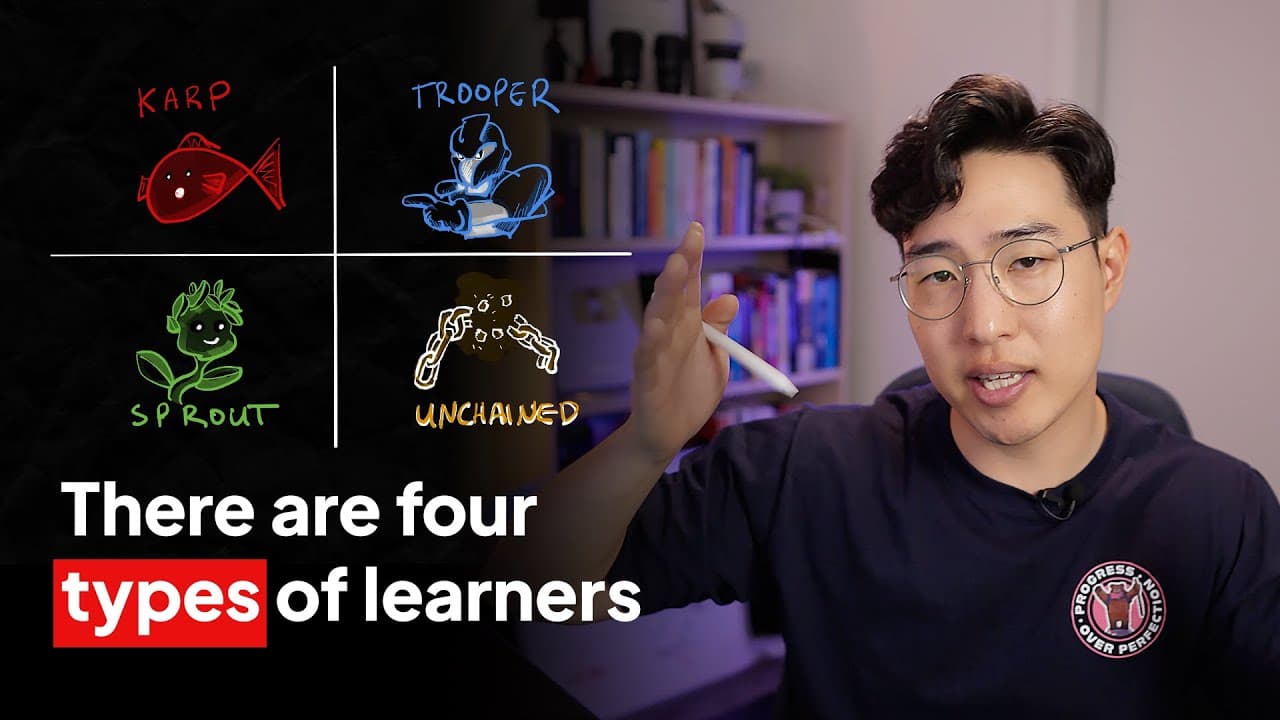
Identifying your learner type is essential for enhancing your study efficiency. The three key dimensions that influence learning are deep processing, self-regulation, and mindset. Understanding your learner type — whether Unchained, Sprout, Trooper, or Carp — can help you target specific areas for improvement in your study habits.
Transcript
your ability to learn is one of the most important skills in your life it is literally life defining but if you've ever tried to get better at learning you probably realize that what works for one person doesn't necessarily work for another person like have you ever try to copy something that some top student will do but then it just doesn't work f... Read More
Key Insights
- 🅰️ Learning styles and learner types are distinct concepts, with learner types focusing on habits and processes.
- 🤳 Deep processing, self-regulation, and mindset are three crucial dimensions that determine learning efficiency.
- ✋ High achieving individuals with high deep processing can use ineffective techniques and still perform well.
- 😘 Individuals with low deep processing need to focus on developing cognitive habits and compensating with other dimensions.
- 🖐️ Mindset plays a significant role in learning, with a growth mindset being essential for improvement.
- 🅰️ The most common learner types are Unchained, Sprout, Trooper, and Carp, each with specific areas to focus on for improvement.
- 🦮 Understanding your learner type can guide you in finding effective learning strategies.
Install to Summarize YouTube Videos and Get Transcripts
Explore YouTube Video Summarizer or Get YouTube Transcript Extractor
Questions & Answers
Q: What is the difference between learning styles and learner types?
Learning styles refer to the theory that individuals have preferred ways of learning, such as visual, auditory, read and write, or kinesthetic. Learner types, on the other hand, focus on habits and processes that impact learning efficiency.
Q: How do mindset and self-regulation affect learning efficiency?
Mindset, specifically having a growth mindset, is crucial for embracing mistakes and learning from them. Self-regulation allows you to adapt your learning methods and monitor progress, ensuring consistency and adaptability.
Q: Can deep processing be improved?
Yes, while deep processing is influenced by genetics and childhood experiences, it can also be trained and improved over time through the development of good cognitive habits.
Q: How do learner types affect learning strategies?
Learner types indicate areas of strengths and weaknesses, allowing individuals to focus their efforts on improving specific dimensions to enhance their learning efficiency.
Summary & Key Takeaways
-
Your ability to learn is vital and can greatly impact your performance.
-
Everyone has a unique learner type, which affects their strengths and areas for improvement.
-
Learning styles are different from learner types, with the latter being focused on habits and processes.
-
Deep processing, self-regulation, and mindset are three key dimensions that determine learning efficiency.
-
The most common learner types are Unchained, Sprout, Trooper, and Carp, each with specific areas to focus on for improvement.
Read in Other Languages (beta)
Share This Summary 📚
Summarize YouTube Videos and Get Video Transcripts with 1-Click
Try YouTube Summary with ChatGPT & Claude or YouTube Transcript Generator
Explore More Summaries from Justin Sung 📚


Summarize YouTube Videos and Get Video Transcripts with 1-Click
Try YouTube Summary with ChatGPT & Claude or YouTube Transcript Generator