How to Estimate Air Pollution Using Nearest Neighbor Method
TL;DR
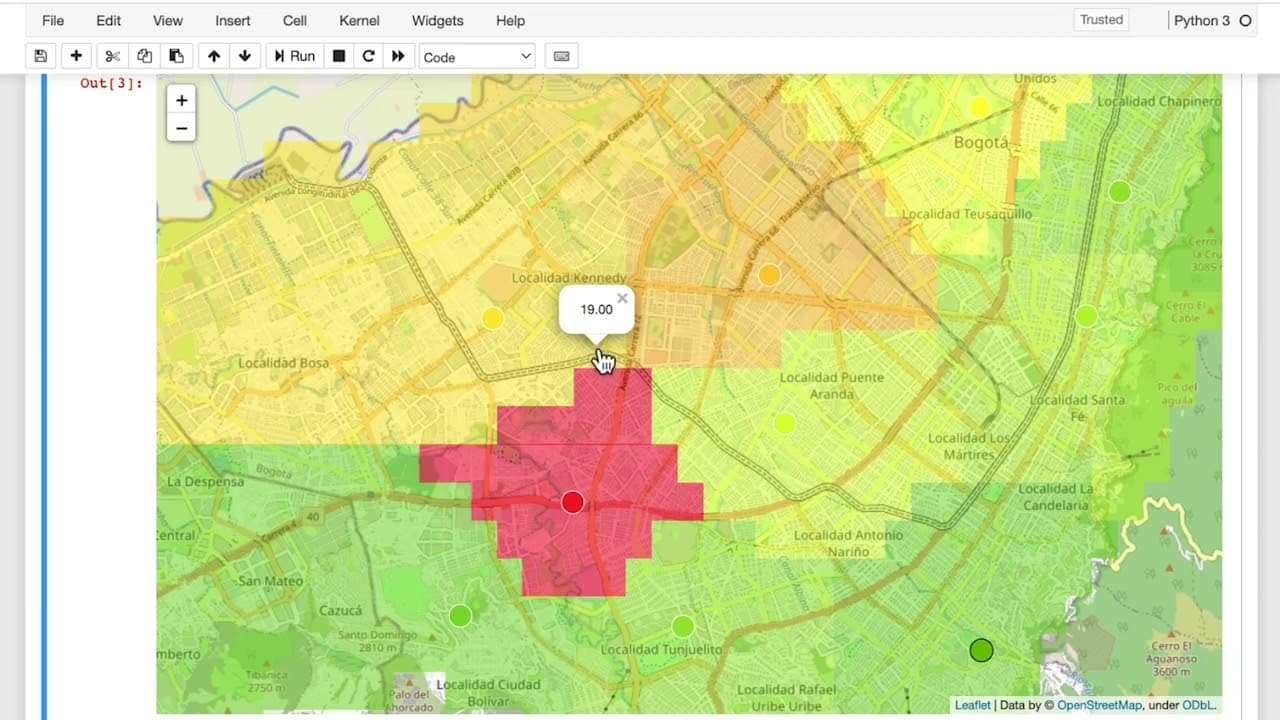
To estimate air pollution levels at any location, use the nearest neighbor method by referencing the closest air quality sensor's measurement. This method can be enhanced by considering multiple neighbors and applying inverse distance weighting, which prioritizes closer sensors for more accurate estimates. An initial simple baseline can be established with one neighbor, while increasing the number of neighbors improves estimation accuracy.
Transcript
in this video we'll wrap up the design phase by working out a methodology to make estimates for pollutant levels between the sensor stations so just like with the issue of missing values at a given sensor station it's good to First think about what is a very simple Baseline that we can Implement what would this look like and once we've established ... Read More
Key Insights
- 👱 The nearest neighbor method is a logical choice for estimating air pollution levels based on the assumption that nearby measurements have similarities.
- ❓ By considering multiple nearest neighbors and using weighting schemes, the nearest neighbor method can be improved.
- 😚 Inverse distance weighting assigns higher weights to measurements from closer neighbors, leading to a more accurate estimate.
- ❓ The mean absolute error is calculated to evaluate the performance of the estimation method, indicating how off the estimates are from actual measurements.
- 👌 Increasing the value of K in the K nearest neighbor method can lead to smoother estimates within a city grid.
- 🎚️ Other algorithms and weighting schemes can be explored, but the physical constraint of unknown pollutant levels limits the accuracy of any model.
- 👌 Establishing a baseline using a K value of 1 and then refining the algorithm with a higher K value and distance weighting can improve pollution level estimates.
Install to Summarize YouTube Videos and Get Transcripts
Explore YouTube Video Summarizer or Get YouTube Transcript Extractor
Questions & Answers
Q: What is the nearest neighbor method and how does it work?
The nearest neighbor method is an approach for estimating values based on the assumption that nearby neighbors in the data set have something in common with the area of focus. In the case of air pollution measurements, it assumes that characteristics of the air at any given location are most similar to the characteristics at the nearest central locations.
Q: How can the nearest neighbor method be improved?
By considering multiple nearest neighbors, known as the K nearest neighbor (KNN) method, a more refined estimate can be obtained. Additionally, weighting schemes, such as inverse distance weighting, can be used to give more weight to measurements from closer neighbors.
Q: How does inverse distance weighting work in pollutant estimation?
In inverse distance weighting, a weight is assigned to each neighbor based on the inverse square of the distance from the location of interest. This means closer neighbors have higher weights in the estimate calculation, reflecting the intuition that nearby measurements hold more relevance.
Q: Are there other algorithms or weighting schemes to consider for pollutant estimation?
Yes, there are alternative algorithms and weighting schemes to explore. However, the physical constraint of not knowing pollutant levels between sensors limits the accuracy of any model. The K nearest neighbor method with inverse distance weighting serves as a reasonable baseline estimate.
Summary & Key Takeaways
-
The video introduces the concept of using a simple baseline, such as the nearest neighbor method, to estimate pollutant levels at any location in a city.
-
The nearest neighbor method involves looking up the most recent measurement from the nearest air quality sensor and assuming it holds true for the location of interest.
-
The video explains how the nearest neighbor method can be improved by considering multiple nearest neighbors and using inverse distance weighting.
Read in Other Languages (beta)
Share This Summary 📚
Summarize YouTube Videos and Get Video Transcripts with 1-Click
Try YouTube Summary with ChatGPT & Claude or YouTube Transcript Generator
Explore More Summaries from DeepLearningAI 📚


Summarize YouTube Videos and Get Video Transcripts with 1-Click
Try YouTube Summary with ChatGPT & Claude or YouTube Transcript Generator