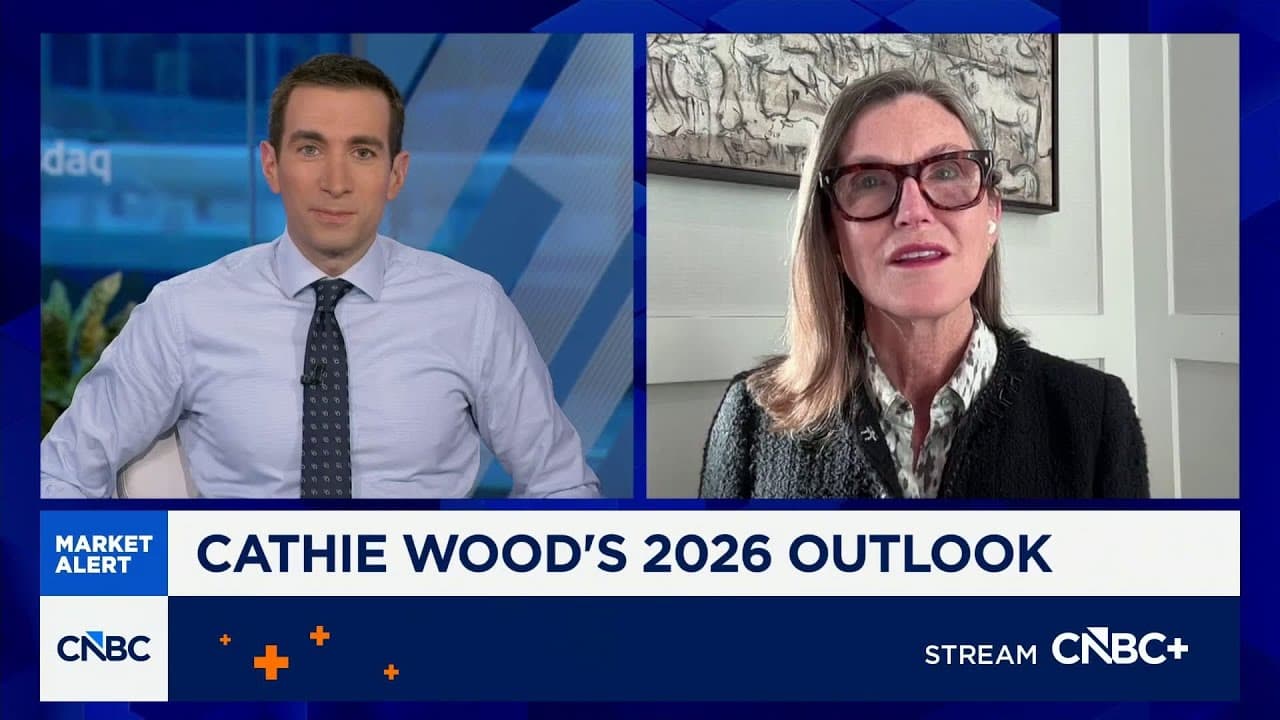
Why Cathie Wood Expects Deflation in 2026
TL;DR
Deflationary pressures could push inflation below expectations in 2026, supported by lower oil and housing prices, productivity gains, falling unit labor costs, and technology. Cathie Wood also expects Tesla’s valuation story to shift from challenged electric vehicle sales toward higher-margin robotaxi revenue, while useful industrial robots should emerge sooner than fully human-capable machines.
Transcript
JOINING US RIGHT NOW ON THE MARKETS, TECH, CRYPTO AND HER OUTLOOK FOR 2026. CATHIE WOOD IS HERE. ARK INVEST CEO AND CIO 2025 WAS QUITE A YEAR BOTH UP AND DOWN AND BACK AGAIN TO SOME DEGREE. WHEN YOU WHEN YOU LOOK AT SOME OF THE BIG HOLDINGS THAT YOU HAVE, WHETHER IT BE TESLA, MAYBE WE GET INTO CRYPTO AND EVERYTHING ELSE. WHERE DO YOU THINK THING... Read More
Key Insights
- Deflationary pressure is central to Wood’s 2026 outlook. She expects inflation results to surprise on the low side because oil prices, housing prices, productivity improvements, declining unit labor costs, and technology are all working against sustained price increases.
- ARK’s correction strategy is to concentrate capital in its highest-conviction holdings. The firm used the severe trade-related market turmoil in April as a buying opportunity and applied a similar approach during the less severe government shutdown correction.
- Valuation compression is built into ARK’s company analysis. Wood argues that markets can remain strong while valuation multiples decline, citing periods in the 1990s through 1997 and the early 2000s as historical patterns informing the firm’s assumptions.
- Housing is contributing to the expected disinflationary trend. Wood points to declining housing prices and says KB Home cut prices by 7%, with other homebuilders following, as evidence that price pressure is weakening in a major part of the economy.
- Unit labor costs are showing substantial moderation. Wood says they were up 1.2% on a year-over-year basis, while the latest reported quarter was negative, supporting her view that productivity gains are creating additional deflationary pressure.
- Tesla’s investment case is shifting from electric vehicle hardware to robotaxi services. Wood contrasts automotive gross margins of about 15% with a recurring-revenue robotaxi model that she says could produce margins in the 70% to 80% range.
- Robotaxi deployment could progress faster than many analysts expect. Wood says Tesla’s footprint is expanding quickly, Waymo provides useful competition, and federal legislation could accelerate proliferation by replacing a slower state-by-state regulatory approach.
- Humanoid robotics is substantially harder than autonomous driving. ARK’s team concluded that making an Optimus robot work correctly at a fully human level would be 200,000 times more difficult than developing a robotaxi, although simpler picking, packing, and lifting robots are already gaining traction.
Install to Summarize YouTube Videos and Get Transcripts
Explore YouTube Video Summarizer or Get YouTube Transcript Extractor
Questions & Answers
Q: Why does Cathie Wood expect deflationary pressure in 2026?
Cathie Wood expects inflation to surprise on the low side because several deflationary forces are developing at once. She identifies oil prices, falling housing prices, homebuilder price cuts, productivity gains, and declining unit labor costs. She also argues that robotics, energy storage, artificial intelligence, blockchain technology, and multi-omics sequencing in health care reduce costs through technological innovation.
Q: How does ARK Invest respond to major market corrections?
ARK Invest typically uses major corrections to concentrate its portfolios toward its highest-conviction companies. Wood says the trade turmoil in April created an especially strong buying opportunity, while the correction associated with the government shutdown was less severe. The approach is selective rather than broad, with additional capital directed toward companies in which ARK has its strongest confidence.
Q: Why does ARK assume investment valuations will compress?
ARK assumes valuation multiples will decline when conducting bottom-up analysis for each company. Wood says high market valuations can make investors fear a correction, but she also notes that strong markets have previously occurred while multiples moved lower. Her cited examples include the 1990s through 1997 and the early 2000s, which inform the firm’s valuation discipline.
Q: What evidence supports Cathie Wood’s housing outlook?
Wood identifies housing prices as a significant source of downward inflation pressure. She specifically says KB Home reduced its prices by 7% and that other homebuilders were following. Combined with her broader view that housing prices are weakening, these reductions support the argument that reported inflation could eventually reflect stronger deflationary conditions than current readings suggest.
Q: How do productivity and labor costs affect the inflation outlook?
Productivity gains can reduce the labor expense required for each unit of output, creating downward pressure on prices. Wood says unit labor costs were up 1.2% on a year-over-year basis, but were negative in the latest reported quarter. She treats that recent decline as evidence that labor-related inflation pressure is moderating significantly.
Q: How could robotaxis change Tesla’s business model?
Robotaxis could shift Tesla away from relying primarily on lower-margin automotive hardware and toward recurring service revenue. Wood places automotive gross margins at about 15%, while describing the potential robotaxi model as software-like, with margins in the 70% to 80% range. She believes analysts are beginning to incorporate this opportunity into their Tesla valuation models.
Q: Why might autonomous robotaxis expand faster than expected?
Wood believes robotaxis could proliferate faster than many analysts forecast because Tesla’s operating footprint is expanding more quickly than expected. She also watches Waymo’s footprint and regards competition between the companies as beneficial. In her view, broader federal legislation could further accelerate deployment by reducing dependence on separate regulatory approvals in each state.
Q: How difficult is Tesla’s Optimus robot compared with a robotaxi?
ARK’s team concluded that making an Optimus robot work correctly at a fully human level is 200,000 times more difficult than developing a robotaxi. Wood therefore expects successive waves of improving robots rather than immediate human-level capability. She notes that narrower systems performing tasks such as picking, packing, lifting, and moving objects are already beginning to make progress.
Summary & Key Takeaways
-
Cathie Wood expects inflation surprises to come in below prevailing expectations because several deflationary forces are developing simultaneously. She highlights oil prices, falling housing prices, homebuilder discounts, productivity gains, declining unit labor costs, and technologically enabled innovation across robotics, energy storage, artificial intelligence, blockchain technology, and multi-omics sequencing in health care.
-
ARK responded to market corrections during trade turmoil and the government shutdown by concentrating investments in its highest-conviction companies. Wood says the firm’s analysis assumes valuation multiples will compress, even though strong markets have historically occurred while multiples declined. She views market weakness as an opportunity to increase exposure selectively to favored names.
-
Tesla’s electric vehicle sales environment remains challenged, but Wood believes investors are increasingly focused on autonomous robotaxis. She expects the business model to move from automotive hardware with roughly 15% gross margins toward recurring software-like revenue with margins in the 70% to 80% range, creating a substantially different valuation framework.
Read in Other Languages (beta)
Share This Summary 📚
Summarize YouTube Videos and Get Video Transcripts with 1-Click
Try YouTube Summary with ChatGPT & Claude or YouTube Transcript Generator
Explore More Summaries from CNBC Television 📚





Summarize YouTube Videos and Get Video Transcripts with 1-Click
Try YouTube Summary with ChatGPT & Claude or YouTube Transcript Generator