GPT-5 Features: What's New in OpenAI's Flagship Model?
TL;DR
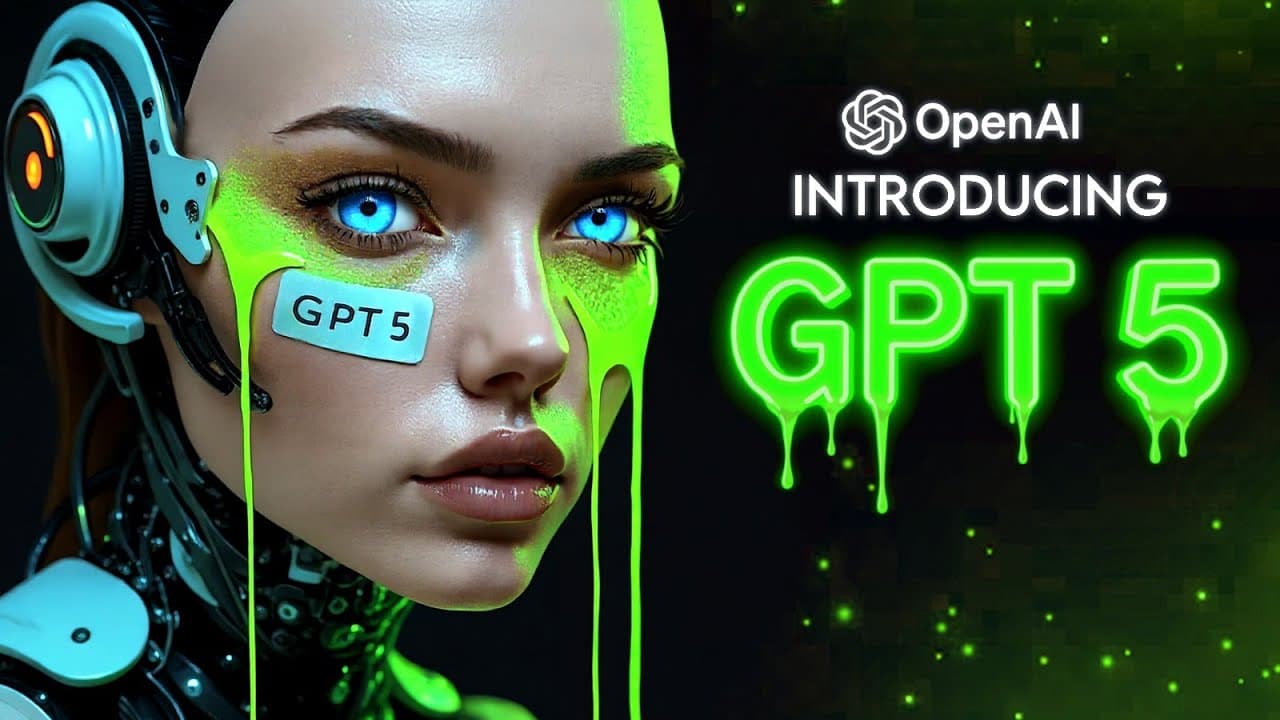
GPT-5 is a unified flagship model that automatically routes each request between a fast 'main' brain and a slower 'thinking' brain, so you no longer pick models manually. It handles text, images, voice, and live video in one conversation, cuts hallucinations by up to 78% in reasoning mode, and offers a 256,000-token context window in ChatGPT.
Transcript
GPT 5 is here and it's packing some of the biggest upgrades we've ever seen in chat GPT. From a unified system that can handle text, images, voice, and live video all at once to a coding engine that can build complex software on demand. This release changes how you'll use AI dayto-day. It's faster, sharper, and more accurate with new tools, smarter... Read More
Key Insights
- GPT-5 is a do-it-all flagship model that uses a dynamic routing system to automatically pick the right submodel for each request, replacing the old need to manually choose between speed, reasoning, or vision models.
- Inside GPT-5 there are two main brains: GPT-5 main, optimized for speed, and GPT-5 thinking, which takes more time to reason through complex problems, with routing deciding which to use on the fly.
- GPT-5 comes in three sizes: standard (best reasoning, largest capacity), mini (balanced middle ground), and nano (lightweight for cost-sensitive tasks), with automatic downgrade to mini or nano if you hit usage limits.
- Hallucinations are down by as much as 78% in reasoning mode, paired with a 256,000-token context window in ChatGPT and up to 400,000 tokens in the API, roughly 200,000 words at once.
- Multimodal ability now combines text, images, voice, and live video in one conversation, including watching a live feed like you fixing a bike and giving step-by-step instructions, though video generation is still handled by Sora.
- GPT-5 is aimed at developers, generating over 400 lines of code in 2 minutes in one demo, running long multi-turn background agents, and handling complex software builds from a single prompt, which Sam Altman called 'software on demand.'
- Personalization improved with four preset personalities (cynic, robot, listener, nerd) to cut the yes-man problem, plus stronger memory that remembers preferences and long-term goals across sessions and days.
- OpenAI flagged GPT-5 as high risk for biological and chemical weapon knowledge, with the reasoning-focused thinking model considered highly capable in those areas, triggering extra safety measures and human review.
Install to Summarize YouTube Videos and Get Transcripts
Explore YouTube Video Summarizer or Get YouTube Transcript Extractor
Questions & Answers
Q: What is GPT-5's dynamic routing system?
GPT-5's dynamic routing system automatically picks the right submodel for your request, so you no longer have to choose between different models for different tasks. Inside GPT-5 there are two main brains: GPT-5 main, optimized for speed, and GPT-5 thinking, which takes more time to reason through complex problems. The system decides which to use on the fly, and it can even move you to the mini or nano versions automatically if you hit usage limits, letting you keep working without interruption.
Q: What are the differences between GPT-5 standard, mini, and nano?
GPT-5 comes in three main sizes. Standard is the high-end version with the best reasoning and the largest capacity, meant for heavy, high-stakes work. Mini is a balanced middle ground for moderate workloads. Nano is a super lightweight version for simple, cost-sensitive tasks. The routing system can automatically shift you to mini or nano if you hit usage limits. Both smaller models are still more capable than the older GPT-o3, so they aren't toys.
Q: How much does GPT-5 reduce hallucinations?
OpenAI says hallucinations, those made-up facts that can creep into AI outputs, are down by as much as 78% in the reasoning mode. This is paired with a massive context window of 256,000 tokens in ChatGPT and up to 400,000 tokens if you're using the API, which is around 200,000 words at once. In practical terms you can throw an entire novel, huge code bases, or giant research documents at it and it will keep track without losing the thread. Hallucinations are way down but not gone.
Q: What multimodal features does GPT-5 support?
GPT-5 combines text, images, voice, and now even live video all in one conversation, so there's no more swapping to a different AI for visual analysis or voice interactions. During the launch demo it generated websites in French with accurate pronunciation, analyzed uploaded images, and interacted over live video. While it can't generate videos yet (that's still handled by Sora), it can watch a live feed, like you fixing a bike, and give step-by-step instructions in real time. The voice mode also adapts tone and pacing to the conversation.
Q: How good is GPT-5 at coding?
Developers and coders are expected to feel this release the most, as OpenAI aimed GPT-5 right at Anthropic's Claude, which has been the go-to for many programmers. They brought in companies like Cursor, Vercel, and Windsurf during the live stream to discuss how well it writes and debugs code. In one demo, GPT-5 produced over 400 lines of code in just 2 minutes, building a Bernoulli effect simulation from scratch. It can also run long multi-turn agents in the background, work through tricky bugs, and handle complex software builds from a single prompt, which Sam Altman called 'software on demand.'
Q: What personalities and memory features does GPT-5 have?
You can now set one of four preset personalities: cynic, robot, listener, and nerd, which affect how GPT-5 interacts with you. They're optional and were designed partly to cut down on the yes-man problem, where the model just agrees with everything you say. Beyond personalities, GPT-5's memory is far better. It can remember preferences, facts, and instructions across sessions, even days later. You can set long-term goals like prepping for an exam or tracking a fitness target, and it will actively adapt its responses to help you reach them.
Q: What are the safety risks OpenAI flagged for GPT-5?
OpenAI flagged GPT-5 as high risk in the context of biological and chemical weapon knowledge, with the reasoning-focused GPT-5 thinking model considered highly capable in those areas, though it hasn't crossed their internal threshold for critical danger. This means extra safety measures like multi-layer filters, human review, account blocking, and limited access for certain research cases. The new agent feature is also classified as high risk. It's harder to jailbreak than older models, but multi-step attacks can sometimes still work, and bad responses can occasionally slip through in long conversations.
Q: How much does GPT-5 cost through the API and subscriptions?
Nothing changes for ChatGPT subscriptions: Plus is still $20 a month and Pro is $200. API pricing is competitive, with standard at $1.25 per million input tokens and $10 per million output tokens, mini at 25 cents and $2, and nano at 5 cents and 40 cents. GPT-5 mini in the API is far cheaper than GPT-4.1 or the o1 Pro model, which can run up to $600 per million tokens. The mini and nano versions are aimed at making advanced AI more accessible for cost-sensitive use cases, and GPT-5 is tuned for higher intelligence while using fewer tokens.
Summary & Key Takeaways
-
GPT-5 replaces model-juggling with a dynamic routing system that automatically selects between GPT-5 main (speed) and GPT-5 thinking (deep reasoning). It ships in standard, mini, and nano sizes, and routing can shift you to smaller models when you hit usage limits so work continues uninterrupted.
-
Performance gains include hallucinations cut by up to 78% in reasoning mode and a large context window of 256,000 tokens in ChatGPT (400,000 via API). Multimodal support unifies text, images, voice, and live video in one conversation, with an upgraded, more natural voice mode now available in custom GPTs.
-
Coding is a major focus, with demos showing 400+ lines generated in two minutes and background multi-turn agents. New personalities and better cross-session memory add personalization, while the system card flags high risk in bio/chemical weapon knowledge and the agent feature, prompting added safety layers.
Read in Other Languages (beta)
Share This Summary 📚
Summarize YouTube Videos and Get Video Transcripts with 1-Click
Try YouTube Summary with ChatGPT & Claude or YouTube Transcript Generator
Explore More Summaries from AI Revolution 📚




Summarize YouTube Videos and Get Video Transcripts with 1-Click
Try YouTube Summary with ChatGPT & Claude or YouTube Transcript Generator