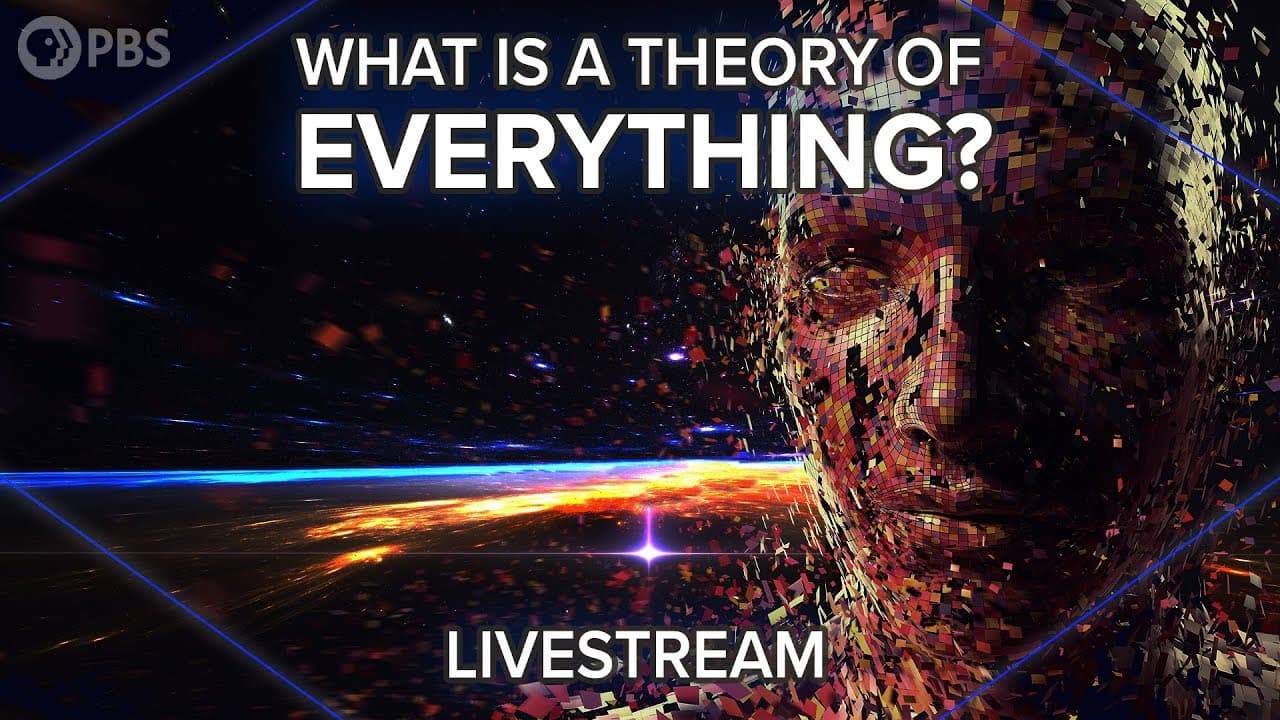
What is a Theory of Everything: Livestream
TL;DR
Physicists discuss the pursuit and challenges of a Theory of Everything.
Transcript
welcome everyone so this is a very special and rather unusual event space time has always been about digging towards the deepest layers of reality for nearly 100 years it's felt like we've been hovering just above the bottom layer and so my friend and colleague brian keating and i decided that the fun thing to do would be to bring together today's ... Read More
Key Insights
- The quest for a Theory of Everything (TOE) involves unifying quantum mechanics and general relativity, two pillars of modern physics that currently do not align.
- The Standard Model of particle physics, while successful, leaves many questions unanswered, such as the nature of dark matter and the Higgs boson's role.
- Experimental limitations, such as the inability to build colliders reaching Planck energy levels, pose significant challenges to testing TOEs.
- Alternative approaches, like multiverse theories and emergent gravity, offer new perspectives but face scrutiny for lack of falsifiability.
- The role of beauty and elegance in mathematical theories is debated, with some physicists advocating for empirical evidence over aesthetic appeal.
- Observers and consciousness are emerging as important factors in understanding quantum mechanics and the universe's fundamental nature.
- New experimental methods, including gravitational wave astronomy and precision measurements, are crucial for probing the unknown aspects of the universe.
- The scientific community is encouraged to pursue diverse ideas and maintain a balance between theoretical innovation and empirical validation.
Install to Summarize YouTube Videos and Get Transcripts
Explore YouTube Video Summarizer or Get YouTube Transcript Extractor
Questions & Answers
Q: What is the main challenge in developing a Theory of Everything?
The primary challenge lies in unifying quantum mechanics and general relativity, two foundational theories that currently do not align. Quantum mechanics governs the microscopic world, while general relativity describes the macroscopic universe, and their integration into a single framework remains elusive.
Q: Why is the Standard Model considered incomplete?
The Standard Model, while successful in describing known particles and forces, does not account for dark matter, dark energy, or the gravitational force. Additionally, it does not explain why there are three generations of particles or the specific values of fundamental constants.
Q: What experimental limitations hinder the testing of Theories of Everything?
Current experimental technology, such as particle colliders, cannot reach the Planck energy scale where quantum gravity effects are expected to become significant. This limitation makes it challenging to test predictions from proposed Theories of Everything directly.
Q: How do alternative theories like the multiverse and emergent gravity fit into the TOE discussion?
Alternative theories offer new perspectives on the universe's fundamental nature. The multiverse suggests multiple, possibly infinite, universes, while emergent gravity proposes that gravity arises from more fundamental interactions. However, these theories face criticism for their lack of empirical testability.
Q: What role does beauty play in theoretical physics?
Some physicists argue that beauty and elegance in mathematical formulations can guide theoretical development, as historically seen with successful theories. However, others caution against relying solely on aesthetic criteria, emphasizing the importance of empirical validation.
Q: Why are observers and consciousness important in understanding quantum mechanics?
Observers play a crucial role in quantum mechanics, as measurement affects quantum systems. Understanding the nature of observers and consciousness could provide insights into the measurement problem and the fundamental structure of reality.
Q: What new experimental methods are being explored to probe the universe?
Gravitational wave astronomy, high-energy cosmic ray detection, and precision measurements of fundamental constants are among the new experimental methods being pursued. These approaches aim to explore unknown aspects of the universe and test predictions from theoretical models.
Q: What is the importance of maintaining diverse ideas in the pursuit of a TOE?
Encouraging diverse ideas fosters innovation and prevents stagnation in theoretical physics. Balancing theoretical creativity with empirical validation ensures that the field progresses and adapts to new discoveries and insights.
Summary & Key Takeaways
-
The discussion highlights the ongoing challenges in unifying quantum mechanics and general relativity into a single Theory of Everything. While the Standard Model has been successful, it leaves many unanswered questions about the universe's fundamental nature.
-
Experimental limitations, such as the inability to reach Planck energy levels, hinder the testing of TOEs. Alternative theories, including multiverse and emergent gravity, offer new perspectives but face criticism for their lack of empirical testability.
-
The debate around the role of beauty and elegance in theoretical physics continues, with some advocating for empirical evidence as the primary criterion for scientific theories. New experimental methods are essential for advancing our understanding of the universe.
Read in Other Languages (beta)
Share This Summary 📚
Summarize YouTube Videos and Get Video Transcripts with 1-Click
Try YouTube Summary with ChatGPT & Claude or YouTube Transcript Generator
Explore More Summaries from PBS Space Time 📚


Summarize YouTube Videos and Get Video Transcripts with 1-Click
Try YouTube Summary with ChatGPT & Claude or YouTube Transcript Generator