Why Doing Things That Don't Scale Is Crucial for Startups
TL;DR
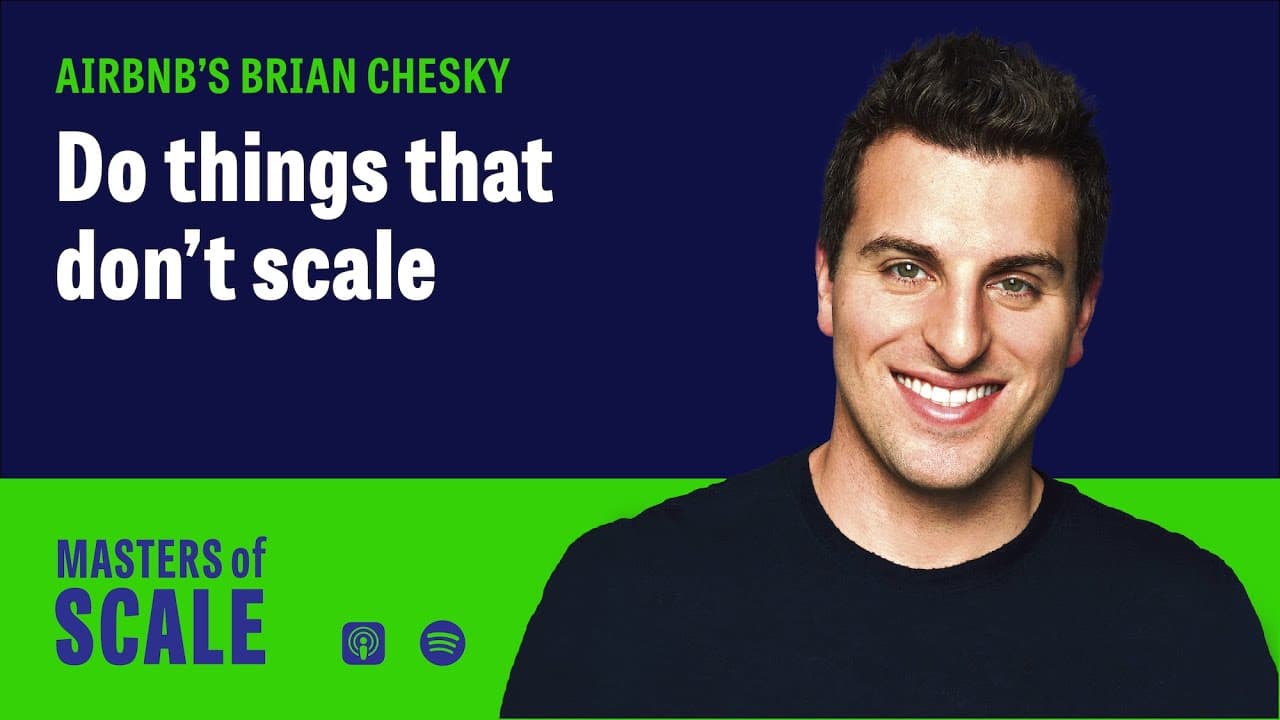
Doing things that don't scale, like personally engaging with early users, is essential for laying a strong foundation for growth. Brian Chesky of Airbnb highlights that these handcrafted experiences lead to valuable customer insights and meaningful improvements in service. This approach ensures that when the company scales, the user experience remains exceptional and memorable.
Transcript
Joe and I are broke we're losing weight and I know have a lot of weight to lose you know those binders that you put baseball cards in we put credit back to them at this point I am twenty five thousand dollars in credit card debt Joe is tens of thousand dollars in credit card debt so this is like make-or-break we need the Lifeline that entrepreneur ... Read More
Key Insights
- Brian Chesky and his co-founders started Airbnb by doing things that don't scale, such as personally visiting early users to understand their needs.
- The idea of crafting an '11-star experience' helped Airbnb focus on creating exceptional and memorable customer experiences.
- Paul Graham from Y Combinator advised Airbnb to meet their users in person, which led to significant insights and improvements to their service.
- Airbnb initially managed operations manually, with interns handling tasks like photo uploads, before automating processes as they scaled.
- User feedback was crucial in shaping Airbnb's features, showing the importance of listening to early customers to refine the product.
- The transition from a handcrafted phase to scaling is challenging and requires different skill sets: creative design versus analytical operations.
- Brian Chesky emphasizes the importance of empathy in design, learned from his background in medical design, to enhance user experience.
- Even as Airbnb scaled, Chesky maintained that the most innovative leaps occurred when the company was small and agile.
Install to Summarize YouTube Videos and Get Transcripts
Explore YouTube Video Summarizer or Get YouTube Transcript Extractor
Questions & Answers
Q: What initial challenges did Airbnb face in terms of traction?
In the early days, Airbnb struggled with low website traffic and limited bookings, which was a significant challenge for the company. To overcome this, co-founders Brian Chesky and Joe Gebbia resorted to creative solutions, such as selling themed breakfast cereals to generate funds and increase brand awareness. This period taught them the importance of resilience and innovation in the face of adversity.
Q: How did Paul Graham's advice impact Airbnb's approach to scaling?
Paul Graham, co-founder of Y Combinator, advised Airbnb to meet their early users in person, which was pivotal for the company's growth. This advice led Brian Chesky and his team to travel to New York to personally engage with hosts, gaining invaluable insights into user needs and preferences. This hands-on approach allowed them to tailor their service more effectively, laying a strong foundation for future scaling.
Q: What is the '11-star experience' concept, and how did it influence Airbnb?
The '11-star experience' is a mental exercise used by Airbnb to envision the most extraordinary customer experience possible. By imagining scenarios ranging from a simple check-in to a grand welcome with celebrities, the team identified elements that could make their service exceptional. This concept pushed Airbnb to enhance every aspect of the user experience, ensuring that even a scaled-back version would still be remarkable and shareworthy.
Q: Why is empathy important in Airbnb's design process?
Empathy is crucial in Airbnb's design process because it allows the company to create user-centric products that truly address the needs and concerns of their customers. Brian Chesky, drawing from his background in medical design, emphasizes the importance of putting oneself in the user's shoes to design with empathy. This approach ensures that Airbnb's offerings are not only functional but also resonate emotionally with users, enhancing overall satisfaction.
Q: What role did manual processes play in Airbnb's early operations?
In Airbnb's early operations, manual processes were essential for managing tasks like photography and user interactions. Interns handled these processes, which provided the company with direct insights into user needs and challenges. As the company grew, these manual processes were gradually automated, allowing Airbnb to scale efficiently while maintaining the quality of service learned from the hands-on approach.
Q: How does Airbnb balance innovation with scaling?
Airbnb balances innovation with scaling by maintaining a dual focus on creative design and analytical operations. In the early stages, the company prioritized designing perfect user experiences through direct engagement and feedback. As they scaled, they distilled these experiences into scalable processes while ensuring that creative innovation continued to inform their offerings. This balance allows Airbnb to grow while still delivering exceptional service.
Q: What are the challenges of transitioning from handcrafted to scalable operations?
Transitioning from handcrafted to scalable operations involves shifting from a creative, user-focused mindset to a more analytical, process-driven approach. This transition requires building robust systems and teams to handle increased demand while maintaining service quality. Challenges include ensuring consistent user experience, managing operational complexities, and adapting to new market demands, all while preserving the innovative spirit that drove initial success.
Q: Why does Brian Chesky value the early days of Airbnb despite the challenges?
Brian Chesky values the early days of Airbnb because they were a time of significant learning and innovation. Despite the challenges of limited resources and manual operations, this period allowed the team to experiment, adapt, and refine their service based on direct user feedback. Chesky believes that the most creative and impactful changes often occur when a company is small and agile, making these early experiences invaluable for long-term success.
Summary & Key Takeaways
-
Brian Chesky, co-founder of Airbnb, emphasizes the importance of doing things that don't scale to create a strong foundation for scaling later. By personally engaging with early users, Airbnb refined its service based on direct feedback.
-
The concept of an '11-star experience' was developed to push the boundaries of customer satisfaction, ensuring that Airbnb provided memorable and exceptional service that would be shared by word of mouth.
-
Transitioning from handcrafted operations to scalable systems involved automating processes and building a robust team. Despite scaling challenges, maintaining a focus on user experience and empathy in design remained central to Airbnb's growth strategy.
Read in Other Languages (beta)
Share This Summary 📚
Summarize YouTube Videos and Get Video Transcripts with 1-Click
Try YouTube Summary with ChatGPT & Claude or YouTube Transcript Generator