What Are Transformers and How Do They Work in NLP?
TL;DR
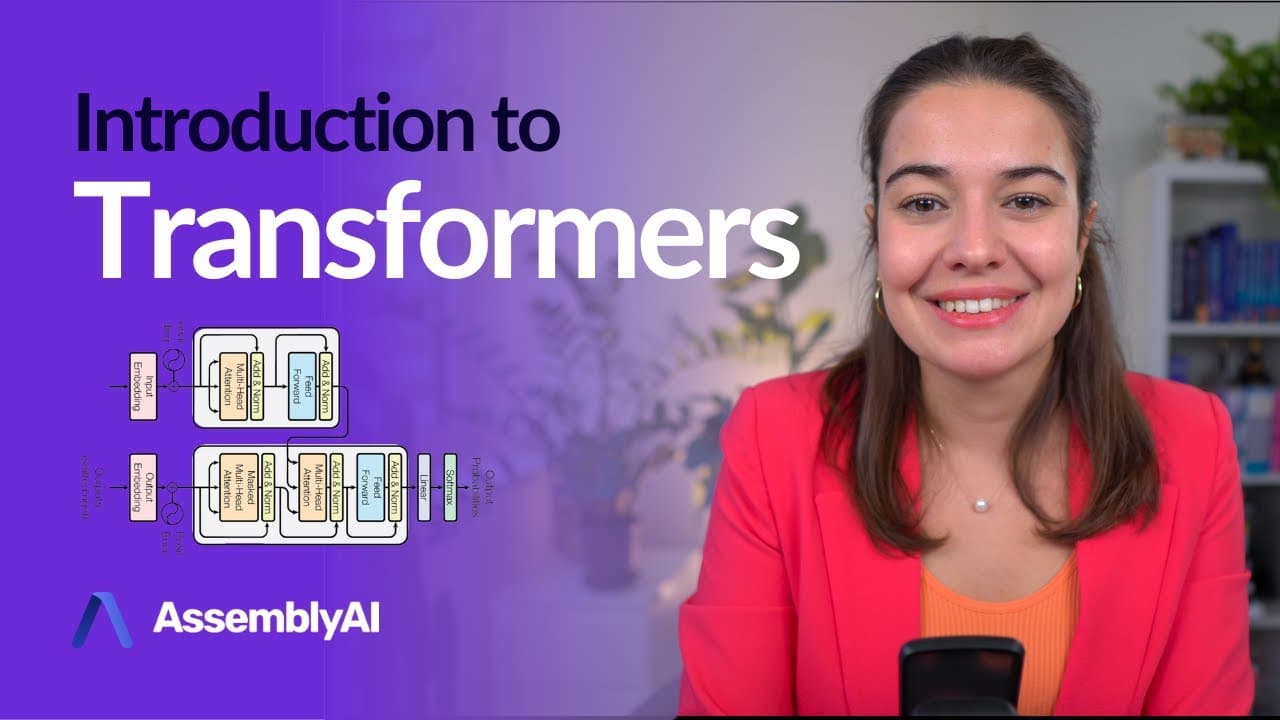
Transformers are advanced models in NLP that utilize attention mechanisms instead of recurrent structures, enabling faster and more efficient processing of sequences. They consist of encoders and decoders that handle information in parallel, with multi-headed attention allowing models to focus on different parts of the input simultaneously. Positional encodings are used to retain the order of words without needing recurrence.
Transcript
transformers came into our lives just a couple of years ago but they have been taking the nlp area by storm libraries like hugging phase has made it very easy for everyone to use transformers or implementations like bert or gpt3 is the reason that everyone is talking about them but what are they and how do they work so in this video we will look cl... Read More
Key Insights
- ❓ Transformers revolutionize NLP with attention mechanisms, reshaping sequence processing.
- ❓ Attention mechanisms enable focusing on crucial elements within sentences or images for enhanced understanding.
- ✖️ Multi-headed attention layers in Transformers facilitate efficient processing of sentences with varying lengths.
- 💁 Positional encodings inject location-based information into word embeddings to maintain sentence structure.
- 🤳 Transformer architecture integrates encoders, decoders, and self-attention mechanisms for parallel computation.
- 💁 Normalization layers and skip connections optimize information flow within the Transformer network.
- 👨💼 Positional encodings utilizing sine and cosine functions help position words accurately in a sentence.
Install to Summarize YouTube Videos and Get Transcripts
Explore YouTube Video Summarizer or Get YouTube Transcript Extractor
Questions & Answers
Q: How do Transformers compare to traditional RNNs and LSTMs in NLP?
Transformers supersede RNNs and LSTMs by utilizing attention mechanisms, parallelization, and efficient sequence processing without recurrence issues.
Q: What is the role of attention mechanisms in Transformers?
Attention mechanisms enable models to concentrate on essential elements within sentences or images, enhancing comprehension and contextual understanding.
Q: How do Transformers handle different sentence lengths effectively?
Transformers use multi-headed attention layers to seamlessly process sentences of varying lengths, ensuring consistent performance across different inputs.
Q: What are the key components of the Transformer architecture?
The Transformer architecture comprises encoders, decoders, self-attention layers, feed-forward neural networks, embeddings, positional encodings, normalization layers, and skip connections.
Summary & Key Takeaways
-
Transformers disrupt NLP, replacing RNNs and LSTMs with attention-based models.
-
Attention mechanism allows focusing on key parts of sentences, images for better understanding.
-
Transformers leverage encoders, decoders, self-attention layers for parallelized computation.
Read in Other Languages (beta)
Share This Summary 📚
Summarize YouTube Videos and Get Video Transcripts with 1-Click
Try YouTube Summary with ChatGPT & Claude or YouTube Transcript Generator
Explore More Summaries from AssemblyAI 📚






Summarize YouTube Videos and Get Video Transcripts with 1-Click
Try YouTube Summary with ChatGPT & Claude or YouTube Transcript Generator