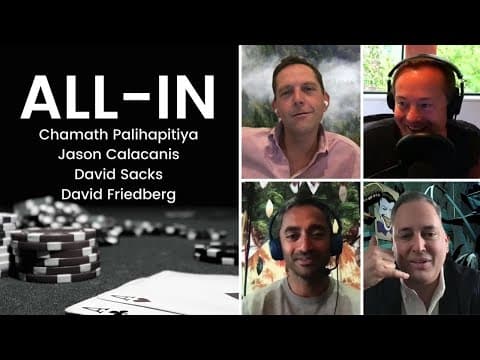
All-In Podcast E72: How Are Sanctions, Deglobalization, Food Shortage Risks, and the Macroeconomic Outlook Connected?

TL;DR
All-In Podcast E72 examines how the war in Ukraine, Western sanctions, threatened food supplies, market volatility, and a possible economic slowdown are connected. More than 20 days into the conflict, the hosts describe its outcome as uncertain and warn that disruptions to wheat production and fertilizer availability could put hundreds of millions of people at risk of starvation. Read on for their assessments of markets, venture capital, and potential paths out of the crisis.
Transcript
i now have a chief of staff he's pretty great he's worked for me for a while and he's he's doing a great job but it's actually really helped i will say that and then i uh started a family office wow congrats what does that mean you have a place in your home that you call an office yeah you don't like to break by your refrigerator there's an office ... Read More
Key Insights
- 🥺 Economic sanctions have led to severed economic ties between Russia and the West, impacting both countries' economies.
- 😋 Disruptions in the food supply chain, particularly in wheat production and fertilizer availability, pose a significant risk of famine.
- ❓ Market volatility and uncertainty persist due to ongoing geopolitical tensions and economic concerns.
- 🔒 The private venture capital market may experience repricing and a shift towards more cautious investment strategies.
Install to Summarize YouTube Videos and Get Transcripts
Explore YouTube Video Summarizer or Get YouTube Transcript Extractor
Questions & Answers
Q: What does All-In Podcast E72 say about the impact of sanctions, deglobalization, and food shortage risks?
The episode says Western sanctions have severed economic ties with Russia and could contribute to broader deglobalization and economic uncertainty. It also warns that disruptions involving wheat production, fertilizer availability, and agricultural supply chains could create severe food shortages and increase famine risks.
Q: Did the hosts believe Russia was losing the war in Ukraine?
David Sacks says Putin clearly miscalculated by expecting a cakewalk, while Ukrainian resistance inflicted serious casualties and losses on Russian forces. However, he describes the outcome three weeks into the war as still very much in doubt rather than declaring that Russia had lost.
Q: What casualty figures are cited in the episode?
The host says exact figures were difficult to verify because the speakers lacked direct information from the ground. He cites The New York Times as reporting 7,000 Russian troops killed and says Zelensky reported on March 12 that 1,300 Ukrainian troops had been killed.
Q: Why are Ukraine and Russia important to the discussion of food supplies?
The episode describes Ukraine and Russia as the breadbasket of the world and raises concerns about their role in agricultural supply chains. The existing discussion specifically identifies wheat production and fertilizer availability as areas where disruption could create widespread food insecurity.
Q: What consequences could food supply disruptions have?
The episode warns that reduced wheat production and limited fertilizer availability could contribute to widespread famine. It says hundreds of millions of people could be at risk of starvation because many already live on limited calories.
Q: How were global markets reacting to the geopolitical and economic uncertainty?
The episode describes volatile markets in which uncertainty remained a central factor. It notes panic selling and capitulation among some retail investors, alongside a recent rally connected to progress toward a peace deal and clearer central-bank economic forecasts.
Q: How could the economic outlook affect private venture capital?
The discussion anticipates deal repricing, more cautious investors, and more rigorous due diligence in private venture capital. It says valuations could return to pre-pandemic levels, while uncertainty and possible recessionary conditions could influence investment decisions and slow deal closures.
Q: How does David Sacks screen SaaS investment opportunities?
Sacks says SaaS investing is highly metrics-driven, so his team handles initial meetings and checks whether companies meet basic growth thresholds. He meets founders when their numbers look good, an approach he says preserves his energy by avoiding endless first meetings.
Summary & Key Takeaways
-
Russia's invasion of Ukraine has led to economic sanctions from the West, severing economic ties and impacting both countries' economies.
-
The food supply chain is at risk due to agricultural sanctions and supply chain disruptions, potentially leading to widespread famine.
-
The global economy is facing uncertainty, with market volatility and concerns about inflation and recession looming.
Read in Other Languages (beta)
Share This Summary 📚
Summarize YouTube Videos and Get Video Transcripts with 1-Click
Try YouTube Summary with ChatGPT & Claude or YouTube Transcript Generator
Explore More Summaries from All-In Podcast 📚

Summarize YouTube Videos and Get Video Transcripts with 1-Click
Try YouTube Summary with ChatGPT & Claude or YouTube Transcript Generator