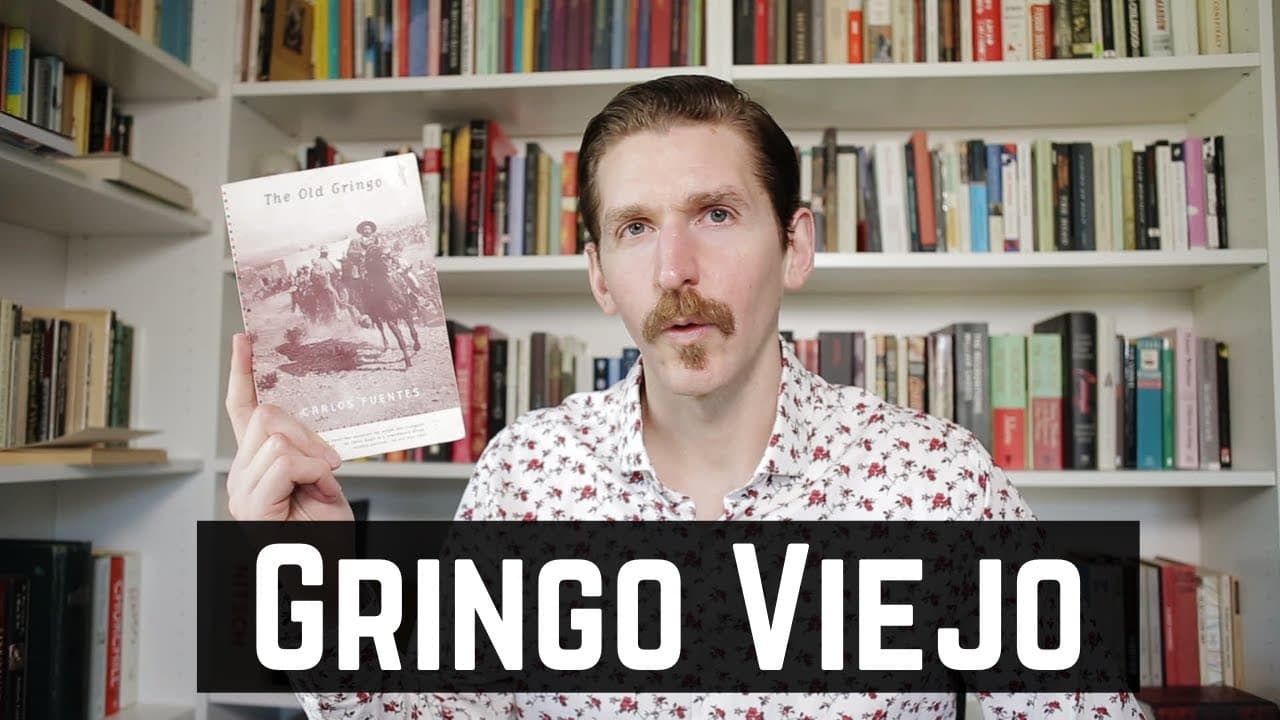
Is Carlos Fuentes's The Old Gringo Worth Reading?
TL;DR
The Old Gringo is worth reading for its brilliant premise, strong writing, and exploration of death, identity, loneliness, and historical repetition. Its fictional account of Ambrose Bierce entering the Mexican Revolution turns a real disappearance into a meditation on choosing how to die, although the reviewer found the later sections slower and more difficult than the opening.
Transcript
who the goes to mexico in their 70s to go and die in a revolution better than food man good afternoon everyone welcome to beth and food book reviews i'm your host clifford lee sergeant great to see you as always hope you're doing well get that coffee happy birthday nicholas carlucci wishing you and your family all the best and i hope you have a gre... Read More
Key Insights
- The novel is a fictional account of Ambrose Bierce's final days after the American author and journalist travels to Mexico in his seventies, joins the Mexican Revolution, disappears, and is never heard from again.
- The central premise is Bierce's deliberate search for a fitting death, since he enters Mexico under the thin pretense of fighting while hoping that Pancho Villa will personally deliver the final mercy shot.
- The novel's broader subject is historical repetition, showing how patterns echo from intimate family structures into larger cultural, national, and governmental structures rather than treating Bierce's disappearance only as an isolated mystery.
- The book is also an examination of identity and loneliness, particularly the experience of feeling deeply out of place while confronting the possibility of a radical change in one's existential constitution late in life.
- Harriet Winslow is presented as the female protagonist through whom much of the book is experienced, even though Bierce's character, history, motives, and desired death provide the narrative's most immediately compelling material.
- Bierce's personal losses help explain his departure, since his two sons are dead, his daughter refuses contact, and his wife is gone, leaving him with little that he believes he is abandoning.
- The novel frames the inward self as the final frontier, but crossing that frontier does not produce complete solitude because a person still encounters the influence, memory, and presence of other people there.
- The reading pace changes significantly, with the first half or first two thirds moving quickly before denser paragraphs and greater intensity slow the later portion, despite the novel being just under 200 pages.
Install to Summarize YouTube Videos and Get Transcripts
Explore YouTube Video Summarizer or Get YouTube Transcript Extractor
Questions & Answers
Q: What is The Old Gringo by Carlos Fuentes about?
The Old Gringo is a fictional account of the final days of Ambrose Bierce, an American horror author and journalist who travels to Mexico in his seventies during the Mexican Revolution. He joins forces connected to Pancho Villa and then disappears. The story uses that premise to explore death, identity, loneliness, personal transformation, and the repetition of history across families and societies.
Q: Is The Old Gringo worth reading?
The reviewer considers The Old Gringo a good novel with strong writing and an exceptionally compelling premise. Its greatest strength is the idea of an elderly Ambrose Bierce deliberately entering the Mexican Revolution while seeking a suitable death. The experience is not consistently fast, however, because the dense and intense later sections move more slowly than the first half or first two thirds.
Q: Why does Ambrose Bierce go to Mexico in The Old Gringo?
Ambrose Bierce appears to go to Mexico to fight in Pancho Villa's revolution, but his deeper purpose is to die in a manner that suits him. He is in his seventies, his two sons are dead, his daughter refuses to see him, and his wife is gone. With little left behind, he pursues what the novel describes as the final frontier within himself.
Q: What themes does The Old Gringo explore?
The novel explores death, the search for a proper way to die, identity, loneliness, displacement, and the possibility of profound personal change late in life. It also presents history as something that repeats or echoes across different scales, from individual families to cultures, countries, and governments. These themes make the book feel expansive despite its length of just under 200 pages.
Q: How does history function in The Old Gringo?
History functions as a pattern that repeats or echoes rather than as a simple background for the plot. The reviewer sees connections between small family structures and larger cultural, national, and governmental structures. Bierce's own family losses, his Civil War experience, and his participation in the Mexican Revolution allow private memory and public conflict to reflect one another throughout the novel.
Q: Who is Harriet Winslow in The Old Gringo?
Harriet Winslow is identified as the novel's female protagonist and as the character through whom readers receive much of the story. Her position means that the book is not exclusively about men confronting death, even though Ambrose Bierce's disappearance and determination to die dominate the review. She provides an important perspective within the fictional reconstruction of Bierce's final days in Mexico.
Q: Who is Tomás Arroyo in The Old Gringo?
Tomás Arroyo is a young, self-appointed general working under Pancho Villa. He lives in a train car decorated in an unusually luxurious fashion and initially doubts the elderly Bierce when he asks to join. After Arroyo flips a silver peso, Bierce shoots a hole through it with a Colt .44, proving his skill and demonstrating why his fearlessness could be useful.
Q: Does The Old Gringo have a fast or slow pace?
The novel begins at a comparatively quick pace, particularly through its first half or perhaps its first two thirds. The reviewer found that the paragraphs became fuller and the narrative more intense near the end, which made the pace feel substantially slower. Consequently, its length of just under 200 pages does not necessarily make it a short or effortless reading experience.
Summary & Key Takeaways
-
Carlos Fuentes builds the novel around the disappearance of American author and journalist Ambrose Bierce, who traveled to Mexico in his seventies during the Mexican Revolution. The fictional narrative imagines his final days, beginning with his arrival on horseback and his determination to find a death that suits his character.
-
The novel explores how history repeats or echoes across families, cultures, countries, and governments. It also examines identity, loneliness, displacement, personal transformation, and the relationship between living and dying. Although the book is just under 200 pages, the reviewer considers its ideas large and its reading experience substantial.
-
Bierce meets Tomás Arroyo, a young self-appointed general working under Pancho Villa. When Arroyo tests him by flipping a silver peso, Bierce shoots through it with a Colt .44, demonstrating experience gained during the Civil War. His fearlessness makes sense because he has entered Mexico intending to die.
Read in Other Languages (beta)
Share This Summary 📚
Summarize YouTube Videos and Get Video Transcripts with 1-Click
Try YouTube Summary with ChatGPT & Claude or YouTube Transcript Generator
Explore More Summaries from Better Than Food 📚

Summarize YouTube Videos and Get Video Transcripts with 1-Click
Try YouTube Summary with ChatGPT & Claude or YouTube Transcript Generator