How Will AI and Robots Reshape Work by 2030?
TL;DR
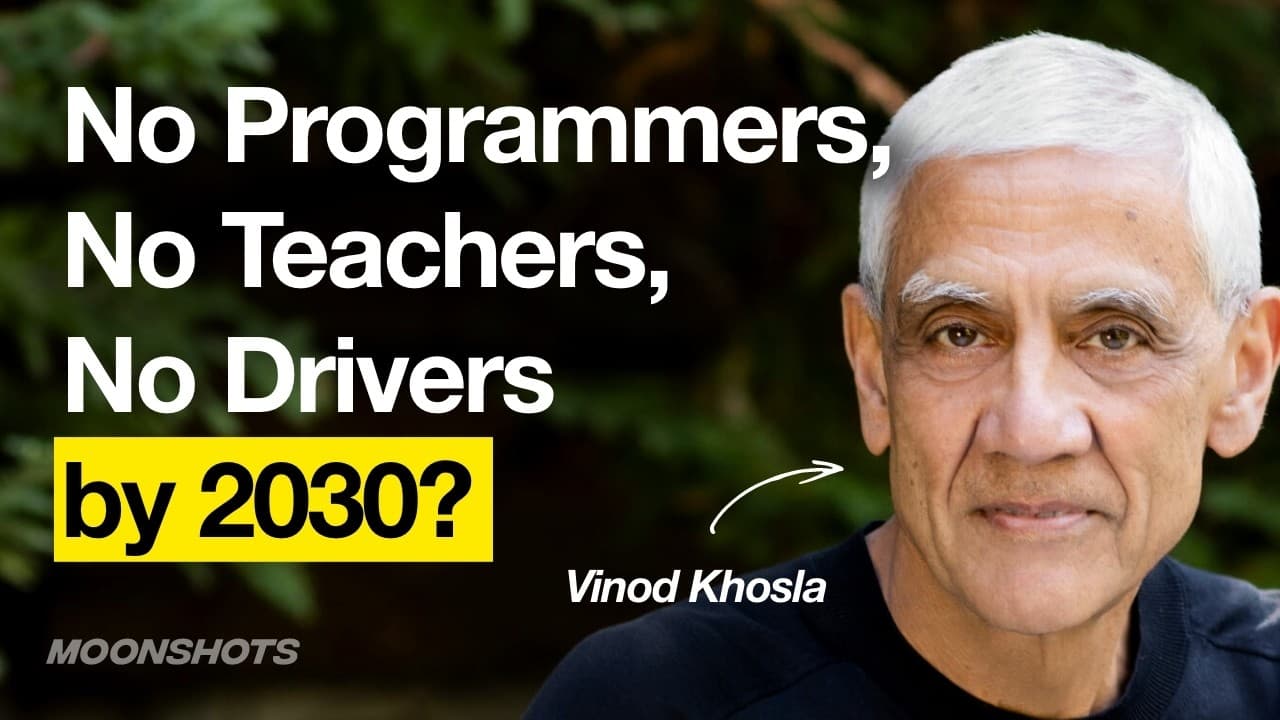
AI could make professional expertise widely available by giving workers several capable AI assistants, while bipedal robots could dramatically expand physical labor capacity. Vinod Khosla argues that organizations should already use tools such as deep research in meetings and strategic work, but he cautions that technological forecasts remain uncertain and must be tested incrementally.
Transcript
the only thing we know about the future is it'll be uncertain We have to figure it out in increments Venard Kosla Venard Kosla Vernard Kosla From Sun Micros Systemystems to billion dollar bets He is shaping the future of AI clean energy and biotech How do you think about the future of programming no more programmers or everyone's a programmer In th... Read More
Key Insights
- Bipedal robots could become a larger business than the auto industry within 20 years. Khosla argues that established automakers have largely failed to recognize this opportunity, while Elon Musk expects Optimus to become Tesla’s largest business.
- A billion capable robots could perform more work than all current human manual labor. Their productive capacity would be amplified because robots could operate continuously rather than following an eight-hour workday with breaks.
- AI expertise could become effectively free across many professional fields. Khosla identifies doctors, teachers, oncologists, structural engineers, and accountants as examples of roles where AI systems could broaden access to specialized knowledge.
- The near-term model for professional AI adoption is one person supervising five AI interns. These assistants could resemble recent graduates in fields such as medicine or accounting, although their development rate may vary substantially by professional category.
- Healthcare should be redesigned around the possibility that expertise becomes free. Khosla asks providers to consider how their systems would work if a farm worker and an oncologist could access the same AI-supported level of knowledge.
- Consumer AI agents could transform advertising from emotional persuasion into useful information. An agent can filter attempts to induce unnecessary purchases, while preserving factual material that helps a person compare products and make informed decisions.
- Deep research can produce strategic and scientific analysis within tens of minutes. Examples in the discussion include an 18-page developmental biology report and a retail product strategy that compared favorably with work produced by a company’s strategy team.
- AI should be actively used during board meetings, executive meetings, and technical discussions. It can address the same problems assigned to human teams, explain unfamiliar scientific concepts, and examine questions from perspectives that an organization may not contain internally.
- More videos with Vinod Khosla:
Install to Summarize YouTube Videos and Get Transcripts
Explore YouTube Video Summarizer or Get YouTube Transcript Extractor
Questions & Answers
Q: How could AI change professional work over the next five years?
Professionals can treat AI systems as a group of capable interns working under human supervision. Khosla suggests that a doctor or accountant could supervise five AI assistants comparable to recent graduates in the relevant field. This arrangement would initially leverage existing expertise rather than immediately eliminate professionals, while the assistants’ progress toward greater independence could vary by category over three, five, or ten years.
Q: Why could bipedal robots become larger than the auto industry?
Bipedal robots, along with equivalent machines in other forms and configurations, could address an enormous market for physical work. Khosla predicts that this business will exceed the auto industry within 20 years. If a billion robots operate continuously rather than working eight-hour schedules with breaks, they could create more labor capacity than all manual work currently performed across humanity.
Q: What would one billion robots mean for global labor capacity?
One billion robots could perform more work than all manual labor currently completed by seven billion people, according to Khosla’s estimate. The comparison reflects both the number of machines and their ability to work around the clock without ordinary schedules or breaks. He also considers one billion an underestimate, suggesting that the eventual physical labor capacity could be substantially larger.
Q: How could free AI expertise reshape healthcare?
Free AI expertise would shift healthcare planning from managing scarce professional knowledge to designing services around abundant knowledge. Khosla asks how a healthcare system should operate if a farm worker and an oncologist can access the same AI-supported expertise. Human doctors may retain an important role in personal connection, but specialized knowledge and guidance could become far more broadly available.
Q: How might AI agents change advertising and shopping?
AI agents could filter advertising that relies on emotional persuasion to encourage purchases people did not intend to make. Khosla expects advertising to become more informational, returning attention to facts that help consumers evaluate products. An agent purchasing for a person would be less influenced by conventional advertisements, attractive imagery, or other techniques that do not improve the underlying buying decision.
Q: How can companies use AI deep research for strategy?
Companies can give deep research tools the same strategic questions assigned to internal teams, then compare the results. In one example, a retailer had completed an extensive review of products to add, while deep research produced a report within tens of minutes that the retailer’s chief executive considered better than the strategy team’s work from the preceding months.
Q: What evidence shows AI can assist specialized scientific research?
Khosla describes a developmental biology research task initially handled by his chief of staff, who has a doctorate in viral immunology. She prepared an 18-page report that recommended disease indications to pursue. Deep research then independently generated another 18-page report and selected the same two final disease indications, demonstrating its usefulness for complex and highly technical analysis.
Q: Why should organizations use AI during important meetings?
Organizations should keep AI available in board meetings and executive meetings because it can address the same challenges assigned to employees, explain unfamiliar concepts, and introduce perspectives absent from the room. Khosla also used ChatGPT during a multiday scientific meeting to understand difficult material well enough to follow the discussion and ask more informed questions.
Summary & Key Takeaways
-
Khosla predicts that bipedal robots, or machines with equivalent capabilities in other configurations, could become a larger business than the auto industry within 20 years. A billion robots working continuously could perform more work than humanity’s current manual workforce, creating a dramatic expansion in available labor capacity.
-
AI could make expertise effectively free across healthcare, education, accounting, engineering, and other professions. During the next five years, professionals can think of themselves as supervising several AI interns. This model initially augments human expertise, while raising longer-term questions about compensation and the design of essential services.
-
AI agents could change advertising by filtering emotional persuasion and emphasizing useful product information. Organizations can also use deep research for scientific analysis, retail strategy, executive discussions, and unfamiliar technical subjects. Khosla recommends testing these capabilities now while recognizing that the future remains uncertain and predictions will often be wrong.
Read in Other Languages (beta)
Share This Summary 📚
Summarize YouTube Videos and Get Video Transcripts with 1-Click
Try YouTube Summary with ChatGPT & Claude or YouTube Transcript Generator
Explore More Summaries from Peter H. Diamandis 📚

Summarize YouTube Videos and Get Video Transcripts with 1-Click
Try YouTube Summary with ChatGPT & Claude or YouTube Transcript Generator