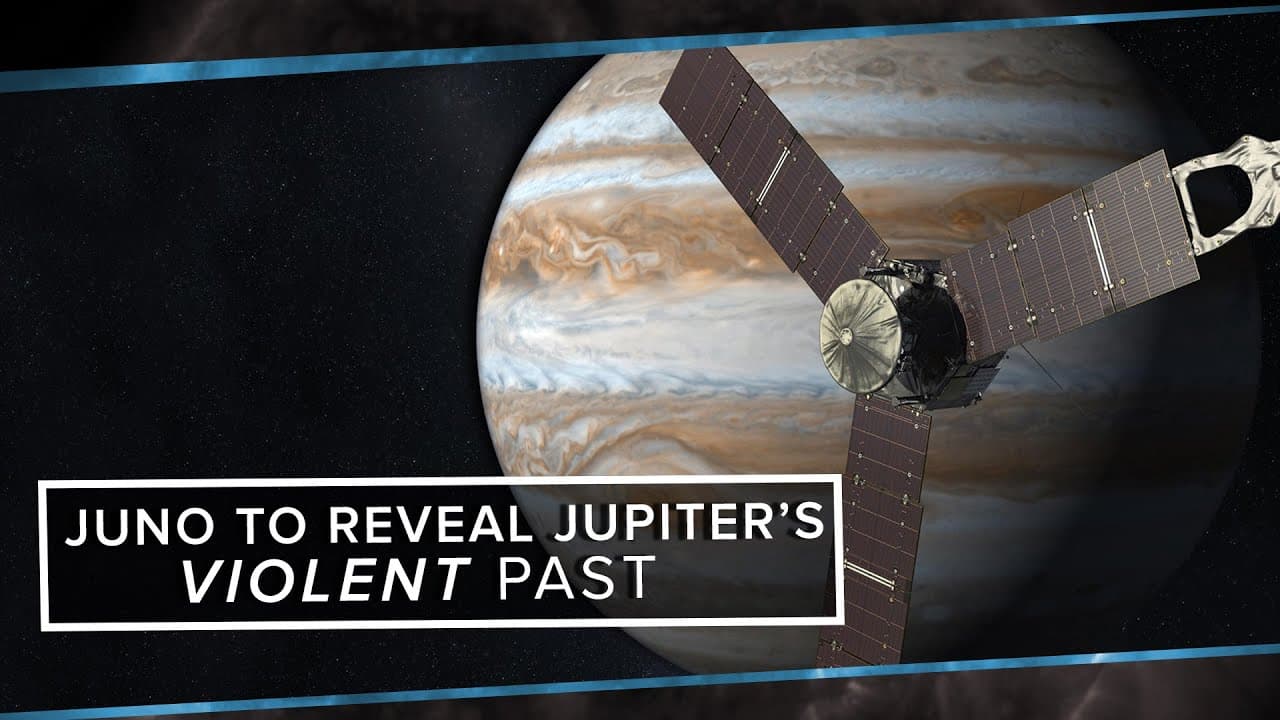
Juno to Reveal Jupiter's Violent Past
TL;DR
Jupiter's formation and migration shaped our solar system's current configuration.
Transcript
Two days ago on the 4th of July, 2016, the Juno spacecraft entered orbit around the planet, Jupiter after a five-year journey from Earth. Why do we care? Because Jupiter is the second most important planet in the universe, at least from our point of view, and it holds the secrets to the formation of the solar system. [MUSIC PLAYING] Jupiter is a mo... Read More
Key Insights
- Jupiter's massive gravitational influence has played a crucial role in shaping the orbits of planets in the solar system, impacting Earth's existence.
- The Grand Tack Hypothesis suggests that Jupiter migrated inward and outward during its early formation, affecting the distribution of material in the solar system.
- The Nice Model proposes that the outer planets' orbits were initially more clustered, leading to significant gravitational interactions that influenced their current positions.
- Jupiter's early movements potentially cleared material that would have formed another planet in Mars's location, explaining Mars's smaller size.
- Jupiter's gravitational influence extends to the asteroid belt, which contains a mix of materials from the inner and outer solar system.
- The Juno spacecraft aims to uncover Jupiter's internal composition to better understand its formation and the solar system's history.
- Jupiter acts as a cosmic shield by intercepting comets, while also perturbing asteroid orbits, potentially sending them towards Earth.
- The formation scenarios involving Jupiter remain hypotheses, with ongoing research needed to confirm the planet's exact role in solar system evolution.
Install to Summarize YouTube Videos and Get Transcripts
Explore YouTube Video Summarizer or Get YouTube Transcript Extractor
Questions & Answers
Q: What is the significance of Jupiter's gravitational influence on the solar system?
Jupiter's gravitational influence is significant because it has shaped the orbits of planets and the distribution of material in the solar system. Its massive gravity affects planetary orbits, contributes to the Milankovitch cycles on Earth, and acts as a cosmic shield by intercepting comets. Understanding Jupiter's influence is crucial to comprehending the solar system's formation and evolution.
Q: How does the Grand Tack Hypothesis explain Jupiter's early movements?
The Grand Tack Hypothesis suggests that Jupiter initially formed closer to the sun and migrated inward due to drag from the protoplanetary disk. It then moved outward after falling into orbital resonance with Saturn. This migration affected the distribution of material in the solar system, potentially clearing space that would have formed another planet in Mars's location.
Q: What role does the Nice Model play in understanding the solar system's formation?
The Nice Model posits that the outer planets' orbits were initially more clustered, with Jupiter roughly in its current position. Gravitational interactions, particularly between Jupiter and Saturn, led to the outer planets moving to their current locations. This model helps explain the distribution of planetesimals and the late heavy bombardment, providing insights into the solar system's early dynamics.
Q: Why is the Juno spacecraft important for studying Jupiter?
The Juno spacecraft is important because it aims to uncover details about Jupiter's internal composition, which can provide clues to its formation and the early solar system. By understanding Jupiter's internal structure, scientists can refine models of the solar system's evolution and better comprehend the planet's role in shaping the current configuration of planets.
Q: How does Jupiter act as a cosmic shield for Earth?
Jupiter acts as a cosmic shield by intercepting comets with its powerful gravity, preventing them from colliding with Earth. Its gravitational influence can also redirect long-period comets, reducing the risk of impact. However, Jupiter's gravity can also perturb asteroid orbits, potentially sending them towards Earth, highlighting its complex role in solar system dynamics.
Q: What are the implications of Jupiter's early migration for Mars's formation?
Jupiter's early migration through the protoplanetary disk likely cleared material that would have formed a larger planet in Mars's location. This explains why Mars is smaller than expected based on simulations of planet formation. Jupiter's movements affected the distribution of material, influencing the current sizes and positions of terrestrial planets in the solar system.
Q: How does the asteroid belt provide clues to Jupiter's early movements?
The asteroid belt contains a mix of materials from both the inner and outer solar system, which aligns with the idea that Jupiter passed through this region during its early migration. This movement would have mixed materials from different parts of the solar system, providing evidence for Jupiter's influence on the distribution of material and the formation of the asteroid belt.
Q: What is the current understanding of Jupiter's role in the solar system's evolution?
Jupiter is understood to have played a crucial role in the solar system's evolution by shaping planetary orbits and influencing the distribution of material. Its early migration and gravitational interactions with other planets have left lasting impacts on the solar system's configuration. Ongoing research, including data from the Juno spacecraft, aims to refine models of Jupiter's formation and its influence on the solar system.
Summary & Key Takeaways
-
Jupiter's formation and migration significantly influenced the solar system's structure, affecting planetary orbits and potentially preventing the formation of additional planets like super-Earths. The Grand Tack and Nice Models offer insights into these early dynamics, with Jupiter's gravitational pull playing a key role.
-
The Juno spacecraft, which recently entered Jupiter's orbit, seeks to uncover details about the planet's internal composition, providing clues to its formation and the early solar system. Jupiter's early movements may explain the current distribution of planetary masses and the asteroid belt's mixed composition.
-
Despite acting as a shield by intercepting comets, Jupiter's gravitational influence can also redirect asteroids towards Earth. Understanding Jupiter's formation and migration is crucial to comprehending the solar system's evolution and Earth's development.
Read in Other Languages (beta)
Share This Summary 📚
Summarize YouTube Videos and Get Video Transcripts with 1-Click
Try YouTube Summary with ChatGPT & Claude or YouTube Transcript Generator
Explore More Summaries from PBS Space Time 📚





Summarize YouTube Videos and Get Video Transcripts with 1-Click
Try YouTube Summary with ChatGPT & Claude or YouTube Transcript Generator