What Are Greg Isenberg’s 3 Ways to Build a $1M Startup With AI Tools?
TL;DR
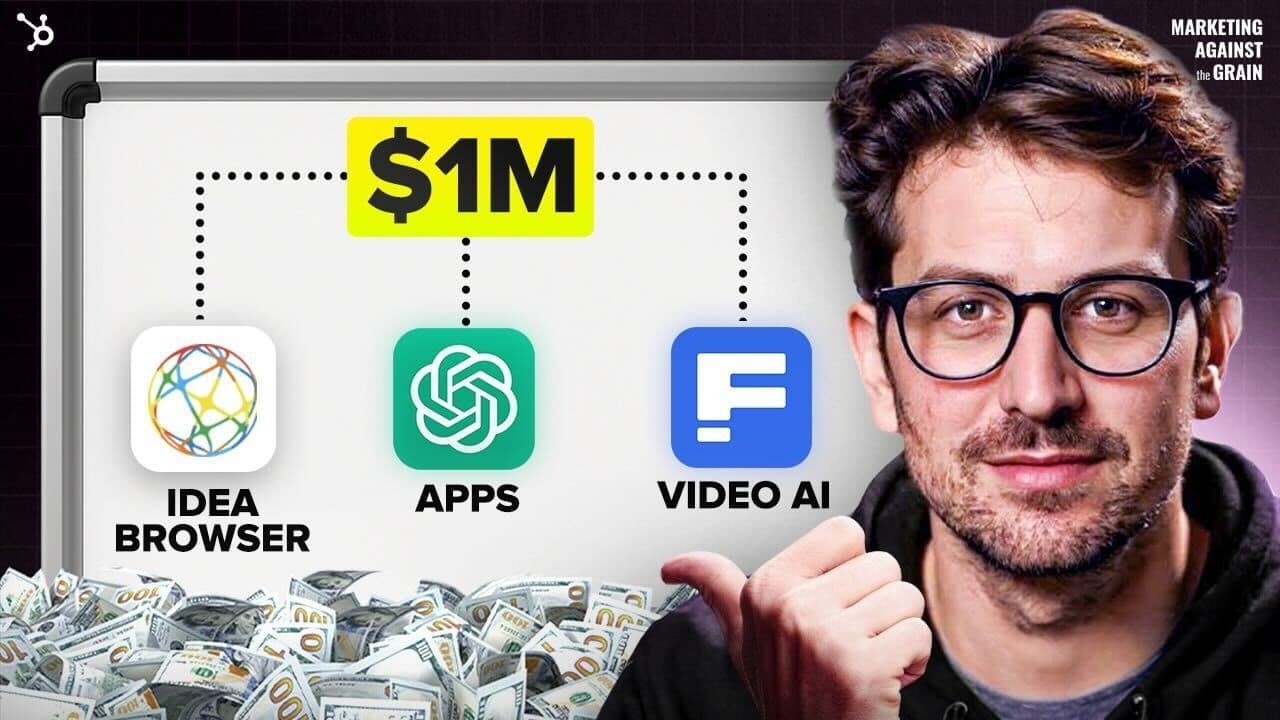
A $1M startup begins with a trend-based niche idea, strong context, and a clear landing page or product requirements document before any full app build. Greg Isenberg demonstrates this framework with Ideabrowser.com and cemetery management software priced from $30 to $200 per month in an estimated $320 million market. Read on for the exact research, prompting, marketing, tool-selection, and scalability lessons.
Transcript
Hey everyone, we have an exciting show today. The one and only Greg Eisenberger is here and we're going to talk about three ways to build a milliondoll business with AI. And you can go and do any of these right away. Greg has shown you all the tools, all the prompts, everything you need to go build these businesses. Let's get to today's show. Uh Gr... Read More
Key Insights
- Ideas regain practical importance: Greg rejects the blanket view that ideas are worthless. When products can be vibe coded quickly, selecting the right niche from a visible trend becomes more consequential, not less. The potential advantage comes from identifying a specific underserved group and matching it with a product concept before committing to execution.
- Trend data guides discovery: Ideabrowser.com bases its daily concepts on information scraped from Facebook groups, Reddit, and similar platforms. This approach connects idea generation to observed discussions rather than relying only on spontaneous brainstorming. Each selected idea then carries data that can be reused as context across product, brand, funnel, and advertising prompts.
- The example starts offline: Small cemeteries are presented as organizations that may still manage historical information through handwritten paper records and hand-drawn plot maps. That operational condition defines a specific digitization problem. The proposed software responds with photo uploads, OCR conversion, searchable text, and a dashboard rather than an undefined collection of AI features.
- Pricing follows customer size: The cemetery management concept proposes monthly pricing from $30 to $200 based on cemetery size. This links the subscription level to a visible customer characteristic instead of presenting one undifferentiated price. The example also cites a $320 million market, giving the builders a concrete commercial frame for evaluating the niche.
- An offer needs multiple levels: The proposed value ladder begins with a digital cemetery transformation guide, continues with a cemetery helper introduction package, and leads to Cemetery Helper Pro. These layers show how the idea can include an entry point and a core paid offer, rather than treating the software application as the entire customer journey.
- Product and marketing stay connected: The prepared materials cover ad creative, a brand package, a landing page, a content calendar, an email funnel system, email sequences, a lead magnet, and the product. That range reflects Greg’s promise to address tools, prompt optimization, and distribution together instead of assuming that a functioning app will attract customers automatically.
- Downloaded data becomes prompt context: Ideabrowser.com takes the information collected for each idea and funnels it into different sections. The prompts therefore begin with material about the opportunity rather than a blank request. Greg treats this transfer of context as the mechanism that makes the resulting AI output more relevant and usable.
- Prompting has two failure points: People may not know how to prompt an AI tool, and they may not know which tool should receive the prompt. Ideabrowser.com addresses both problems by organizing prompts around defined tasks. Its training-wheel structure helps a non-expert move from idea research into branding, acquisition, funnels, and product work.
- A landing page can lead: Greg says he would realistically start with a landing page and prompts related to go-to-market strategy rather than a full application. ChatGPT can be used to generate a comprehensive go-to-market strategy from the supplied context. This sequence clarifies the offer and distribution plan before more development effort is committed.
- A PRD directs the builder: For product execution, Greg likes to begin with a product requirements document. That document can be supplied to an AI coding agent so the builder has a clearer account of what it should produce. The principle is described as measuring twice and cutting once, with understanding preceding construction.
- Tool choice follows user skill: Bolt, Lovable, and V0 are presented as suitable choices for non-technical users, particularly for front ends and landing pages. Technical builders can use Claude Code or Cursor when they want more control over the codebase. Replit Agent stands out for autonomy and can use a PRD to attempt a build.
- Generation outpaces maintenance: AI tools can make initial creation feel remarkably effective, but editing an existing codebase is described as much less reliable. One discussed project reached about 30,000 lines before the tools began losing track of the code and introducing strange integrations. Its next stage combined two developers, Claude Code, and an app builder.
Install to Summarize YouTube Videos and Get Transcripts
Explore YouTube Video Summarizer or Get YouTube Transcript Extractor
Questions & Answers
Q: How can you build a $1M startup with AI tools using Greg Isenberg’s framework?
Start by finding a niche idea connected to a trend, then collect enough data to give AI meaningful context. Define the offer and distribution system with prompts for branding, a landing page, advertising, content, lead magnets, and email funnels. Before building the full application, create a landing page or product requirements document so the concept and go-to-market plan are clear. Choose an AI builder according to your technical ability and the kind of product you need. The framework supports outcomes that Greg describes as potentially ranging from $100,000 to $10 million, but it does not promise a particular result.
Q: What is Ideabrowser.com, and how does it generate startup ideas?
Ideabrowser.com is a tool Greg Isenberg co-founded after first building it for his holding company. It scrapes Facebook groups, Reddit, and similar platforms, then generates an idea of the day based on trends. For each idea, the associated data is downloaded and distributed into task-specific sections. Those sections provide context for prompts covering the product, landing page, brand, advertising, content, lead magnet, and email funnel. The process is intended to connect opportunity discovery with both building and marketing.
Q: What cemetery management software opportunity does Greg Isenberg examine?
The concept targets small cemeteries that operate with paper records and hand-drawn plot maps. Its proposed web dashboard lets managers upload photographs of paper records and convert them into searchable text through OCR. Suggested pricing ranges from $30 to $200 per month based on cemetery size, and the cited market estimate is $320 million. The value ladder includes a digital cemetery transformation guide, an introduction package, and Cemetery Helper Pro. These details turn the trend-based idea into a defined product and offer structure.
Q: Why does context improve results from AI tools?
Greg says users often receive poor results because they do not provide the right amount of context. They may then decide that ChatGPT, coding tools, or vibe coding are useless, even though the initial request lacked the information needed for a useful response. Ideabrowser.com addresses this by downloading the data behind an idea and funneling it into prepared prompt sections. The AI consequently receives both the task and relevant background about the opportunity. Greg describes this structure as training wheels that help anyone prompt more effectively.
Q: Should you build a landing page, a PRD, or a full application first?
Greg recommends starting with a landing page or a product requirements document rather than immediately constructing the full application. A landing page supports early work on positioning and go-to-market strategy. A PRD gives an AI coding agent a more complete description of the intended product and can guide a fast prototype or fuller build. This follows the measure-twice, cut-once principle discussed in the page. The reason is that a working app alone does not provide the market clarity required to build a substantial business.
Q: Which AI coding tool should a non-technical or technical builder choose?
For non-technical builders, Greg points to Bolt, Lovable, or V0, especially when the work emphasizes front ends or landing pages. Replit is also discussed, with Replit Agent highlighted as one of the more autonomous agents available. Technical builders can use Claude Code or Cursor when they need more direct control over the codebase. For landing pages, Greg considers the available tools broadly similar and suggests choosing the one whose brand feels right. The selection should therefore follow the builder’s skill level, desired autonomy, and need for code control.
Q: What can Replit Agent build from a product requirements document?
Replit Agent can accept a PRD and attempt to turn it into a working application. The page describes a fast version taking about a minute and a more complete build taking roughly 20 minutes. A Reddit user cited in the discussion reported completing a fairly complex RSVP app with it. If a user becomes stuck, Replit Bounties allows the task to be posted for a developer. These capabilities make Replit Agent useful for early execution, although the discussion also warns about later editing and production reliability.
Q: What scalability and editing limits affect vibe-coded applications?
The initial creation stage can feel highly effective, but editing an existing AI-generated codebase is described as unreliable. Greg says it can become easier to restart than to repair the existing work because the consistency needed for production is not yet dependable. In one example, a codebase reached about 30,000 lines before AI tools began losing track of the code and adding strange integrations. The project then required two real developers alongside Claude Code and an app builder. The example shows why an early AI-built version does not eliminate the need for human development as complexity grows.
Summary & Key Takeaways
-
Finding a trend-based niche: Greg Isenberg challenges the claim that ideas mean nothing, arguing that the right niche idea can create a major opportunity when AI makes products easier to build. His co-founded tool, Ideabrowser.com, scrapes sources such as Reddit and Facebook groups to identify trends and generate an idea of the day. Its purpose is to help users find promising concepts before they invest effort in building, prompting, or distribution.
-
Testing cemetery management software: The example idea serves small cemeteries that still depend on paper records and hand-drawn plot maps. Its proposed web dashboard would let managers upload photographs of those records and convert them into searchable text through OCR. The suggested subscription ranges from $30 to $200 per month according to cemetery size, while the cited market estimate is $320 million. This gives the discussion a concrete product, customer, price, and market to examine.
-
Designing the complete offer: Ideabrowser.com does more than state a product concept. It outlines a value ladder that includes a digital cemetery transformation guide as a possible lead magnet, a cemetery helper introduction package, and Cemetery Helper Pro as the core offer. It also provides prompts for ad creative, branding, a landing page, a content calendar, funnel systems, email sequences, the lead magnet, and the product itself, connecting development with distribution.
-
Giving AI sufficient context: For every idea, the supporting data is downloaded and funneled into separate prompt sections. Greg identifies inadequate context as a major reason people receive disappointing results from ChatGPT, coding tools, or vibe-coding platforms and then dismiss those tools as useless. Ideabrowser.com functions like training wheels for prompting because its prepared inputs help non-experts provide both relevant data and clearer instructions instead of beginning from an unsupported request.
-
Planning before full development: Greg prefers to begin with a product requirements document or landing page instead of immediately building an entire application. A landing page can support early go-to-market work, while a PRD gives an AI builder a clearer description of the intended product. Tool choice then depends on skill level and purpose: non-technical builders can use Bolt, Lovable, V0, or Replit, while technical builders can seek greater codebase control with Claude Code or Cursor.
Read in Other Languages (beta)
Share This Summary 📚
Summarize YouTube Videos and Get Video Transcripts with 1-Click
Try YouTube Summary with ChatGPT & Claude or YouTube Transcript Generator
Explore More Summaries from Marketing Against the Grain 📚

Summarize YouTube Videos and Get Video Transcripts with 1-Click
Try YouTube Summary with ChatGPT & Claude or YouTube Transcript Generator