How Google's Antitrust Ruling Affects Chrome
TL;DR
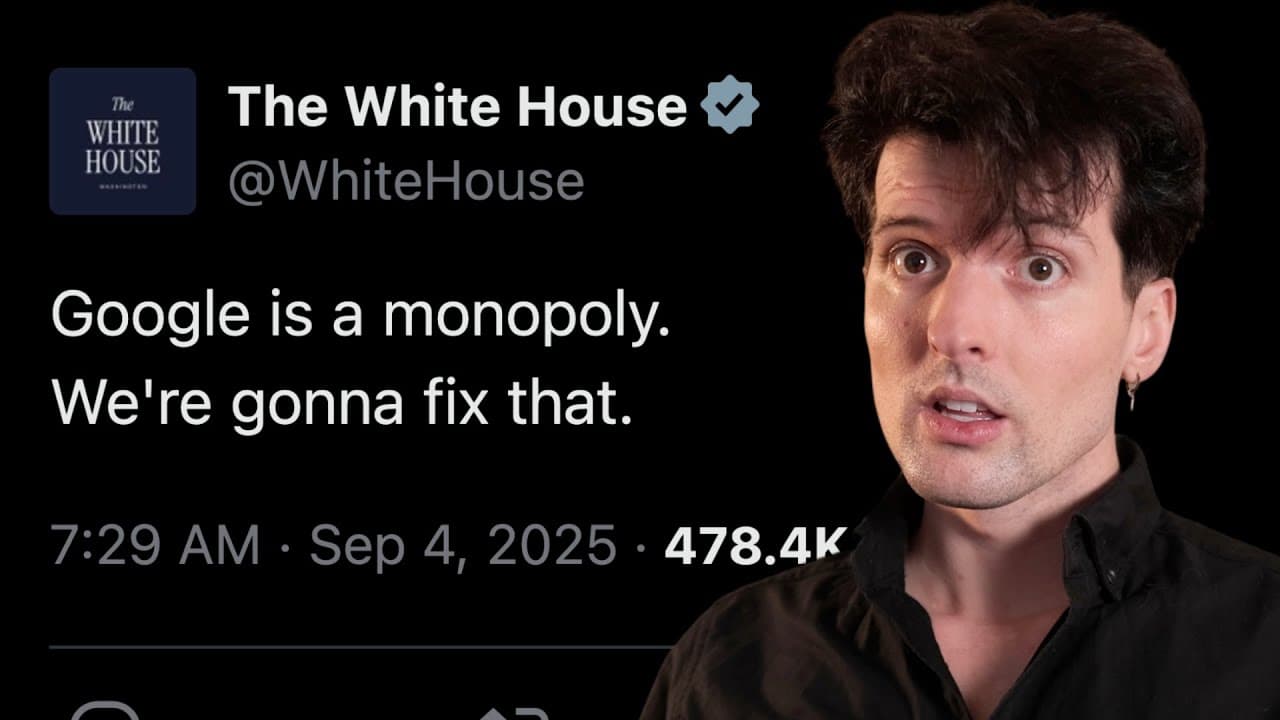
Google can keep Chrome, but it cannot maintain exclusive distribution contracts for Search, Chrome, Assistant, or Gemini. The remedies also require Google to share certain search data and offer search and text-ad syndication services, potentially helping rivals while threatening Mozilla's Google-funded business model. The outcome is meaningful but far less severe than breaking up Google or forcing a Chrome sale.
Transcript
Been a while since we could talk about a court case. I know it's not what many of you guys are here for, but the Google Antitrust case has been super interesting to watch as this went down. I'm really invested in these types of things. They're just kind of fun for me, but also spell out really big impact on the industry. And this one's looking real... Read More
Key Insights
- Google retains Chrome because the described remedies focus on contracts, data access, and syndication rather than requiring the browser to be sold or separated from the company. The decision therefore constrains Google's distribution practices without dismantling a major part of its business.
- Exclusive distribution contracts are prohibited for Google Search, Chrome, Google Assistant, and Gemini. This restriction targets agreements that can prevent rival search engines, browsers, assistants, or AI products from gaining default placement and reaching users through major devices and software platforms.
- Google must make certain search indexes and user-interaction data available to rivals and potential rivals. The intended competitive benefit is that other search providers can gain access to resources that may help them improve their services instead of building every component independently.
- Search and search text-ad syndication services must be offered by Google under the remedies. These services are meant to enable rivals and potential rivals to compete in general search and search advertising, two areas where Google's accumulated infrastructure creates substantial competitive advantages.
- Mozilla reportedly receives $550 million per year from Google, accounting for 85% of its revenue, in connection with making Google the default search engine. Restrictions on exclusive agreements could therefore destabilize Firefox funding, although the transcript does not establish that all payments or nonexclusive arrangements are prohibited.
- Default placement is valuable because many users continue using whichever search provider comes preselected. The speaker characterizes Google's payments to Apple as a cash-driven effort to preserve iOS search traffic, while arguing that funding Mozilla also helps prevent the browser ecosystem from becoming entirely Chrome-based.
- Vertical leverage is harmful when dominance in one market is used to force advantages in another. The transcript identifies Gemini's privileged integration inside Chrome as an example of how browser control could give Google's AI product access that competing AI providers cannot match.
- Play Store access cannot be conditioned on distributing, preloading, or favorably placing Google Search, Chrome, Search Assistant, or Gemini. This provision matters because Android device makers depend heavily on the Play Store, giving Google significant influence over which applications and services appear by default.
Install to Summarize YouTube Videos and Get Transcripts
Explore YouTube Video Summarizer or Get YouTube Transcript Extractor
Questions & Answers
Q: Does the antitrust ruling force Google to sell Chrome?
No requirement to sell Chrome appears in the remedies described in the transcript. Instead, the court prohibited exclusive contracts involving the distribution of Google Search, Chrome, Google Assistant, and Gemini. It also ordered access to certain search data and required search and search text-ad syndication. Google therefore keeps Chrome while facing limits on how it uses contracts and platform control to distribute its products.
Q: What remedies were imposed on Google after the search case?
The US District Court prohibited Google from entering or maintaining exclusive distribution contracts involving Search, Chrome, Google Assistant, and Gemini. It ordered Google to make certain search indexes and user-interaction data available to rivals and potential rivals. Google must also provide search and search text-ad syndication services, while avoiding agreements that tie Play Store licensing to the placement or preloading of its products.
Q: Why could Google's antitrust remedies hurt Firefox?
Mozilla reportedly receives $550 million each year from Google for making Google the default search engine, and the transcript says this represents 85% of Mozilla's revenue. A prohibition on exclusive search-distribution contracts could undermine that arrangement and leave Mozilla without enough funding to continue Firefox development. However, the transcript raises this as a serious risk rather than proving that every form of future Google payment is forbidden.
Q: Why does Google fund Mozilla and Firefox?
The speaker argues that Google's support for Mozilla is not solely about earning revenue from Firefox searches. Funding Firefox also helps preserve a browser ecosystem that is not completely dominated by Chrome. An independent browser can support continued development of the open web, which benefits Google because the company can build web products instead of creating separate Windows and Mac applications for everything it offers.
Q: Why are default-search payments considered anti-competitive?
Default-search payments can block competition when one company can spend billions to secure placement across major hardware and software platforms. A smaller search provider without comparable funds cannot outbid Google, even if its product is competitive. Since many users keep the default search engine, these agreements preserve Google's distribution advantage and make it much harder for rivals to reach a meaningful audience.
Q: How does Chrome give Gemini a competitive advantage?
Gemini receives access to a special integration button inside Chrome, according to the transcript. If rival AI services cannot obtain the same integration while Google's service ships by default, Google can use its browser position to strengthen its AI product. The concern is not merely that Gemini competes successfully, but that control of Chrome provides a distribution advantage unavailable to competing AI providers.
Q: What restrictions apply to Google Play Store licensing?
Google cannot condition licensing of the Play Store or another Google application on the distribution, preloading, or placement of Google Search, Chrome, Search Assistant, or Gemini on a device. The restriction matters because Android users and device makers rely heavily on the Play Store for applications. Google therefore cannot use access to that essential distribution channel to demand favorable treatment for its other products.
Q: Why is the Google antitrust outcome considered mixed?
The outcome is mixed because Google was found to have behaved monopolistically and now faces meaningful limits on exclusive contracts, data control, and service access. Rivals may benefit from search data and syndication services, and Google has less freedom to secure defaults through exclusivity. At the same time, the remedies described do not require a Chrome sale or a broader breakup, so Google preserved much of its existing structure.
Summary & Key Takeaways
-
A US District Court prohibited Google from maintaining exclusive contracts connected to distributing Google Search, Chrome, Google Assistant, and Gemini. Google also cannot condition access to the Play Store or other Google applications on favorable placement or preloading of those products, limiting its ability to turn control of one platform into advantages elsewhere.
-
The remedies require Google to provide certain search indexes and user-interaction data to rivals and potential rivals. Google must also offer search and search text-ad syndication services. These measures are intended to reopen a general-search market described as frozen for over a decade and prevent similar tactics from shaping generative AI competition.
-
The ruling creates uncertainty for Mozilla because Google reportedly provides $550 million annually, representing 85% of Mozilla's revenue, to remain Firefox's default search engine. The speaker argues that Google supports Firefox partly to preserve an independent web ecosystem, while its much larger default-search arrangement with Apple more directly protects valuable search traffic from iOS users.
Read in Other Languages (beta)
Share This Summary 📚
Summarize YouTube Videos and Get Video Transcripts with 1-Click
Try YouTube Summary with ChatGPT & Claude or YouTube Transcript Generator
Explore More Summaries from Theo - t3․gg 📚






Summarize YouTube Videos and Get Video Transcripts with 1-Click
Try YouTube Summary with ChatGPT & Claude or YouTube Transcript Generator