What Makes Boston Dynamics’ New Fully Electric Atlas Humanoid Robot Different?
TL;DR
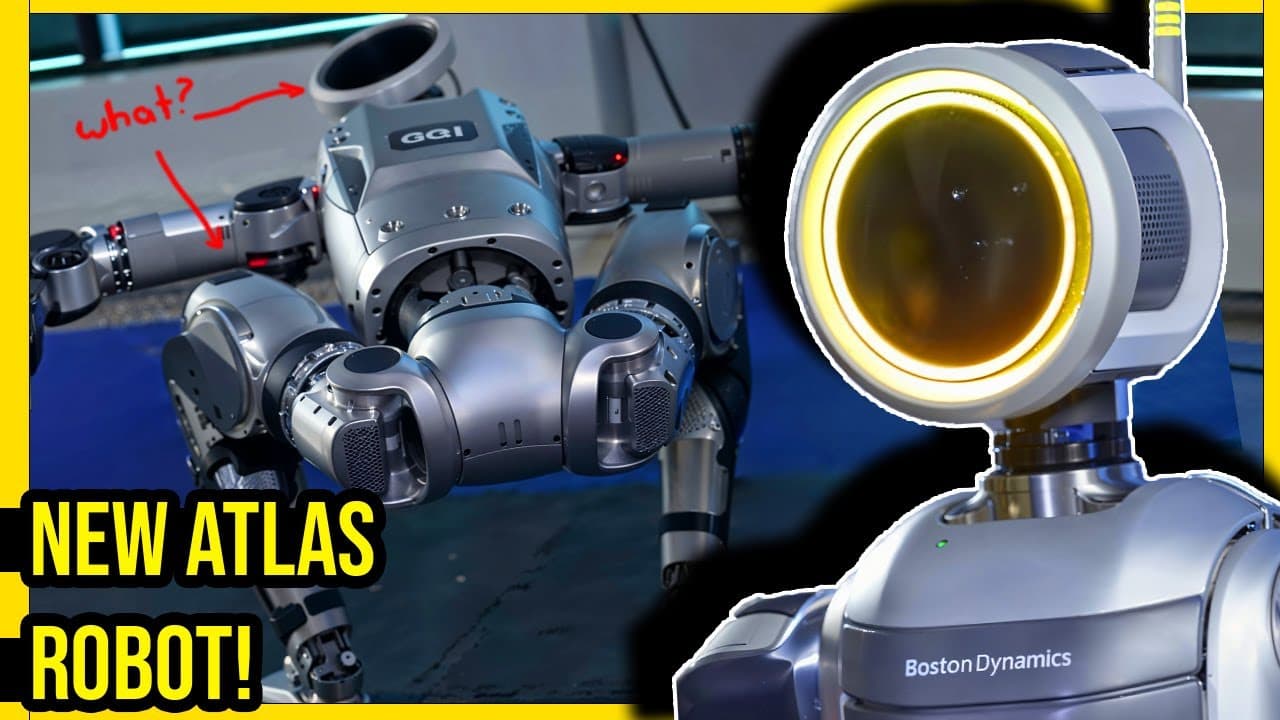
Boston Dynamics’ new Atlas is a fully electric humanoid robot designed for real-world applications, replacing the retired hydraulic Atlas. The company is pairing its hardware with reinforcement learning, computer vision, simulation, and model-predictive control, while Hyundai’s automotive manufacturing operations will provide a testing ground for applications. Read on to understand Atlas’s unusual movement, control strategy, and potential factory role.
Transcript
it was just yesterday that Boston Dynamics posted their farewell to HD Atlas video people were upset it had 671 th000 views in one day but if you're not the all new Atlas is here here it is lying so unassumingly on the ground but wait what's this that is kind of freaky I got to say what if it comes up to you goes I need your boots your clothes and ... Read More
Key Insights
- 🤖 The new Atlas robot represents a significant advancement in robotic technology, marking a shift towards human-level capabilities.
- 🌍 Partnerships with companies like Hyundai are driving real-world applications for advanced robotics.
- 🤖 Integration of AI and machine learning tools is crucial for enhancing the adaptability of robots to complex scenarios.
- 🥶 Predictions suggest a future where robotics technology will revolutionize the labor industry, freeing humans from repetitive tasks.
- 🌍 Elon Musk's initiatives in artificial intelligence showcase promising advancements in understanding the physical world.
- ❓ Boston Dynamics' journey over 40 years illustrates the significant progress made in robotic development.
- 🤩 Advancements in software, including AI and machine learning, are key drivers of the evolving robotic technology landscape.
Install to Summarize YouTube Videos and Get Transcripts
Explore YouTube Video Summarizer or Get YouTube Transcript Extractor
Questions & Answers
Q: What makes Boston Dynamics’ new Atlas humanoid robot different?
The new Atlas is fully electric and designed for real-world applications, unlike the retired hydraulic Atlas. Its unusual range of movement also reflects Boston Dynamics’ willingness to move beyond treating human motion as the ceiling for humanoid robots.
Q: Why did Boston Dynamics retire the hydraulic Atlas?
Boston Dynamics retired the hydraulic Atlas as it unveiled the fully electric Atlas that comes next. The new platform is intended to support the company’s goal of delivering capable, useful mobile robots for real-world applications.
Q: What role will Hyundai play in developing the new Atlas?
Hyundai is investing in Boston Dynamics and building its next generation of automotive manufacturing capabilities. Those operations are expected to provide a testing ground for new Atlas applications in the months and years ahead.
Q: How does Boston Dynamics use AI and machine learning in its robots?
Boston Dynamics says it equips its robots with reinforcement learning and computer vision. These tools are intended to help the robots operate efficiently and adapt to complex real-world scenarios.
Q: How does Boston Dynamics control Atlas and expand its capabilities?
The company describes a hybrid strategy combining a model-predictive controller with learned policies. It is also exploring different architectures to unlock new capabilities and tolerate situations that significantly violate the assumptions built into its models.
Q: How is simulation used to train Boston Dynamics robots?
Boston Dynamics is working with Nvidia on simulation-based robot training. The transcript specifically mentions a GPU-accelerated Spot simulation environment based on Nvidia Isaac Lab.
Q: How does Boston Dynamics’ approach compare with Google DeepMind’s robot-control research?
The transcript describes Google DeepMind’s RT-2 as a vision-language-action model that converts reasoning into robot movements. Actions can be represented as output tokens specifying changes such as the gripper’s position and rotation, while Boston Dynamics discusses model-predictive control, learned policies, and alternative control architectures.
Q: What does the growth of robots suggest about the future of labor?
Amazon is described as having about 750,000 robots compared with 1.5 million human warehouse workers. The transcript also cites a tech investor’s prediction of near-free labor and a billion bipedal and other robots freeing people from undesirable jobs, presenting these as forecasts rather than established outcomes.
Summary & Key Takeaways
-
Boston Dynamics introduces the new Atlas robot, marking a significant leap in robotic capabilities.
-
The partnership with Hyundai aims to push the boundaries of robotics in real-world applications.
-
Advances in software, including AI and machine learning, are driving the evolution of robotic technology.
Read in Other Languages (beta)
Share This Summary 📚
Summarize YouTube Videos and Get Video Transcripts with 1-Click
Try YouTube Summary with ChatGPT & Claude or YouTube Transcript Generator
Explore More Summaries from AI Unleashed - The Coming Artificial Intelligence Revolution and Race to AGI 📚



Summarize YouTube Videos and Get Video Transcripts with 1-Click
Try YouTube Summary with ChatGPT & Claude or YouTube Transcript Generator