What Is Unsupervised Learning? | #7 Machine Learning Specialization [Course 1, Week 1, Lesson 2]
TL;DR
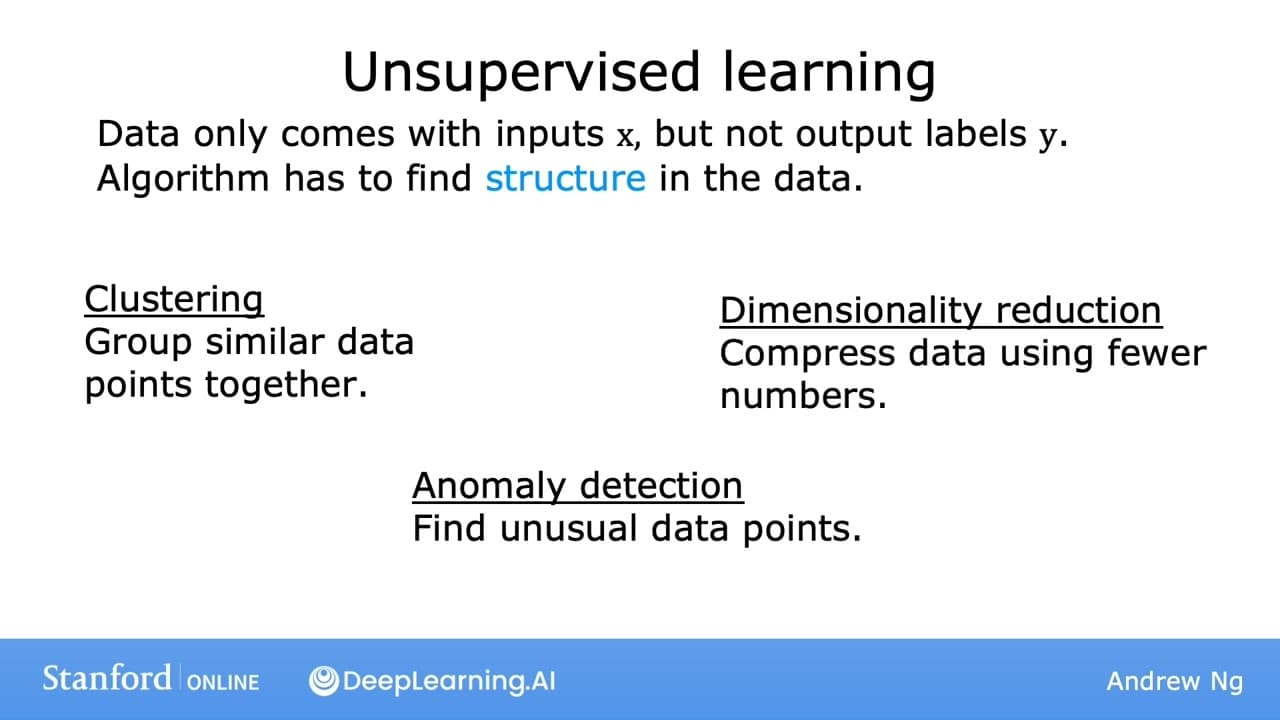
Unsupervised learning uses input data X without output labels Y to discover structure, patterns, or other interesting features in the data. The lesson introduces three types: clustering groups similar data points, anomaly detection identifies unusual events or transactions, and dimensionality reduction compresses a large dataset while losing as little information as possible. Read on to see which example problems are supervised or unsupervised.
Transcript
in the last video you saw what is unsupervised learning and one type of unsupervised learning called clustering let's give a slightly more formal definition of unsupervised learning and take a quick look at some other types of unsupervised learning other than clustering whereas in supervised learning the data comes with both inputs X and output lab... Read More
Key Insights
- 🏷️ Unsupervised learning does not require labeled data, focusing on finding patterns or structure in the input data.
- 😥 Clustering is a common unsupervised learning technique that groups similar data points together.
- 🈸 Anomaly detection is crucial for identifying unusual events, which is vital in fraud detection and other applications.
- 👻 Dimensionality reduction allows for the compression of large datasets while preserving important information.
Install to Summarize YouTube Videos and Get Transcripts
Explore YouTube Video Summarizer or Get YouTube Transcript Extractor
Questions & Answers
Q: What is the difference between supervised and unsupervised learning?
Supervised learning uses data containing both inputs X and output labels Y. Unsupervised learning receives only inputs X, without output labels Y, and tries to find structure, patterns, or something interesting in the data.
Q: What types of unsupervised learning are introduced in Machine Learning Specialization Course 1, Week 1, Lesson 2?
The lesson introduces clustering, anomaly detection, and dimensionality reduction. Clustering groups similar data points, anomaly detection finds unusual events, and dimensionality reduction compresses a large dataset into a much smaller one.
Q: How does clustering work in unsupervised learning?
A clustering algorithm groups similar data points together. The lesson applies this idea to grouping news articles and automatically discovering market segments.
Q: What is anomaly detection used for?
Anomaly detection is used to detect unusual events. It is important for fraud detection in the financial system because unusual transactions could be signs of fraud.
Q: What does dimensionality reduction do?
Dimensionality reduction takes a large dataset and compresses it into a much smaller dataset. Its goal is to use or lose as little information as possible during that compression.
Q: Is spam filtering supervised or unsupervised learning?
Spam filtering is supervised learning when emails are labeled as spam or non-spam. Those labels provide the output Y that accompanies the input data.
Q: Why can grouping news articles be treated as unsupervised learning?
News articles can be grouped with a clustering algorithm. Because clustering discovers groups among similar data points, the news-story example is an unsupervised learning problem.
Q: Which lesson examples are supervised and which are unsupervised?
Grouping news articles and discovering market segments are presented as unsupervised learning examples. Spam filtering with spam or non-spam labels and diagnosing diabetes as diabetes or not diabetes are supervised learning examples.
Summary & Key Takeaways
-
Unsupervised learning does not have labeled data and focuses on finding structure or patterns in the data.
-
Clustering is a type of unsupervised learning that groups similar data points together.
-
Anomaly detection is used to identify unusual events, such as fraud, in a dataset.
-
Dimensionality reduction compresses large datasets while maintaining important information.
Read in Other Languages (beta)
Share This Summary 📚
Summarize YouTube Videos and Get Video Transcripts with 1-Click
Try YouTube Summary with ChatGPT & Claude or YouTube Transcript Generator
Explore More Summaries from DeepLearningAI 📚
Summarize YouTube Videos and Get Video Transcripts with 1-Click
Try YouTube Summary with ChatGPT & Claude or YouTube Transcript Generator