How Should Open-Source AGI Be Governed?
TL;DR
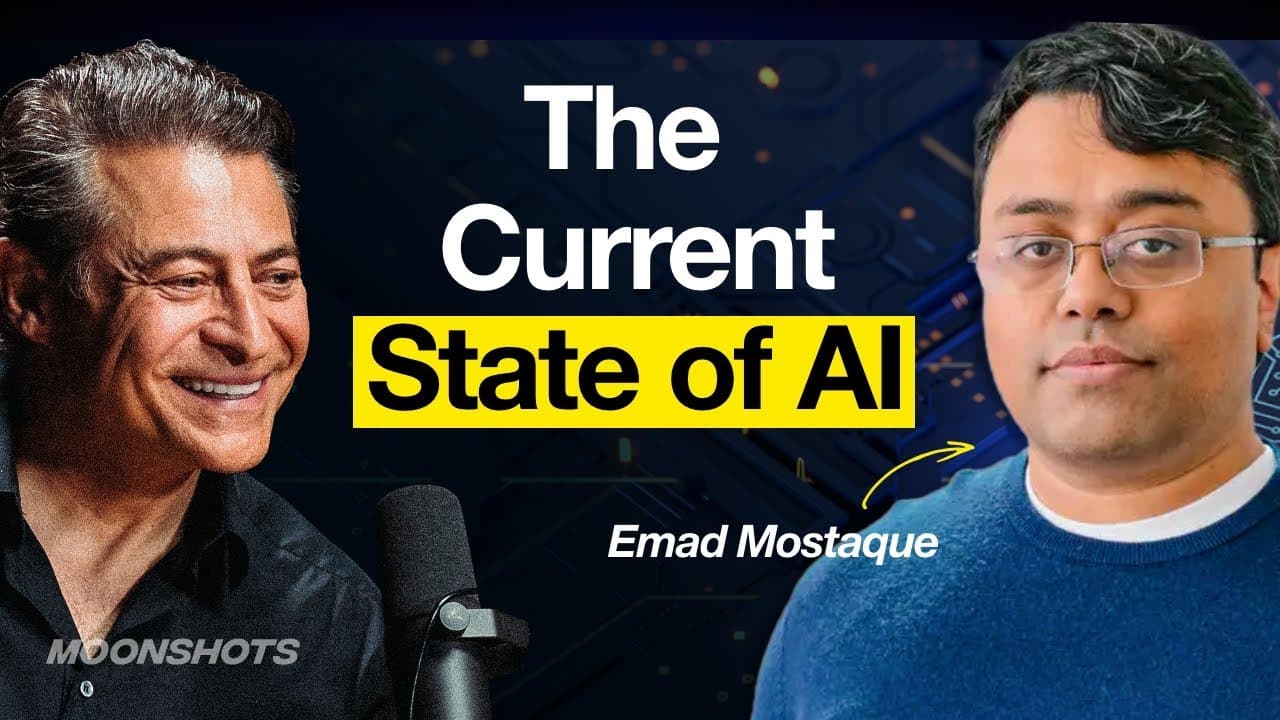
AGI governance should prevent any single organization from becoming a choke point, while treating important models and datasets as collectively or individually owned public goods. Emad Mostaque argues that safety should focus on transparent, high-quality inputs and clear social goals because containment becomes impractical as models grow cheaper, faster, distributable, and capable of running on personal devices.
Transcript
hey M good to hear you it was always a pleasure yeah so where are you today I'm in London good other side of the planet I'm in Santa Monica it's uh it's been quite the uh extraordinary game of pingpong out there these last four or five days I was like I didn't think the first thing that AI would disrupt would be reality TV right yeah yeah it's been... Read More
Key Insights
- Open-source infrastructure is foundational to both the internet and artificial intelligence, because systems such as Linux, transformer research, and openly available model architectures support products developed by large companies.
- AI governance is broader than existential safety, because it must balance beneficial outcomes against immediate social harms, including unequal access to powerful technology and the possibility that some people or nations will be left behind.
- A single organizational choke point is incompatible with deeply personal AI, according to Mostaque, because models may become integrated into everyday thought, decision-making, knowledge access, and guidance through individually owned copilots.
- National AI models are cultural technologies, because the datasets selected by a country shape model outputs and influence how its language, knowledge, priorities, and values are represented in computational systems.
- Training inputs are central to model safety, because a model's behavior depends heavily on the information placed in its dataset. Mostaque argues that debates focused primarily on harmful outputs overlook the upstream importance of data selection.
- Safety goals become clearer when societies define beneficial destinations, such as universal access to cancer knowledge, climate knowledge, or creative tools. Explicit goals allow safety measures to be evaluated against desired outcomes instead of generalized uncertainty.
- AI containment is impractical in an open world, according to Mostaque, because model weights can be copied, distributed training can operate at scale, and increasingly capable systems may no longer require a small number of enormous supercomputers.
- Data quality can reduce dependence on brute-force scale, because Mostaque describes giant datasets and supercomputers as shortcuts for poorly organized information. He cites Stability AI's study suggesting that 92% of data was unused 99% of the time.
Install to Summarize YouTube Videos and Get Transcripts
Explore YouTube Video Summarizer or Get YouTube Transcript Extractor
Questions & Answers
Q: How should open-source AGI be governed?
Open-source AGI should be governed through structures that prevent any organization from controlling a decisive technological choke point, according to Emad Mostaque. He proposes important models and datasets as public goods that can be collectively owned, while personal copilots could be individually owned. Governance should pursue beneficial social outcomes, mitigate harms, maintain transparency, and give affected communities meaningful control over data and model development.
Q: Why does Emad Mostaque support citizen-owned national AI models?
Citizen-owned national models could keep decisions about language, culture, and training data accountable to the people represented by those systems. Mostaque proposes local organizations, such as a Stability Mexico or another suitable structure, where knowledgeable residents make decisions with fellow citizens about datasets and models. His central concern is that countries should not outsource their culture and collective intelligence to foreign companies or communities.
Q: What is the difference between AI governance and AI safety?
AI governance concerns ownership, decision-making, beneficial outcomes, access, transparency, and mitigation of real social harms. AI safety discussions often focus on uncertain AGI risks and the possibility of catastrophic outcomes. Mostaque argues that combining the two can produce a precautionary turn toward centralized authority. He recommends defining desirable social goals first, then aligning safety measures with those destinations while addressing present consequences.
Q: Why does Mostaque argue that AI containment will not work?
Mostaque argues that containment cannot succeed when valuable model weights can be copied, capable models can be released openly, and distributed training can operate across many machines. He also expects powerful performance to become available on smartphones within 12 to 18 months. Under those conditions, control through a few companies, giant supercomputers, or centralized off switches becomes technically and institutionally difficult to sustain.
Q: How do training datasets affect AI safety and behavior?
Training datasets shape what models know, how they respond, and which cultural assumptions appear in their outputs. Mostaque says safety debates focus too heavily on outputs even though inputs are more fundamental. A high-quality dataset that excludes dangerous knowledge is less likely to produce instructions based on that knowledge. Transparency about dataset composition therefore provides a practical basis for evaluating safety, culture, and accountability.
Q: Why are localized AI models important for national cultures?
Localized models matter because foundational models function as cultural technologies, reflecting the information and priorities included during training. Mostaque argues that Mexican, Chinese, Vietnamese, Japanese, and other communities should influence what enters their national datasets. Local control can preserve language and cultural context while preventing societies from transferring authority over their collective knowledge to organizations rooted in substantially different places and perspectives.
Q: Can better data reduce the need for giant AI supercomputers?
Better data can reduce dependence on brute-force computing, according to Mostaque. He characterizes giant datasets and supercomputers as shortcuts that compensate for low-quality information by processing it for longer. He cites a Stability AI study indicating that 92% of the data was not used 99% of the time, and points to synthetic-data training as evidence that carefully structured information can support capable models.
Q: What ownership model does Mostaque propose for personal AI?
Mostaque proposes a layered ownership model. Broad models that collect global knowledge across different modalities could operate as collectively owned public goods, while personal copilots should belong to the individuals they guide. His phrase, "not your models, not your mind," captures the concern that deeply integrated AI should not remain under one company's control. Personal ownership would reduce dependency on centralized providers and their decisions.
Summary & Key Takeaways
-
Emad Mostaque argues that open-source foundations already support much of the internet and modern AI. He questions whether governments or citizens should depend on opaque systems controlled by individual companies, and proposes public, collective, national, and personal ownership structures that prevent powerful AI technology from becoming concentrated behind a single organizational choke point.
-
Mostaque separates governance from speculative AGI safety debates. Governance should pursue beneficial outcomes while mitigating present social harms, including the risk that some groups advance while others are left behind. Safety discussions become more practical when they are aligned with explicit goals, such as providing broad access to cancer or climate knowledge.
-
Containment is presented as impractical because valuable model weights can be copied, distributed training reduces dependence on giant supercomputers, and smaller systems may approach powerful performance levels. Mostaque instead emphasizes transparent datasets, localized cultural control, careful selection of training inputs, and citizen ownership of national models as foundations for accountable AI governance.
Read in Other Languages (beta)
Share This Summary 📚
Summarize YouTube Videos and Get Video Transcripts with 1-Click
Try YouTube Summary with ChatGPT & Claude or YouTube Transcript Generator
Explore More Summaries from Peter H. Diamandis 📚






Summarize YouTube Videos and Get Video Transcripts with 1-Click
Try YouTube Summary with ChatGPT & Claude or YouTube Transcript Generator