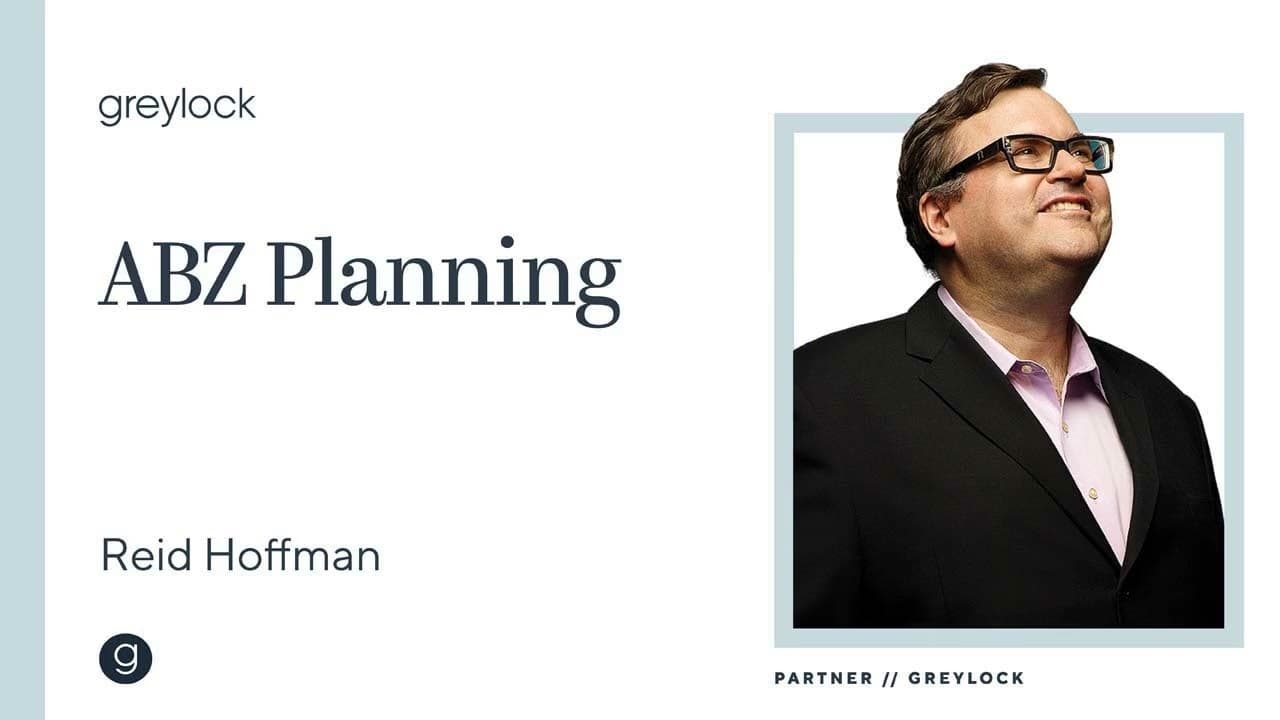
Reid Hoffman | ABZ Planning
TL;DR
ABZ planning starts with a clear investment thesis, improves the active Plan A through multiple incremental Plans B, and preserves a Plan Z for a major reset. The framework helps entrepreneurs respond to evidence, changing markets, execution problems, and unexpected opportunities while resources remain available, supporting intelligent risk management instead of blind persistence or desperate last-minute action.
Transcript
hi i'm chris yay the co-author of blitzscaling and i'm here with my co-author and old friend reid hoffman the co-founder of linkedin and an investor at greylock partners reid one of the key concepts from your first book the startup of you is the abz planning framework and it strikes me that in this year of extreme change and uncertainty abz plannin... Read More
Key Insights
- ABZ planning is a framework for adapting to changing circumstances, avoiding threats, responding to failed assumptions, and capturing opportunities discovered during execution. Although presented as career advice for individuals, the same framework applies naturally to companies navigating markets, employees, investors, competitors, and operational uncertainty.
- Plan A is the current investment thesis receiving the entrepreneur's main commitment. It should describe the need being addressed, expected market response, initial product, target customers, competition or substitutes, distribution approach, required talent and resources, and the path from early validation toward growth.
- No startup plan survives execution unchanged because contact with markets, investors, employees, and competitors reveals new information. Plan A should therefore be treated as a testable thesis rather than a fixed blueprint, with its components examined continuously as the company builds, sells, learns, and encounters unexpected conditions.
- Plans B are multiple incremental alternatives for changing parts of Plan A. A company might keep its target while switching between field sales and telesales, change its marketing program, open-source something, provide a free widget, or moderately revise the goal based on what execution reveals.
- A fully detailed Plan B is usually a misallocation of resources because the primary effort should strengthen and execute Plan A. Entrepreneurs still need to identify assumptions that may fail, determine how to measure them, and maintain a practical sense of the alternative adjustments available if evidence changes.
- Measurement is broader than dashboards and quantitative data. Entrepreneurs can test confidence in an investment thesis by asking smart contacts what seems wrong, what might break, and whether the plan appears credible. Additional reflection and informed feedback can justify a pivot before decisive numerical evidence appears.
- Plan Z is a lifeboat plan for resetting the strategy when successive Plans B leave the investment thesis substantially less attractive. It should be considered before cash is exhausted or the organization becomes unable to act, preserving enough assets to establish an entirely new Plan A.
- Intelligent risk management is the entrepreneurial skill of seeing risks clearly, monitoring them, and navigating them in pursuit of valuable outcomes. It does not mean reducing risk to zero, denying that risk exists, blindly jumping into uncertainty, or waiting until failure removes every available option.
Install to Summarize YouTube Videos and Get Transcripts
Explore YouTube Video Summarizer or Get YouTube Transcript Extractor
Questions & Answers
Q: What is the ABZ planning framework?
The ABZ planning framework is a systematic approach to adaptation for individuals and companies. Plan A is the active investment thesis and receives the main commitment of resources. Plans B are multiple incremental modifications made as evidence challenges parts of that thesis. Plan Z is a lifeboat plan that enables a major reset while sufficient assets, time, and organizational capacity remain available.
Q: How do you create Plan A in ABZ planning?
Create Plan A by writing down the full investment thesis for the career, product, service, or company. For a startup, this includes the customer need, expected market response, initial product, early customers, competitive or substitute offerings, distribution method, necessary talent and resources, and expected path toward growth. The result is a testable working strategy, not a permanent prediction.
Q: How are Plans B different from a traditional backup plan?
Plans B are a collection of possible adjustments to the active investment thesis, not one large replacement blueprint prepared in complete detail. Each adjustment addresses an assumption that may fail, such as the sales channel, customer acquisition method, product positioning, or goal. As evidence arrives, the relevant alternative can modify Plan A and become part of the newly configured strategy.
Q: What should entrepreneurs measure when using ABZ planning?
Entrepreneurs should measure whether the important assumptions within their investment thesis are working. Dashboards and data are useful, but measurement can also include conversations with smart contacts about weaknesses, likely failure points, and confidence in the plan. The aim is to notice declining confidence early enough to revise tactics, modify goals, or pursue a more promising alternative.
Q: When should a company activate Plan Z?
A company should consider Plan Z when repeated adjustments have made its investment thesis look substantially less likely to work or less worthy of further investment. It should not wait until it has no cash, has become bankrupt, or cannot act. Triggering the lifeboat while resources remain creates a realistic opportunity to preserve assets and form a new Plan A.
Q: Can ABZ planning change the original company goal?
ABZ planning can change both execution methods and the intended outcome. Some Plans B preserve the target while altering sales, marketing, or distribution. Other adjustments moderately revise the goal, such as shifting from making a game to providing infrastructure for games. A sufficiently large change can function as Plan Z and establish a fundamentally different Plan A.
Q: How does Slack illustrate a Plan Z reset?
The example described involves the Game Neverending project changing direction after its original plan was not working. The team still had resources, useful work, and a strong group of people. It focused on an internal IRC-related project for remote work, making that shift its Plan Z and then its new Plan A within the same corporate framework, investors, equity, and shareholders.
Q: How does ABZ planning support intelligent risk management?
ABZ planning supports intelligent risk management by requiring entrepreneurs to identify uncertain assumptions, monitor whether they hold, consider alternative responses, and preserve a viable reset option. The goal is not to eliminate risk. It is to take risks with potentially significant returns while seeing those risks clearly, managing them actively, and avoiding both denial and blind exposure.
Summary
In this video, Chris Yeh interviews Reid Hoffman about the ABZ planning framework and its relevance in times of change and uncertainty. They discuss how ABZ planning works, the importance of having an investment thesis, the concept of Plan B, and when to consider executing Plan Z. They also touch on the adaptability of startups and the significance of networks and marketplaces in times of rapid change.
Questions & Answers
Q: How does ABZ planning work?
ABZ planning is a framework used to be adaptive to changing circumstances, both to avoid difficulties and seize opportunities. It involves having an investment thesis that outlines the need for a product or service, the market's response, building the initial product, competition analysis, target customers, required resources, and talent.
Q: How does ABZ planning apply to companies?
While ABZ planning is originally designed for individuals, it can be applied to companies as well. Companies can have an investment thesis that aligns with their goals and adapt their plans based on changing circumstances, just like individuals do.
Q: What is an investment thesis?
An investment thesis is a statement that outlines the need for a specific product or service, the market's response, the expected growth, competition analysis, target customers, required resources, and talent. It serves as a guide for decision-making and strategy planning.
Q: What is Plan A?
Plan A refers to the initial investment thesis and plan that a person or company starts with. It is based on the assumption that the product or service will be successful and the market will respond positively.
Q: How does Plan B differ from Plan A?
Plan B is not a completely different plan from Plan A, but rather a set of alternative plans that can be used to adapt and improve the investment thesis. It involves considering different scenarios and adjusting strategies and approaches to address changing circumstances.
Q: How should entrepreneurs modify Plan A?
Entrepreneurs should constantly learn and adjust their plans as they go along. They should identify potential risks and difficulties, come up with alternative plans (Plan B), and measure the effectiveness of their investment thesis. Feedback from others, such as smart friends and advisors, can also help in modifying and improving the plan.
Q: What is Plan Z?
Plan Z is the last resort plan, or the lifeboat plan, when the current investment thesis is no longer viable. It involves significant changes, such as pivoting to a new market or shutting down the current venture and starting a new one.
Q: How can ABZ planning be applied during a time of rapid change?
ABZ planning becomes more challenging during periods of rapid change, such as the current COVID-19 pandemic. Assumptions about the world and the market may no longer hold true, and entrepreneurs need to adapt their investment thesis and constantly measure the changing variables. Seeking out new truth and being adaptable are key during these times.
Q: Can you provide an example of ABZ planning during rapid change?
Airbnb is an example of a company that demonstrated adaptability during the pandemic. They were able to shift their focus and offerings in response to changing travel demands. By leveraging their network and marketplace, hosts were able to adapt their offerings and make their homes more suitable for safe and comfortable stays. This exemplifies the value of networks and the ability to quickly pivot in a rapidly changing environment.
Q: How has Reid used ABZ planning in his life?
Reid applies ABZ planning to almost everything in his life. For example, when faced with the challenge of changing plans for the release of the blitzscaling playbook due to the pandemic, he and Chris Yeh adapted their original plan and created a new plan A. They shifted their focus to creating a series of relevant business content, including podcasts, that would be helpful to people during these times.
Takeaways
ABZ planning is a framework that helps individuals and companies navigate through changing circumstances and manage risk. It involves having an investment thesis, adapting plans (Plan B), measuring variables, and considering a lifeboat plan (Plan Z) when necessary. ABZ planning becomes even more important in times of rapid change, and adaptability is key. Networks and marketplaces can provide opportunities for adapting and finding new ways to thrive. It's important to constantly seek out new truth and manage risk intelligently for success.
Summary & Key Takeaways
-
ABZ planning treats a career or company as an entrepreneurial project that must adapt as circumstances change. The process begins by writing an investment thesis covering customer needs, market response, competition, distribution, talent, resources, and expected outcomes. This thesis becomes Plan A, the strategy receiving the main commitment of effort and resources.
-
Plans B are multiple possible adjustments to elements of the active strategy, not one fully developed replacement plan stored away for failure. Entrepreneurs identify vulnerable assumptions, measure whether those assumptions hold, seek feedback from smart contacts, and change tactics or goals as evidence reduces confidence in the original investment thesis.
-
Plan Z is a lifeboat plan used when repeated adjustments leave the investment thesis unattractive. It should be activated while enough assets remain to reorganize, preserve a strong team or useful work, return resources where appropriate, or establish a new Plan A. The objective is a deliberate reset, not desperate survival.
Read in Other Languages (beta)
Share This Summary 📚
Summarize YouTube Videos and Get Video Transcripts with 1-Click
Try YouTube Summary with ChatGPT & Claude or YouTube Transcript Generator
Explore More Summaries from Greymatter Podcast (Audio) 📚






Summarize YouTube Videos and Get Video Transcripts with 1-Click
Try YouTube Summary with ChatGPT & Claude or YouTube Transcript Generator